
Livraison le jour même ou le lendemain

Qualité garantie

Débloquez vos offres de bienvenue: Livraison GRATUITE | Jusqu'à -80 % | 30 jours d'essai gratuits à JoyPlus
Téléchargez l'application
By Joybuy, our product expert | Published August 26, 2026
Excessive humidity is much more than a simple discomfort. Condensation on windows, musty odours, wall stains, or laundry that just won’t dry—these tell-tale signs threaten the health of your home. To combat this problem, the dehumidifier stands out as the most effective solution. The issue? The market is flooded with models making often confusing claims. To help you cut through the noise, we've decoded the pitfalls to avoid and the criteria that truly matter.
Navigating the jungle of spec sheets is a real headache. Some marketing claims are designed to mislead you into buying an unsuitable device. Here are the three mistakes you must not make.
For a successful purchase, forget the marketing jargon and focus on the data that specifically addresses your needs.
The crucial factor is the unit's extraction capacity, expressed in litres per day (L/day). This value must be directly correlated with the room's surface area (in m?) that needs to be treated.
Noise is a non-negotiable criterion. Measured in decibels (dB), it determines your comfort. For a living area or bedroom, a silent dehumidifier is not a luxury.
Also, check for practical modes like the laundry drying function, which runs the unit at full power to cut your laundry's drying time in half.
For water removal, two systems exist:
To keep an eye on your electricity bill, choose a low-energy dehumidifier with a hygrostat. This smart sensor measures the humidity level and only runs the unit when necessary, ensuring optimised consumption.
Rather than an endless catalogue, we've identified units that target specific needs, keeping in mind the criteria and pitfalls we've just covered.

Why it fits this profile: Ideal for treating a bathroom, laundry room, or bedroom up to 16 m?. Its compact size and castors make it easy to move from one room to another without taking up too much space.
It features an adjustable hygrostat (35-85%) that prevents continuous operation and keeps consumption in check. Its 10 L/day capacity is perfectly sized for its recommended coverage of 16 m?, avoiding the trap of being oversized for small spaces.
Offers a continuous drainage option, a feature rarely seen on entry-level models. Frost and overflow protection provide complete peace of mind during use.
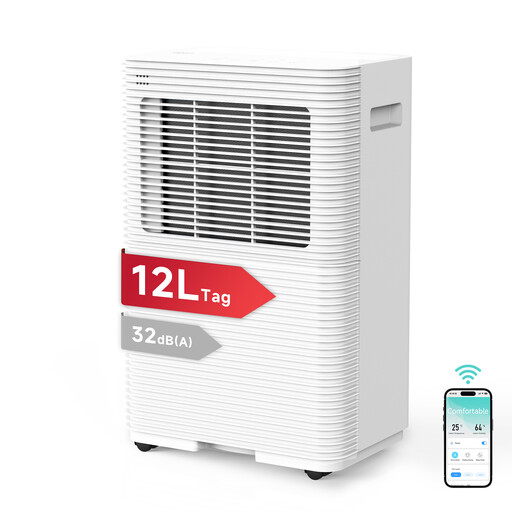
Why it fits this profile: Perfect for a bedroom or living room up to 24 m?. Its mobile app control and 24-hour timer let you manage humidity remotely, while its laundry drying function is a valuable ally for families on rainy days.
It avoids the "false silence" trap by offering an ultra-quiet "Sleep" mode at 32 dB—an honest and verified value, ideal for nighttime use. The WiFi connectivity provides precise control that goes far beyond standard settings.
Integrates plasma air purification and an antibacterial filter for air that is not only drier but also healthier. It offers dual drainage (tank or continuous) for maximum flexibility.
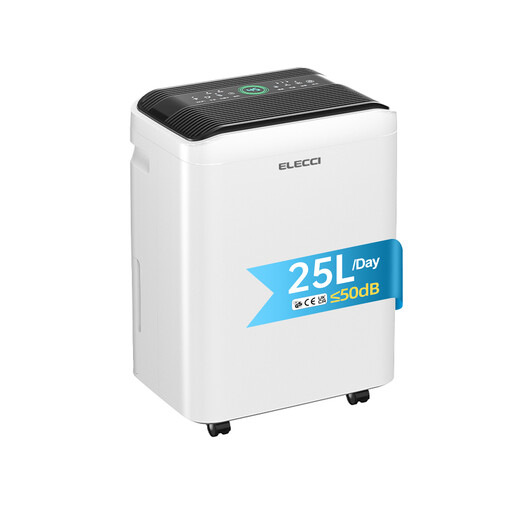
Why it fits this profile: With its 25 L/day extraction capacity and coverage of up to 50 m?, this unit is built for basements, large living rooms, or garages. Its large 4.8 L tank and continuous drainage option ensure complete autonomy.
It meets the need for autonomy by including a hose for continuous drainage, avoiding the trap of a powerful unit that's a slave to its tank. Its auto-defrost function ensures consistent performance even in a cool cellar, where other models would throw in the towel.
Features an LED display with a colour-coded humidity indicator for an at-a-glance visual diagnosis. It offers 3 fan speeds and a night mode at 36 dB to adapt to any situation.
Our editorial team has selected a full range of products that meet our quality charter and European safety standards.
Consumption depends on the unit's power (in Watts) and its operating time. A 200W model running for 8 hours a day will consume 1.6 kWh. To manage your budget, the secret is to choose a unit with a hygrostat. It will only activate when necessary, making it a truly low-energy appliance for daily use.
Yes, it's possible and even recommended in places like a cellar or a second home. To do this, the absolute must is to opt for a model with continuous drainage. Also, check that it includes overflow protection and an auto-restart function after a power cut.
For optimal results, place the unit in the centre of the room if possible. The golden rule: leave a clear space of at least 20 to 30 cm all around it to ensure good air circulation. Never place it right against a wall or behind furniture, or you'll throttle its performance.