
Livraison le jour même ou le lendemain

Qualité garantie

Débloquez vos offres de bienvenue: Livraison GRATUITE | Jusqu'à -80 % | 30 jours d'essai gratuits à JoyPlus
Téléchargez l'application
Far more than a simple nuisance, excessive humidity is a real scourge for any home. Condensation on windows, a musty smell, mould spots on the walls… These are all warning signs that your home's structural integrity and the quality of the air you breathe are at risk. A home dehumidifier is often the most effective solution.
The problem is, the market is flooded with marketing promises that can easily mislead you. As a product expert at Joybuy, I'm here to help you cut through the noise. Before you make your choice, here are the 3 most common traps that many buyers fall into.
You'll often see impressive figures like "12 L/day" or "20 L/day". The catch? This performance is almost always measured in a lab (typically at 30°C and 80% relative humidity). A cool basement in winter will never reach these conditions. A 12 L/day unit might only extract 3 or 4 litres in a more realistic environment, proving to be completely inadequate.
The word "silent" is one of the most subjective terms in marketing. A background noise level that's acceptable in a living room can become unbearable in a bedroom at night. Without a specific value in decibels (dB), this promise is worthless. A unit marketed as silent can easily exceed 50?dB—the noise of a normal conversation—which is far from ideal for getting to sleep.
A budget-friendly electric moisture absorber might seem tempting, but its power consumption can quickly make your electricity bill skyrocket. A poorly optimised model running for hours on end will cancel out the initial savings within a few months. A true low-energy dehumidifier is an investment that pays for itself over time.
To choose a truly effective anti-humidity solution, rely on concrete data. Here are the three criteria you must check.
The capacity (in litres per day) must be suited to the size and humidity level of your room.
Noise is a non-negotiable comfort factor. Here are a few benchmarks to guide you:
A good electric dehumidifier should simplify your life, not complicate it.
Rather than drowning you in technical specs, we've selected devices that meet specific needs, all while avoiding the traps we've just discussed.
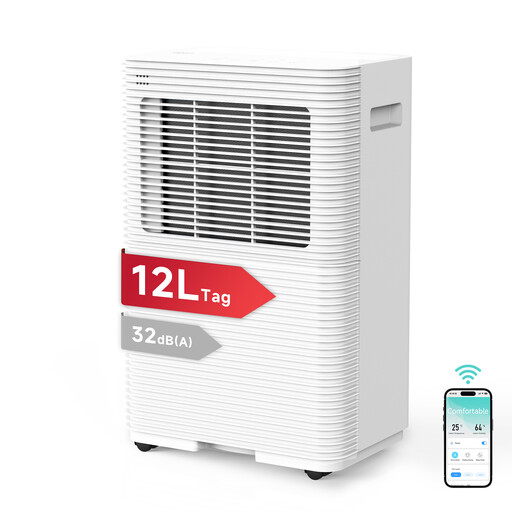
Why it's perfect for this use: Perfect for a bedroom or studio up to 24 m?. Its main advantage? Its quiet operation, which makes it an ideal ally for peaceful nights.
It doesn't just make a vague promise of "silence." It specifies a noise level of 32 dB in night mode: a concrete figure that guarantees true tranquillity.
Control via the Wi-Fi app allows you to program it remotely and adjust settings to precisely optimise its power consumption.
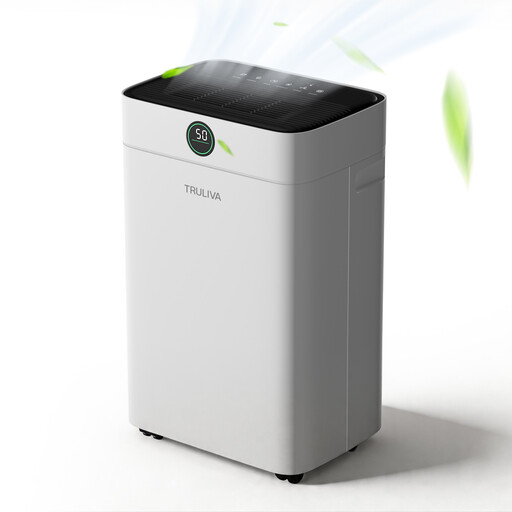
Why it's perfect for this use: Its large extraction capacity is built for the most demanding environments (basements, garages, laundry rooms) where humidity is a constant battle and autonomy is paramount.
No empty promises. Its 25 L/day capacity is sized for large volumes, and it includes a continuous drain hose. This feature acknowledges that manually emptying a tank in these conditions is simply unrealistic.
The combination of its power and continuous drainage makes it a true "set it and forget it" solution for the most critical areas of the house.
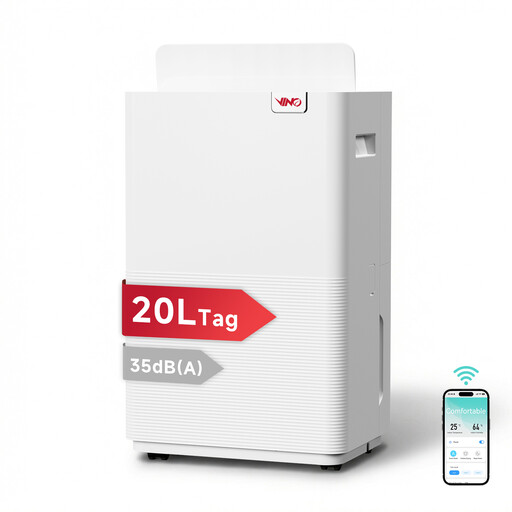
Why it's perfect for this use: This is the Swiss Army knife of dehumidifiers, perfect for family use. Powerful enough for a living area up to 40 m?, it juggles its modes (night, laundry dry) and Wi-Fi connectivity for tailor-made comfort.
It avoids the hidden costs trap thanks to its smart hygrostat and dedicated modes that adjust consumption. Its night mode at 35 dB is a promise of silence that is quantified and therefore reliable.
Its laundry dry function and app control make it an incredibly effective 2-in-1 appliance for daily life, especially on rainy days.
We have curated a complete range of products that meet these demanding selection criteria as well as current safety standards.
The cost depends on its power rating (in watts), how long it runs, and your electricity rate. Let's take a 200?W (or 0.2?kW) model that runs for 8 hours a day. The calculation is simple: 0.2 kW x 8 h x €0.25/kWh (average rate) ≈ €0.40 per day. Fortunately, a unit with a hygrostat will only run intermittently, which significantly reduces the bill.
No, it's neither necessary nor economical. The ideal approach is to set the hygrostat to a target humidity level (usually between 45% and 55%). The device will then only turn on when needed to maintain that level, thus optimising its power consumption.
With regular maintenance (especially cleaning the air filter, about every two weeks), a good compressor dehumidifier can easily last 5 to 10 years. A clean filter ensures optimal air circulation and extends the life of the motor.