What should you look for?
First, measure the humidity in the room and check air circulation and ventilation. If the need persists during everyday activities, choose a dehumidifier based on the room, how often you’ll use it and how you’ll manage drainage.
| Consideration |
What to check before buying |
Who this matters to |
| Source of the humidity |
Use a hygrometer to monitor humidity after the activity and airing the room. Have the cause of persistent marks on the walls investigated. |
If marks keep coming back, I want to understand what’s causing them rather than buy an appliance that leaves a leak or water ingress untreated. Around 31% of consumers would put this check first. |
| Room and laundry drying |
Compare the stated floor area or room volume, then the capacity in L/24 h under comparable test conditions. Check whether it has a laundry mode if that’s important to you. |
If I often dry laundry indoors, I look for an appliance suited to the room it’ll be used in and the expected running time. This would be a priority for around 31% of consumers. |
| Noise and operation |
Check the noise level in the mode you plan to use, the power consumption in W and whether it has an adjustable humidistat. |
In an occupied room, I want to be able to use the appliance without overlooking noise or how long it runs for. Around 23% of consumers would prioritise this balance. |
| Drainage and placement |
Check the tank, continuous drainage and filter access. For a bathroom, consult the model’s instructions and check the requirements for the exact location. |
If the appliance needs to run for a long time, I want to be able to manage the collected water and find an approved place for it. For around 15% of consumers, this would be the first thing to resolve. |
Dehumidifiers for everyday household use
These models are designed to help manage humidity in a room after everyday household activities, including drying laundry, depending on the features listed. Before choosing, compare the room size, maintenance requirements and placement instructions. None of these appliances replaces airing the room or fixing a leak.
 Image unavailable
VINO 20L Smart Wi-Fi dehumidifier, 2.5 L tank
Worth considering for a room where laundry is dried regularly, if the features and placement suit your needs.
The title states 20 L/day, coverage of up to 40 m², three modes and a 2.5 L tank. The stated capacity doesn’t guarantee the same moisture extraction in your home; check the instructions before considering use in a bathroom or shower room.
View on Joybuy
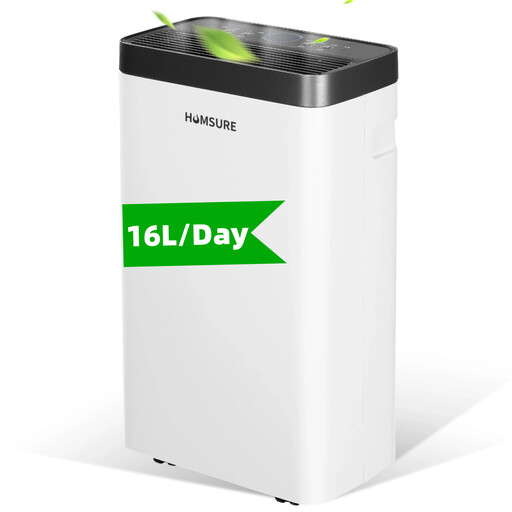 Image unavailable
HUMSURE 16L/Day dehumidifier for 25 m²
Worth considering for a room of around 25 m² if you can manage emptying the tank or check the model’s drainage options.
The title states a 1.4 L tank and a 24-hour timer. Check which modes are available on this variant before buying, as well as the placement instructions if you plan to use the appliance near a bathroom.
View on Joybuy
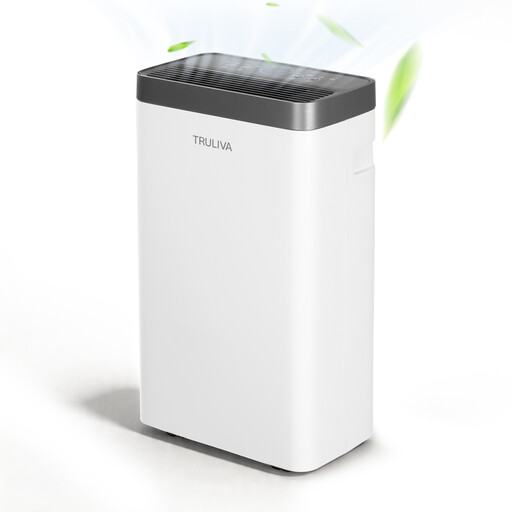 Image unavailable
TRULIVA AP10-2012EE dehumidifier for around 32 m²
Worth considering for drying laundry in a room that matches the stated size, if continuous drainage can be set up in accordance with the instructions.
The title mentions a 24-hour timer, a laundry-drying function and continuous drainage. Before buying, confirm the humidity setting range for this variant and check its placement instructions.
View on Joybuy
 Image unavailable
Comfee' MDDN-10DEN7, 10 L/24 h dehumidifier
Worth considering for a small room if the stated size and installation requirements suit the intended location.
The title states around 40 m³, or 16 m², as well as an LED display and automatic dehumidification. The stated capacity doesn’t guarantee the same results in every condition. If you’re considering using it in a bathroom, check the instructions and the exact placement.
View on Joybuy
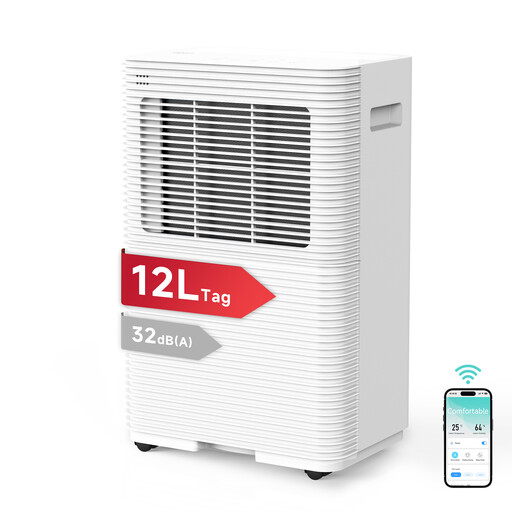 Image unavailable
VINO 12L Smart Wi-Fi dehumidifier, 1.8 L tank
Worth considering for a room where laundry is dried regularly, if the stated floor area and how often you’ll need to empty the tank suit your needs.
The title states 12 L/day, coverage of up to 24 m² and three modes, with a 1.8 L tank. If noise is a deciding factor, confirm the level and test conditions for the mode you’re interested in. Check the instructions before using it near a shower, too.
View on Joybuy
Frequently asked questions
Can a dehumidifier replace airing the room or mechanical ventilation?
No. A dehumidifier removes water from the air, but it doesn’t replace air circulation. ADEME highlights the role of airing and ventilation in removing moisture. Check they’re working properly even if you use an appliance.
How can I tell whether I need a dehumidifier?
Measure the relative humidity in the room and see whether it falls after the activity and airing the room. Qualitel gives 40% to 60% as a general guide for a home. A single reading after a shower isn’t enough to establish persistent damp, and marks on the walls need to be investigated to find their cause.
Can you use a dehumidifier in a bathroom?
It depends on the model and the exact location. Don’t assume a portable appliance is suitable near a shower or bath. Promotelec sets out the electrical safety zones in France, and the instructions for the Meaco DD8L Zambezi Z2 expressly prohibit using it in a bathroom. Check the instructions for your chosen model and have the installation checked if necessary.
Should I choose a tank or continuous drainage?
A tank is suitable if you can empty it as often as your usage requires. For longer periods of operation, check that the model supports continuous drainage and that the hose, its route and any height restrictions are suitable for your set-up.
What should I do if damp marks keep coming back on the walls?
Have the cause investigated before relying on a dehumidifier. France Rénov’ recommends having damp marks assessed. The Ministry of Health says a leak, water ingress or thermal bridge may be responsible, and that treating mould without addressing its cause isn’t enough.


