
Livraison le jour même ou le lendemain

Qualité garantie

Débloquez vos offres de bienvenue: Livraison GRATUITE | Jusqu'à -80 % | 30 jours d'essai gratuits à JoyPlus
Téléchargez l'application
A decorative LED bulb isn't chosen for its looks alone. In an open pendant light, a wall light or a chandelier, its shape, the tint of its glass and the colour of its light all play a part in your décor. But be warned: a very attractive model can give off light that's too dim, be incompatible with your dimmer switch, or simply not fit your light fitting.
Before you place your order, three common pitfalls keep cropping up:
The E27 cap is a large screw thread that's very common on pendant lights, table lamps, wall lights and chandeliers. You'll find it on vintage bulbs, Edison models and LED filament bulbs in A60, ST64, T45 or Globe shapes.
The GU10 cap uses two pins and a quarter-turn lock. It's mainly found on recessed spotlights, track lighting and certain adjustable ceiling lights. Also remember to measure the available height and diameter: a 12.5 cm diameter Globe bulb won't fit inside a narrow lampshade.
Colour temperature is expressed in kelvins:
A 2200 K LED bulb is generally a good fit for a decorative light fitting that's on show. A 2700 K LED bulb is more versatile if you want to keep a warm feel while enjoying a more noticeable level of light.
Lumens measure the amount of light emitted. Watts indicate electricity consumption, but they're not enough to compare the brightness of two LED bulbs.
As a guide, the decorative models featured here range from 100 to 500 lumens. An energy-efficient LED bulb intended for general lighting can reach 840 lumens at 4 W, depending on the product specification. To make a consistent choice, look at the energy class, the stated wattage and the nominal lifespan together.
If you use a dimmer switch, you must check for the dimmable label. Non-dimmable models, such as some GU10 bulbs, must not be connected to a dimmer.
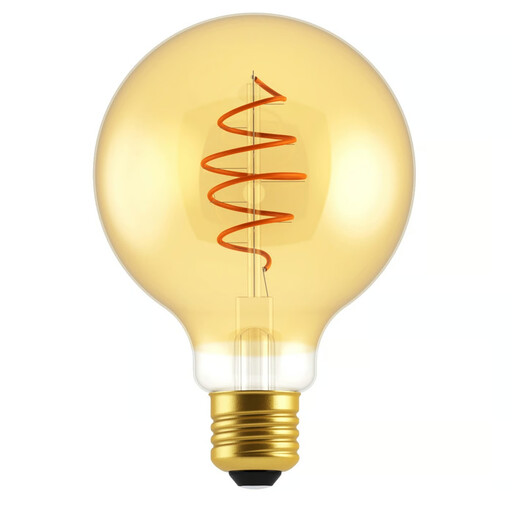
Why this choice suits this profile: its E27 cap fits many light fittings, and its 9.5 cm Globe shape easily finds a home in an open pendant light or a lamp where the bulb stays on show.
The specification states 400 lumens, 4.9 W and dimmer compatibility, so you know it's an ambient bulb whose brightness can be adjusted.
Amber glass, visible spiral filament, 2200 K and a nominal lifespan of up to 15,000 hours.
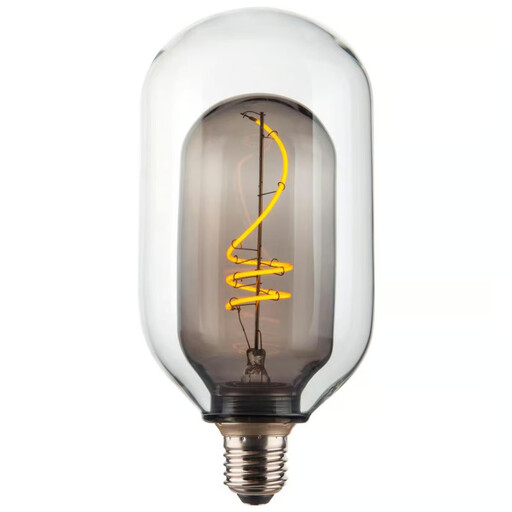
Why this choice suits this profile: its smoked glass and visible filament are ideal for a retro or industrial interior, where the bulb becomes a real decorative feature.
At 100 lumens, it clearly states its purpose: it's an ambient bulb, not a main light source capable of lighting an entire room.
Smoked glass, 1800 K, 4.1 W power and dimmer compatibility according to the product specification.
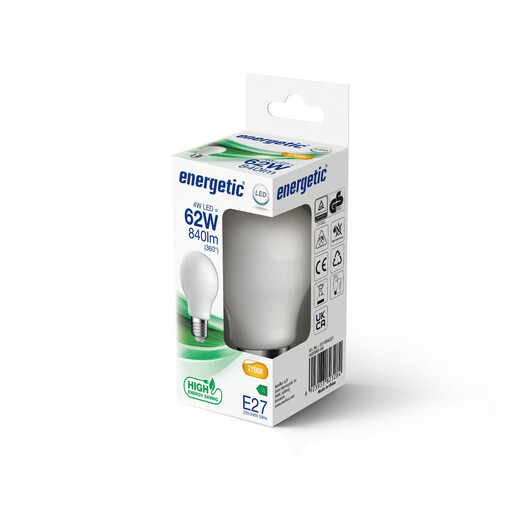
Why this choice suits this profile: it's suitable for regular use in a living room, bedroom or professional space that requires wide light distribution.
Its stated 360° light distribution and 840 lumens let you check that it meets a functional lighting need, rather than just providing a soft glow.
Energy class A stated, 4 W consumption, nominal lifespan of 50,000 hours and warm white light at 2700 K.
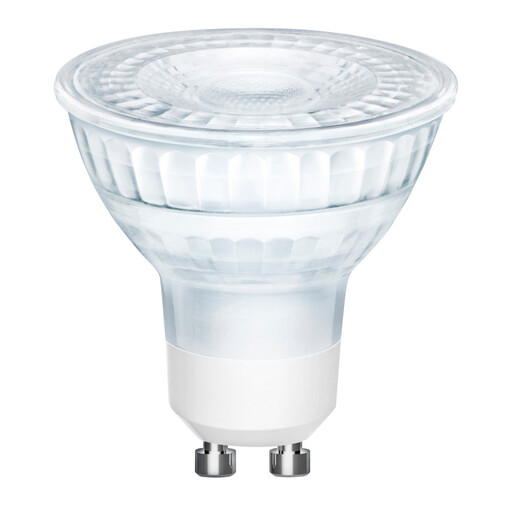
Why this choice suits this profile: its 36° beam is ideal for highlighting a painting, a shelf or a specific area in a hallway or kitchen.
The GU10 cap and 36° angle are clearly stated. The specification also notes that this model is not dimmable.
PAR16 format, 345 lumens, 2700 K, 4.7 W and a nominal lifespan of up to 15,000 hours.
We've put together a comprehensive, real-time selection of products that meet these strict criteria and the requirements of European safety regulations.
Turn off the power supply before replacing the bulb. For an E27, screw it in gently into a compatible holder. For a GU10, align the pins, then twist it a quarter turn. Wait for the glass to cool down before handling it, and clean it with a soft, dry cloth.
Also check the light fitting's instructions regarding use in an enclosed space, humidity and heat dissipation. A decorative bulb designed for indoor use must not be installed outdoors or in a damp area without a suitable fitting.
A 2200 K LED bulb gives off a very warm light, particularly suited to amber glass, smoked glass and vintage-style interiors. For more versatile use, 2700 K offers a warm white that's slightly brighter.
It all depends on its light output. A model with 100 to 400 lumens is mainly suitable for creating an atmosphere or supplementing existing lighting. To light a room broadly, choose a bulb with wide light distribution and a higher output, such as this model stated at 840 lumens.
It depends on its wattage, how long it's used and your electricity tariff. To compare two models, note their wattage, energy class and nominal lifespan. However, bear in mind that low consumption doesn't necessarily mean the bulb will meet your lighting needs.