When choosing decaffeinated instant coffee in a jar while shopping with diabetes, start by checking the ingredients list, then compare the carbohydrate and sugar content per 100 g. Next, choose a size that suits how much you drink. A product made solely from coffee is different from an instant coffee preparation containing other ingredients, and ‘decaffeinated’ does not mean caffeine-free.
Who is this option for?
People looking for coffee-only ingredients
When shopping with diabetes, the ingredients list and nutritional information can help you tell decaffeinated instant coffee apart from instant preparations containing other ingredients. France’s Assurance Maladie recommends reading food labels.
People who keep coffee in the cupboard
If you make coffee at home regularly, compare 100 g and 200 g jars based on how much you drink, the storage advice after opening and availability at your local shop or through its online grocery service.
People keeping an eye on their caffeine intake
Decaffeinated coffee can still contain caffeine. If you need to stick to a specific personal limit, don’t assume you know how much is in each cup just because the label says ‘decaffeinated’.
What should you check before buying?
For a jar to keep in the cupboard, first check the ingredients and nutritional information, then look for the ‘decaffeinated’ label and choose a size that suits how you’ll use it.
| What matters |
What to check |
Who it matters to |
| Ingredients and sugars |
Read the ingredients, then compare the carbohydrate and sugar content per 100 g across the products you’re considering. |
When I’m shopping with diabetes, I want to tell instant coffee apart from a preparation containing other ingredients. This would be the top priority for around 50% of consumers. |
| Caffeine |
Check for the ‘decaffeinated’ label, but don’t take it as a guarantee that the product contains no caffeine at all. |
If I need to limit my caffeine intake, I want to know what this label means before choosing a jar. Around 30% of consumers would make this their priority. |
| Size and restocking |
Compare the net weight, storage advice and availability at your local shop or through its online grocery service. |
If I don’t drink much coffee, I’d rather avoid a jar that would stay open for a long time. If I make it often, restocking matters more. Jar size would be the top priority for around 20% of consumers. |
Mistakes to avoid
-
Confusing instant coffee with an instant coffee preparation
The product name alone doesn’t tell you what’s in it. When comparing drinks while shopping with diabetes, France’s Assurance Maladie advises reading food labels. The ingredients and nutritional values can help you spot the differences.
For the jar you’re considering, check the ingredients list as well as the carbohydrate and sugar content per 100 g, especially if you’re switching recipe or flavour.
-
Assuming ‘decaffeinated’ means ‘caffeine-free’
The label ‘decaffeinated’ doesn’t guarantee that a product contains no caffeine at all. European Directive 1999/4/EC governs its use for coffee extracts, but it doesn’t mean the caffeine content is zero.
If you need to stick to a specific caffeine limit, don’t rely on the product name alone; ask your healthcare professional for advice.
-
Choosing 200 g without considering how much you drink
A 200 g jar may not be right for you if you rarely use instant coffee. Availability can also vary between shops and online grocery services.
Compare the net weight with how quickly you’ll use it, check local availability and follow the storage instructions on the jar you buy.
Brands to consider
NESCAFÉ
Carrefour’s product listing describes Spécial Filtre Décaféiné as a 200 g jar, advertised as making 100 cups.
- Carrefour lists ‘decaffeinated coffee’ in the ingredients for this product.
- Carrefour marks this jar as unavailable; check with your local shop before planning to buy it.
Carrefour Extra
The Carrefour listing describes a 100 g jar of decaffeinated instant coffee.
- Its listing gives the ingredients as ‘100% freeze-dried decaffeinated instant coffee’.
- Carrefour says this product has been discontinued and is unavailable through its online grocery service.
PLANTATION (Marque Repère)
E.Leclerc lists a 200 g pack of freeze-dried decaffeinated instant coffee under this brand.
- The E.Leclerc page lists ‘freeze-dried decaffeinated instant coffee’ in the ingredients.
- The page advises checking with your E.Leclerc store or its online grocery service for purchasing options.
Maxwell House
Carrefour lists a 200 g jar of Maxwell House decaffeinated instant coffee.
- The listing describes it as freeze-dried decaffeinated instant coffee.
- Carrefour says this product has been discontinued and is unavailable through its online grocery service.
Decaffeinated instant coffee on Joybuy
This 100 g jar is a good option if you’re looking for decaffeinated instant coffee to keep in the cupboard. Check its label against your ingredient preferences and your usual coffee consumption.
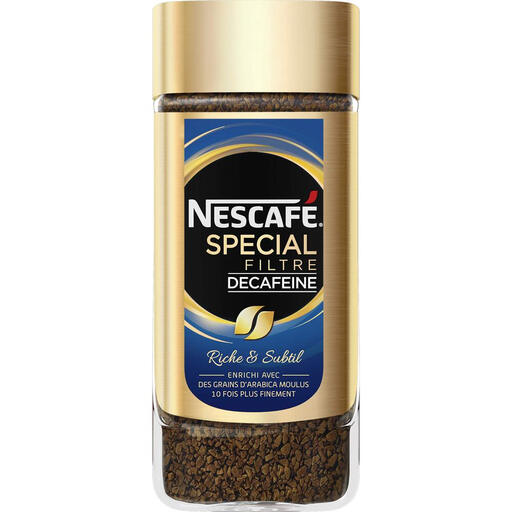 Image unavailable
NESCAFÉ Decaf Filter Coffee 100 g
The 100 g size may suit you if you don’t drink much decaffeinated instant coffee or would like to try this product. Check the ingredients list, carbohydrate and sugar content per 100 g, and storage instructions after opening on the jar you buy. ‘Decaffeinated’ doesn’t mean it contains no caffeine at all.
View on Joybuy
Frequently asked questions
How can I compare two decaffeinated instant coffees when shopping with diabetes?
Compare the ingredients lists and the carbohydrate and sugar content per 100 g, rather than relying on the word ‘coffee’ alone. France’s Assurance Maladie recommends reading food labels; also consider how much powder you use.
Is decaffeinated instant coffee completely caffeine-free?
No. ‘Decaffeinated’ doesn’t mean that it contains no caffeine at all. European Directive 1999/4/EC governs the use of this label for coffee extracts. If you need to stick to a specific personal limit, don’t estimate your caffeine intake per cup from the wording on the label alone.
How should I prepare the 200 g jar of NESCAFÉ decaffeinated coffee listed by Auchan?
Auchan’s listing for this 200 g product recommends one heaped teaspoon per 100 ml of just-boiled water and says to close the jar tightly. Check the instructions on your own jar: this dosage shouldn’t be assumed to apply to every NESCAFÉ product.
Will a jar listed by a retailer be available at my local shop?
Not necessarily. Check with the shop or online grocery service where you plan to shop. Carrefour’s listings for NESCAFÉ Spécial Filtre Décaféiné, Carrefour Extra Décaféiné and Maxwell House Décaféiné show these products as unavailable, while E.Leclerc’s PLANTATION page advises checking with your local store.


