Anyone looking to limit caffeine after dinner
If caffeine is your main concern, look for the ‘decaffeinated’ label on instant coffee. An intensity rating won’t tell you how much residual caffeine it contains.


For a cup after dinner, first choose an instant coffee labelled ‘decaffeinated’, then compare the options based on the flavour you prefer and the format: a jar to measure out at home or individually portioned sticks. The stated intensity indicates the flavour profile, not the amount of residual caffeine; decaffeinated does not mean completely caffeine-free.
If caffeine is your main concern, look for the ‘decaffeinated’ label on instant coffee. An intensity rating won’t tell you how much residual caffeine it contains.
Depending on how you serve your coffee, compare a jar that you measure out yourself with individually portioned sticks. Also check the ingredients and storage instructions for the product you choose.
The blend and intensity stated by a brand can help you choose a flavour profile, but they can’t guarantee you’ll enjoy it or tell you how much residual caffeine it contains.
For instant coffee to enjoy after dinner, first check that it’s decaffeinated. You can then compare the flavour and how you prefer to measure out each cup.
| Criteria | What to check | Who is it for? |
|---|---|---|
| Caffeine | The ‘decaffeinated’ label and ingredients list, to distinguish instant coffee from a mixed instant drink. | If I have coffee after dinner, my main priority is limiting caffeine without assuming that decaffeinated coffee contains none at all. Around 50% of consumers put reducing caffeine first. |
| Flavour | The blend and any intensity or flavour profile information, if provided for the product. | I want a flavour I enjoy to round off my meal, even if the coffee is decaffeinated. Flavour comes first for around 30% of consumers. |
| Format and serving size | The net quantity, the number of sticks if applicable, and the preparation and storage instructions. | Whether I’m making cups at home or taking a portion with me, I want a format that suits my routine. For around 20% of consumers, ease of measuring is the main consideration. |
For the coffee extracts covered, European Directive 1999/4/EC allows the label ‘decaffeinated’ when the anhydrous caffeine content does not exceed 0.3% of the dry matter in the coffee-based product. This threshold does not mean zero caffeine.
Choose a product explicitly labelled ‘decaffeinated’. If you need to know exactly how much caffeine you’re consuming, check the information for that specific product.
Auchan labels its intense instant coffee as both ‘decaffeinated’ and intensity 6/10. These details describe two different aspects of the product.
Check for the ‘decaffeinated’ label first, then use the intensity rating as a guide to flavour.
The Carrefour Extra listing we checked shows the product as unavailable for Drive collection. That means a particular product or format may not be available at your chosen collection point.
Before ordering or setting off, check availability at your chosen store, for Drive collection or with your preferred delivery service.
According to NESCAFÉ France, Spécial Filtre Décaféiné comes in a 100 g jar and is made with a blend of Arabica and Robusta decaffeinated using water.
Auchan describes its 100 g decaffeinated freeze-dried instant coffee as having an intensity of 6/10.
E.Leclerc stocks PLANTATION decaffeinated freeze-dried instant coffee in a 200 g jar, among other options.
Carrefour France describes its 100 g Extra product as decaffeinated freeze-dried instant coffee.
This selection features decaffeinated instant coffee to measure out at home for a cup after dinner.
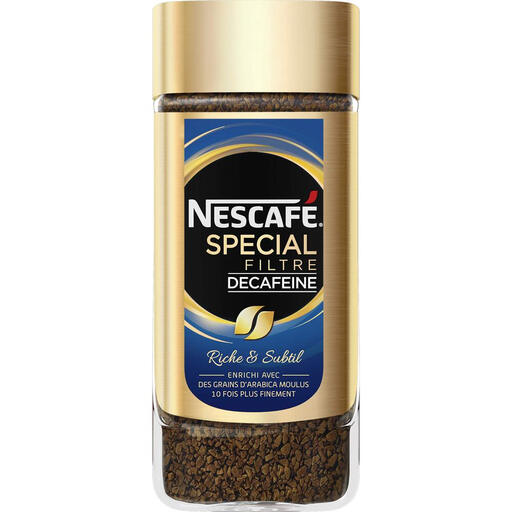 Image unavailable
This 100 g decaffeinated coffee is ideal for making a cup after dinner and adjusting the amount of instant coffee to suit your taste.
Check the preparation instructions on the pack. The ‘decaffeinated’ label doesn’t guarantee that the coffee is completely caffeine-free.
No, the label ‘decaffeinated’ doesn’t promise zero caffeine. For the coffee extracts covered in the European Union, Directive 1999/4/EC allows this label when the anhydrous caffeine content does not exceed 0.3% of the dry matter in the coffee-based product.
No. Intensity is a guide to flavour, while the ‘decaffeinated’ label relates to caffeine. For example, Auchan gives its intense decaffeinated instant coffee an intensity rating of 6/10. Don’t use this figure to estimate its caffeine content.
Follow the instructions for the product you’ve bought rather than assuming the same amount applies to all products. NESCAFÉ France recommends one teaspoon per 100 ml of hot water for its Spécial Filtre Décaféiné. Don’t automatically apply this instruction to another product.
Instant coffee explicitly labelled as decaffeinated is more directly suited to this aim than regular instant coffee, but it isn’t guaranteed to be completely caffeine-free. Anses says caffeine can delay the time it takes to fall asleep and reduce sleep duration or quality. If you have a specific individual concern, check the product information and seek appropriate professional advice.
Always check the storage instructions on the packaging first. For its intense decaffeinated instant coffee, Auchan recommends storing the product in a cool, dry place and closing the jar tightly after use.