Travellers having coffee in the evening
You’d like to enjoy a coffee-flavoured drink with your meal without choosing regular coffee. Look for the “decaffeinated” label, but don’t take it to mean that the drink contains no caffeine at all.


For a single cup with your meal at the airport, choose sachets of instant coffee clearly labelled “decaffeinated”. If you’re planning to make several cups or adjust the amount of coffee, a jar will be more convenient. In either case, check the ingredients to distinguish instant coffee from a milky or sweetened coffee mix, and make sure you’ll be able to get a cup and hot water after security. “Decaffeinated” doesn’t necessarily mean caffeine-free.
You’d like to enjoy a coffee-flavoured drink with your meal without choosing regular coffee. Look for the “decaffeinated” label, but don’t take it to mean that the drink contains no caffeine at all.
You want to take a single portion and avoid handling a jar. The individual sachets listed by Auchan and E.Leclerc suit this need, provided you have a cup and hot water to prepare them.
You want to adjust the amount of coffee and add milk or sugar separately, if you wish. A jar of decaffeinated instant coffee lets you do this, but you’ll need a spoon and must make sure the jar is properly closed while travelling.
For an evening meal at the airport, first check that the drink is decaffeinated as you want it to be. Then choose the format based on how many cups you plan to make and the recipe you have in mind.
| What matters | What to check | Who it’s for |
|---|---|---|
| Evening coffee | Look for “decaffeinated” and “instant coffee” on the packaging. | I want a coffee after my meal without choosing the regular version, while bearing in mind that “decaffeinated” doesn’t guarantee that it contains no caffeine at all. Around 42% of consumers would make this their priority. |
| Portability and portioning | Check how many sachets there are or the size of the jar, and whether you’ll have access to a cup and hot water. | If I’m only making one cup while travelling, I’d rather take a pre-measured portion than a jar. Easy transport would be the top priority for around 33% of consumers. |
| A drink you can customise | Check the ingredients to distinguish decaffeinated instant coffee from a mix that already contains other ingredients. | I want to choose the amount of coffee and any extras myself, rather than opt for a ready-made mix. This would be the top priority for around 25% of consumers. |
In France, the decree on coffee extracts allows the term “decaffeinated” to be used for the products concerned when anhydrous caffeine does not exceed 0.3% of the coffee-derived dry matter. So the label doesn’t mean the caffeine content is zero.
Check that the product you choose is labelled “decaffeinated”. If it matters to your decision, also take into account any other drinks you consume that contain caffeine.
A jar lets you adjust the amount of coffee, but you’ll also need a way to measure it and to close the jar before continuing your journey. A sachet avoids these extra steps for a single portion.
Choose a format based on how many cups you’ll actually make: a sachet to keep what you carry to a minimum, or a jar if you’ll use it more than once.
According to the European Commission, liquids presented at security screening at airports in the European Union are subject to a limit of 100 ml per container. This rule for liquids does not, in itself, determine whether coffee powder is allowed.
If you’re planning to have a cup of more than 100 ml, prepare it or buy it after security. Also check the rules of your departure airport and airline about carrying coffee powder.
Carrefour Extra’s product listing shows its decaffeinated instant coffee as unavailable for Drive delivery. E.Leclerc also notes that availability depends on the chosen store or Drive service.
If you’re planning to buy your coffee before setting off, check with the retailer in question rather than relying on the product listing alone.
The Spécial Filtre Décaféiné range includes instant coffee in a jar, which you can measure out for several cups.
Its freeze-dried decaffeinated instant coffee sachets are a good option if you want to carry a separate portion.
E.Leclerc lists freeze-dried decaffeinated instant coffee in individual portions.
Carrefour Extra’s listing describes freeze-dried decaffeinated instant coffee, which is different from a ready-made sweetened or milky mix.
Carte Noire provides information about instant coffee, but the decaffeinated coffee in the range we checked is ground coffee.
These two products offer different ways to enjoy a decaffeinated drink at the airport: a jar of instant coffee you can measure out, and sachets of coffee with milk in individual portions. If you’re after black coffee with no extras, check the ingredients carefully before choosing.
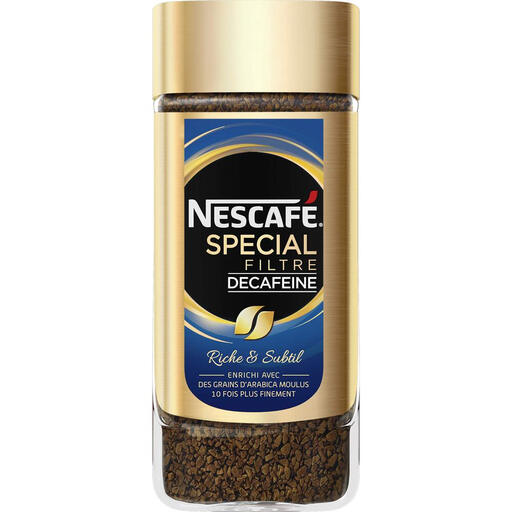 Image unavailable
This jar is a good choice if you want to measure out your own decaffeinated instant coffee or make several cups without a machine.
100 g jar. Joybuy describes it as 100% soluble decaffeinated instant coffee in a glass jar. Make sure you have something to measure it with, and close the jar after use.
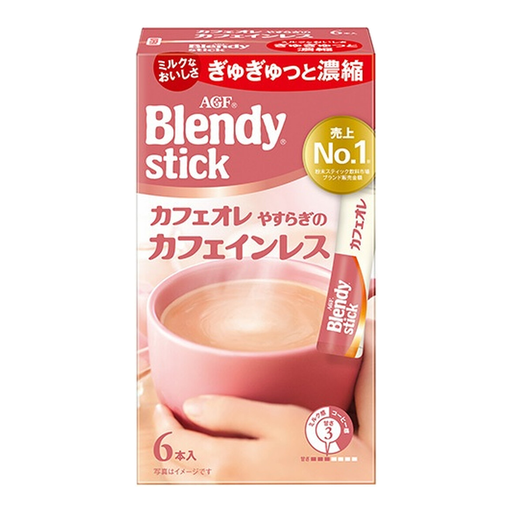 Image unavailable
These individual portions are a good choice if you’d rather take a sachet than a jar for a drink while travelling.
Pack of 6 decaffeinated café au lait sachets. This isn’t black coffee made solely from instant coffee, so check the ingredients if you want to choose what to add to your cup yourself.
No. The label doesn’t guarantee that it contains no caffeine. In France, the decree on coffee extracts sets a limit of 0.3% anhydrous caffeine in the coffee-derived dry matter for the products concerned to be labelled “decaffeinated”.
Follow the product instructions and make sure you have a cup and hot water. For its Spécial Filtre Décaféiné, NESCAFÉ recommends one teaspoon per 100 ml of hot water. For its decaffeinated sachets, Auchan recommends using one sachet with hot, but not boiling, water. Make sure you’ll be able to get hot water before relying on making a drink with your meal.
If you’re travelling from an airport in the European Union, a drink presented before security screening is subject to the 100 ml per-container limit for liquids, according to the European Commission. For a larger cup, plan to prepare or buy it after security. Check separately the rules on what you can take into the cabin.