What should you check before buying?
When choosing an evening drink, start with the ingredients, then check the ‘decaffeinated’ label and finally pick a format that suits how you’ll use it.
| What to consider |
What to check |
Who is it for? |
| What’s in your cup |
Read the ingredients list. For a prepared mix, also check the sugar per serving you’ll consume. |
If I want to decide for myself whether to add milk or sugar, I need to distinguish coffee on its own from a ready-made mix. Around 44% of consumers put control over what they add first. |
| Caffeine in the evening |
Look for the ‘decaffeinated’ label, but don’t take it to mean there’s no caffeine at all. |
For my evening cup, my main priority is limiting caffeine while bearing in mind that a small amount may remain. This is a priority for around 33% of consumers. |
| Format and product availability |
Compare jars and sticks based on how you plan to use them, then check availability through your chosen retailer. |
If I want to keep coffee at home or take individual portions with me, packaging is the main factor in my choice. Around 23% of consumers prioritise format and availability. |
Brands and products to know
These products show how ingredients and formats can differ. Always check the label of the product you’re planning to buy.
NESCAFÉ
The brand describes its Spécial Filtre Décaféiné as a decaffeinated Arabica and Robusta blend made using water. Carrefour lists the 100 g jar as containing decaffeinated instant coffee.
- With this product, you can choose separately whether to add anything to your cup.
- This ingredient list doesn’t apply to all the brand’s products: Carrefour’s listing for NESCAFÉ 3-in-1 includes sugar and glucose syrup, among other ingredients.
AUCHAN
Auchan’s product listing describes a 100 g jar of freeze-dried decaffeinated instant coffee, with a stated intensity of 6/10 and around 50 cups per jar.
- The pack size and stated intensity give you useful points of comparison.
- Check availability at the store, on the Drive service or through the delivery option you plan to use.
PLANTATION (Marque Repère, E.Leclerc)
E.Leclerc lists freeze-dried decaffeinated instant coffee in a 200 g jar and in a box of 25 sticks weighing 50 g.
- The jar is suited to home use, while the sticks are handy individual portions to take with you.
- E.Leclerc’s product listings advise checking availability with the relevant centre, store or Drive service.
Carrefour Extra
Carrefour listed a 100 g decaffeinated instant coffee, but says this product is no longer available in its stores.
- RappelConso reported that specific batches of Carrefour Extra ‘Café soluble Decaffeinato Quality Filtre bocal 100g’ may contain pieces of glass. If you have a jar, check its product and batch details before consuming it.
Joybuy products to consider
These two products offer different options for a decaffeinated drink: instant coffee in a jar that you prepare yourself, and a coffee-and-milk mix in sticks. Compare their ingredients before choosing, depending on what you want to be able to add yourself.
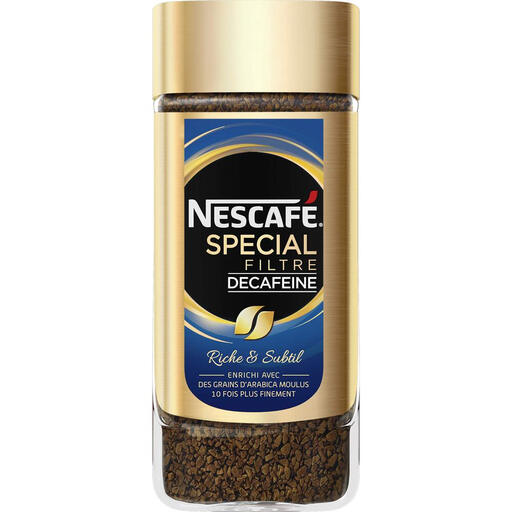 Image unavailable
NESCAFÉ Decaf Filter Coffee, 100 g
If you want to choose what goes into your cup, this decaffeinated instant coffee is described as containing coffee only. The jar contains 100 g. Before buying, check the ingredients list and the sugar information on the pack for the amount you’ll use. The ‘decaffeinated’ label doesn’t tell you how much caffeine is in each cup.
View on Joybuy
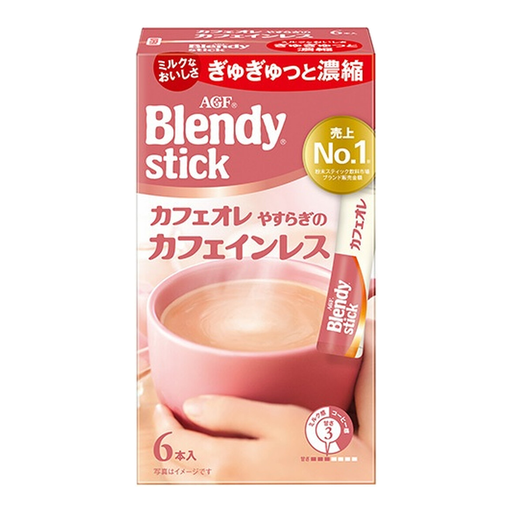 Image unavailable
AGF Blendy stick Cafe au Lait Decaffeinated, 6 sticks
These sticks are for anyone looking for individual portions of a coffee-and-milk drink, rather than black coffee where you decide what to add. The product description lists sugar, cream powder and milk proteins, so check the sugar per stick and the allergen information on the pack. The description gives conflicting information about milk and allergens, so it’s especially important to check the packaging if you have a milk allergy.
View on Joybuy
Frequently asked questions
Is decaffeinated instant coffee completely caffeine-free?
No: ‘decaffeinated’ doesn’t mean there’s no caffeine at all. For the relevant coffee extracts in France, Decree No. 2001-977, published by Légifrance, sets a maximum of 0.3% anhydrous caffeine in the coffee-derived dry matter. It doesn’t specify how much caffeine is in a cup.
How can I control what goes into my cup?
Choose a product whose ingredients list is limited to decaffeinated instant coffee, then decide separately whether to add anything. When shopping with diabetes in mind, Assurance Maladie recommends reading labels. If you choose a prepared mix, also check its nutritional information for the serving you’ll consume.
Does a decaffeinated stick always contain coffee on its own?
No: ‘stick’ describes the packaging, not the recipe. The Plantation sticks listed by E.Leclerc contain freeze-dried decaffeinated instant coffee, while other sticks may be coffee-and-milk mixes. Check the ingredients on the box you choose.
Can you compare a 3-in-1 mix directly with black instant coffee?
No, because it may contain ingredients other than coffee. Carrefour’s product listing for NESCAFÉ 3-in-1 includes sugar, glucose syrup and milk-derived ingredients, among other things. Compare its ingredients and nutritional information per serving with your needs, rather than treating it as black coffee.
What should I check on a Carrefour Extra decaffeinated coffee jar I’ve already bought?
Check the product and batch number before consuming it. RappelConso issued recall 2025-06-0045 for batches of Carrefour Extra ‘Café soluble Decaffeinato Quality Filtre bocal 100g’ sold between 20 March and 6 June 2025: E2493/07A3, E2493/07B3, E2493/07C3 and E2493/08A3, with a best-before date of 4 December 2026. As the jars may contain pieces of glass, don’t consume an affected jar and follow the official instructions for returning or disposing of it.


