For a late afternoon snack or an evening cup, first look for instant coffee labelled ‘decaffeinated’ — this does not necessarily mean it contains no caffeine at all. Then choose a product to suit how you’ll use it: a jar for making coffee regularly at home, or sticks for a handy single serving. Treat the stated intensity as a guide to flavour, not caffeine content.
Who is this choice for?
Those who enjoy a coffee later in the day
You’d like to enjoy a cup with an afternoon snack or in the evening while reducing your caffeine intake. France’s food safety agency, Anses, reminds us that caffeine can disrupt sleep. However, ‘decaffeinated’ does not mean ‘caffeine-free’.
Those who enjoy a full coffee flavour
You’re looking for decaffeinated instant coffee with a flavour profile you enjoy. A brand’s stated intensity can help you compare its blends, but it doesn’t tell you how much caffeine they contain.
Occasional drinkers and people on the go
You might want to make a cup away from home or prefer a pre-measured serving. Sticks are handy for this, while a jar or bottle is better suited to making coffee regularly at home.
What should you look for first?
For a cup with an afternoon snack or in the evening, first check that the product is decaffeinated instant coffee. Then use the flavour notes and packaging to find an option that suits the way you like to prepare it.
| Criterion |
What to check |
Who it matters to |
| Caffeine |
The ‘decaffeinated’ label on the instant coffee, as well as any other sources of caffeine you consume during the day. |
When I have a coffee late in the day, I want to reduce my caffeine intake without assuming my cup is completely caffeine-free. Around 43% of consumers would put this need at the top of their list. |
| Flavour |
The stated intensity for the exact decaffeinated product and, if provided, details of its blend. |
I mainly want a coffee flavour I enjoy, even when choosing decaffeinated coffee. Around 29% of consumers would make this their priority. |
| Format |
The net weight or number of servings, and whether the packaging you want is available. |
If I make cups at home or take my coffee with me, the first thing I look for is packaging that fits my routine. Format would be the main consideration for around 28% of consumers. |
Common mix-ups to avoid
-
Assuming ‘decaffeinated’ means ‘zero caffeine’
In France, a decree dated 26 October 2001 sets a limit of 0.3% anhydrous caffeine, by dry matter derived from coffee, for certain coffee extracts to be labelled ‘decaffeinated’. A small amount of caffeine may therefore remain.
If reducing caffeine is your priority, check the product description and remember to take account of any other caffeinated drinks or foods you have during the day.
-
Taking intensity to mean caffeine content
Auchan gives its 100 g decaffeinated instant coffee an intensity rating of 6/10, while a 200 g NESCAFÉ decaffeinated product is rated 7. These ratings describe the flavour profile; they don’t measure the caffeine left in the coffee.
Use the intensity rating as a guide to flavour, and the ‘decaffeinated’ label to identify the type of coffee you’re looking for.
-
Confusing instant coffee with an instant drink mix
An instant drink mix may contain ingredients other than coffee. For example, Carrefour describes its Carrefour Extra sticks as ‘100% freeze-dried decaffeinated instant coffee’.
Check the product description and ingredients list if you want a cup of decaffeinated instant coffee rather than a coffee-based drink mix.
-
Assuming a product listing means it’s available
Carrefour Extra lists its decaffeinated sticks as unavailable, while E.Leclerc says its 200 g PLANTATION jar is not sold on its website.
Check that the format you want is available from the store or ordering service you plan to use.
Brands to compare
NESCAFÉ
The Spécial Filtre Décaféiné range includes a 100 g bottle; Auchan also lists a 200 g option.
- According to NESCAFÉ France, Spécial Filtre Décaféiné blends Arabica and Robusta coffees decaffeinated using water.
- The intensity rating of 7 shown by Auchan applies to its 200 g product. Check the rating for the format you choose.
Auchan
Auchan offers 100 g of freeze-dried decaffeinated instant coffee and also lists a sticks format.
- For its 100 g jar, Auchan specifies freeze-dried decaffeinated instant coffee, an intensity of 6/10 and around 50 cups.
- Check that the format you want is available at your selected store or for your chosen click and collect service.
PLANTATION (Marque Repère / E.Leclerc)
E.Leclerc lists PLANTATION freeze-dried decaffeinated instant coffee in a 200 g jar, as well as a pack of 25 sticks.
- The 200 g jar is a larger option for making coffee regularly at home.
- E.Leclerc says the jar is not sold on its website and advises customers to contact their local store.
Carrefour Extra
Carrefour has listed freeze-dried decaffeinated instant coffee in a pack of 25 x 2 g sticks.
- The Carrefour product listing states that it contains 100% freeze-dried decaffeinated instant coffee.
- The same listing shows the product as unavailable, so check current stock before relying on this format.
Carte Noire
Carte Noire is included here as a comparison for anyone considering a different way to make coffee instead of using instant coffee.
- Carte Noire offers decaffeinated coffee in soft coffee pods, among other options.
- Soft coffee pods require a compatible machine and are not a substitute for instant coffee that you can make without one.
Decaffeinated instant coffee on Joybuy
This selection features decaffeinated instant coffee in a 100 g format, for making a cup at home with an afternoon snack or in the evening.
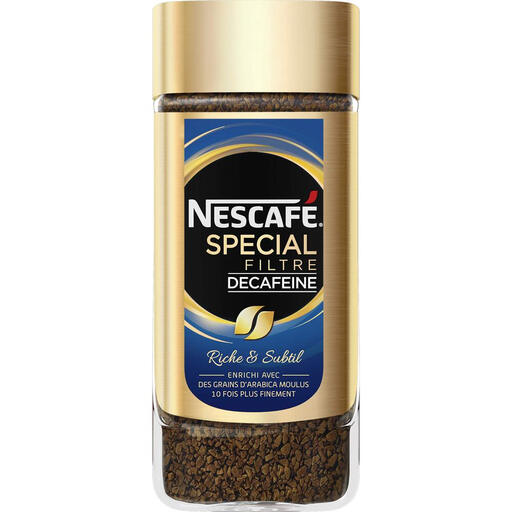 Image unavailable
NESCAFÉ decaffeinated filter coffee 100 g
A decaffeinated instant coffee to consider for making a cup at home with an afternoon snack or in the evening.
Format: 100 g. The ‘decaffeinated’ label does not guarantee that the coffee is completely caffeine-free.
View on Joybuy
Frequently asked questions
Is decaffeinated instant coffee completely caffeine-free?
No. ‘Decaffeinated’ does not necessarily mean ‘caffeine-free’. In France, a decree dated 26 October 2001 allows certain coffee extracts to carry this label if the anhydrous caffeine content does not exceed 0.3% of the dry matter derived from coffee.
Why should you consider caffeine in an evening coffee?
Caffeine can disrupt sleep, as Anses points out. Choosing decaffeinated instant coffee means you can look for a cup with less caffeine, without assuming it contains none at all.
How do you make NESCAFÉ Spécial Filtre Décaféiné?
For this product, NESCAFÉ France recommends adding one teaspoon to a cup with 100 ml of hot water. There’s no need to boil the water. If you choose another product, follow its specific instructions.
Should you choose decaffeinated sticks rather than a jar?
Sticks are handy if you want to take pre-measured servings with you; a jar or bottle is better suited to making coffee regularly at home. Compare the net weight and number of servings, then check that your chosen format is available.


