Those who like to enjoy coffee in the evening
You want to keep the ritual of a hot drink after a meal while choosing a decaffeinated coffee. Anses notes that caffeine can affect sleep, and that sensitivity varies from person to person.


For a cup after dinner, first look for a specific instant coffee product clearly labelled ‘decaffeinated’. A jar lets you adjust the amount at home, while sachets make it easier to serve individual portions or take your coffee with you. Then compare the ingredients and preparation instructions. Don’t assume a coffee is decaffeinated just because it’s described as ‘mild’ or comes in a particular format.
You want to keep the ritual of a hot drink after a meal while choosing a decaffeinated coffee. Anses notes that caffeine can affect sleep, and that sensitivity varies from person to person.
Whether you’re enjoying dessert or lingering over conversation, you’re looking for a flavour profile you’ll enjoy. Intensity ratings can help guide your choice, but they’re specific to the products that display them.
You might make just one cup, serve several guests or take your coffee with you. Decaffeinated sachets give you a ready-to-pour portion, but make sure the box you choose is labelled ‘decaffeinated’.
For a drink after a meal, check for the word ‘decaffeinated’ and read the ingredients before choosing a flavour profile and format to suit how you’ll use it.
| Criteria | What to check | Who is it for? |
|---|---|---|
| Decaffeination | Look for ‘decaffeinated’ on the specific product, rather than relying on its taste or format. | After a winter meal, I want to enjoy my usual cup of coffee without automatically reaching for a regular version; around 36% of consumers put ‘decaffeinated’ at the top of their list. |
| Flavour profile | Compare the flavour description and, where available, the intensity rating for the product. There’s no single scale used by all brands. | If I’m serving dessert, I want a decaf I’ll enjoy, without treating the stated intensity as a guarantee; this is the top priority for around 29% of consumers. |
| Ingredients | Read the ingredients to tell the difference between a product made from coffee alone and an instant drink mix with other ingredients. | I prefer to add my own milk or sugar to my cup; around 21% of consumers put control over the ingredients first. |
| Format | Choose between a jar and individual portions based on how often you’ll use it, and check the storage instructions after opening. | When I’m serving guests or taking a portion with me, I mainly want a format that’s easy to measure and store; convenience comes first for around 14% of consumers. |
The word ‘instant’ doesn’t tell you what’s in the product. A coffee made from coffee alone and a drink mix containing other ingredients won’t offer the same scope for customisation.
If you want to add your own milk or sugar, check the product name and ingredients of the one you’re considering.
Auchan gives its decaffeinated instant coffee an intensity rating of 6/10, while an Auchan product page gives a decaffeinated NESCAFÉ product a rating of 7. These ratings apply to the individual products and aren’t part of a shared tasting scale.
Use the intensity rating to help guide your choice, then read the coffee description before opting for a larger pack.
A jar should be tightly closed and stored according to the instructions on its packaging. If you only make a few cups now and then, the pack size matters just as much as how easy it is to prepare.
Compare a small jar with decaffeinated sachets, based on how many cups you usually make.
The Carrefour Extra product page for decaffeinated instant coffee says that this product is no longer on the shelves. So just because a product is listed online doesn’t mean it’s available in your local shop.
Check the product and its availability at your chosen shop or collection service before ordering.
NESCAFÉ sells its Spécial Filtre Décaféiné in a 100 g jar. The brand describes this product as a decaffeinated Arabica-Robusta blend, decaffeinated using water.
Auchan describes its 100 g jar of freeze-dried decaffeinated instant coffee as having an intensity of 6/10 and making around 50 cups.
Auchan lists Qualité Filtre Décaféiné in a box of 25 sachets of freeze-dried instant coffee.
Carrefour describes a 100 g jar of freeze-dried decaffeinated instant coffee made from 100% decaffeinated instant coffee.
Carte Noire also sells decaffeinated coffee in soft coffee pods, a different format from instant coffee that you prepare directly in a cup.
E.Leclerc Drive lists instant coffee among the coffee formats sold by the retailer.
This jar is suited to making decaffeinated instant coffee at home after a meal, with the amount adjusted to suit each cup.
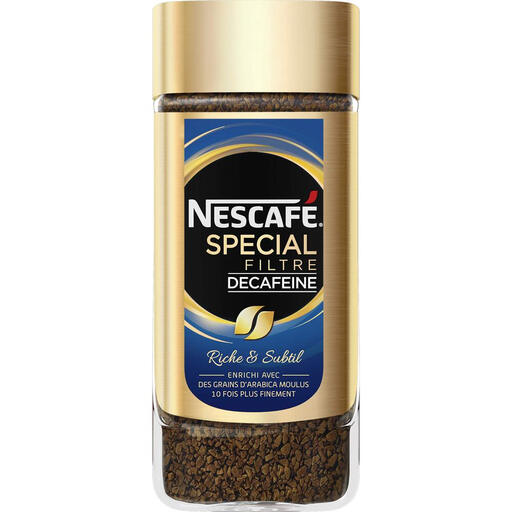 Image unavailable
A jar worth considering if you make decaffeinated coffee at home after a meal.
The product details state that this is decaffeinated instant coffee made from coffee alone. If flavour or your sensitivity to caffeine is a deciding factor, check the information on the packaging.
Look for the word ‘decaffeinated’ on the specific product, then read its name and ingredients. A mild taste or sachet packaging doesn’t mean the coffee is decaffeinated.
Not necessarily: check the ingredients of the product you’re choosing. Some products described by Auchan and Carrefour are made from decaffeinated coffee alone, while other types of instant drink may contain additional ingredients.
Follow the instructions for the product you’ve bought. NESCAFÉ recommends one teaspoon per 100 ml of hot water for its Spécial Filtre Décaféiné; the product page for Maxwell House Qualité Filtre Décaféiné recommends one sachet with around 100 ml of water just off the boil.
Close the jar after use and follow the instructions on the packaging. Product information for several varieties recommends storing the coffee in a dry place, away from heat and moisture.
No, it can’t predict how you’ll personally react. Anses notes that sensitivity to caffeine varies from person to person. If you’ve been given medical advice about your caffeine intake, check the label and speak to the healthcare professional looking after you.