Travellers who fancy a coffee after dinner
If you’d like to limit your caffeine intake in the evening, look for ‘decaffeinated’ on the product. However, this doesn’t mean the coffee is completely caffeine-free.


For a decaffeinated coffee with a meal on the train, a sachet means there’s no need to measure out the powder, while a jar is more suitable if you’re planning several cups. Before packing instant coffee, check how you’ll get hot water: onboard services vary by train and route. Buying a drink on board avoids the preparation, provided decaffeinated coffee is available on your journey.
If you’d like to limit your caffeine intake in the evening, look for ‘decaffeinated’ on the product. However, this doesn’t mean the coffee is completely caffeine-free.
An individual sachet fits easily into a bag, so there’s no need to carry a jar and spoon for a one-off journey.
A 100 g jar lets you measure out several cups, as long as you can carry the container and have access to hot water.
Choose a format based on how many cups you plan to make, then check whether you’ll have access to hot water. If you’d rather buy a drink on board, check the services listed for your train.
Choose this: if you want to take one or two portions without measuring out the powder.
Bear in mind: you’ll still need hot water, even with an individual portion.
Choose this: if you’re planning to have several cups during your journey.
Bear in mind: you’ll need to carry the jar and measure out each serving with a spoon.
Consider this: if you don’t want to carry or prepare any powder.
Check first: according to SNCF Connect, catering varies by train and route, so decaffeinated coffee may not be available.
| What to consider | What to check | Who is it for? |
|---|---|---|
| Caffeine in the evening | Look for ‘decaffeinated’ in the product name; this doesn’t guarantee that it’s completely caffeine-free. | If I want a cup after dinner, I’d choose decaffeinated coffee rather than regular coffee. Around 33% of consumers put this first. |
| Portions to take with you | Check the number of sachets and the stated serving size, or how much room you’ll need for a jar and spoon. | If I’m only making one cup during the journey, I’d rather take a pre-portioned sachet. This is the top priority for around 27% of consumers. |
| What’s in the drink | Check the ingredients list to distinguish decaffeinated instant coffee from a mix containing other ingredients. | If I want to add my own milk or sugar, I’d look for plain decaffeinated coffee rather than a ready-mixed drink. Around 20% of consumers prioritise this. |
| Making your drink during the journey | Check the amount of water stated for the product and the services listed for your train. | Before packing powder, I’d want to know whether I could actually make a cup. Preparing a drink on board is the main concern for around 20% of consumers. |
This label doesn’t guarantee that your cup will contain no caffeine at all.
If you need to avoid every trace, ask the manufacturer for specific information rather than relying on the product name alone.
The preparation instructions from NESCAFÉ for Spécial Filtre Décaféiné and from Auchan for Maxwell House sachets call for hot water. SNCF Connect says that onboard services vary by train.
Check how to prepare your chosen product and what services are available on your journey before you set off.
Decaffeinated instant coffee and an instant mix containing ingredients such as milk or sugar won’t give you the same drink to customise.
Read the ingredients list if you want to add your own milk or sugar.
Whether a specific format is in stock may depend on the shop or the collection option you choose.
Check with your shop or chosen Drive collection service before relying on it for your journey.
NESCAFÉ offers Spécial Filtre Décaféiné in a 100 g jar; Carrefour states that this product makes 50 cups.
Carrefour offers decaffeinated instant coffee in 25 sachets of 2 g each.
E.Leclerc offers Plantation freeze-dried decaffeinated instant coffee in 25 sachets, weighing 50 g in total.
Auchan offers intense decaffeinated instant coffee in a 100 g jar, which is stated to make around 50 cups.
Auchan offers a filter-style decaffeinated instant coffee in a pack of 25 sachets.
This jar is suited to travellers planning to make several cups who can measure out their instant coffee during the journey. If you only need one cup, consider the space the container takes up and whether you’ll have access to hot water.
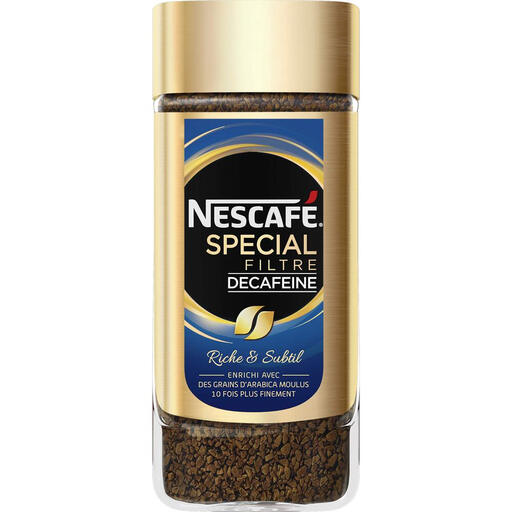 Image unavailable
Worth considering if you’re making several cups and don’t mind measuring out the powder with a spoon. The 100 g container is less convenient than a sachet for a single serving. Check the preparation instructions on the packaging and make sure you have hot water.
No. ‘Decaffeinated’ doesn’t mean there’s no caffeine at all. If you need to avoid every trace, ask the manufacturer for specific information.
It depends on the product. NESCAFÉ recommends 100 ml of hot water for one teaspoon of Spécial Filtre Décaféiné, while Auchan’s product information for Maxwell House sachets specifies around 100 ml of just-boiled water. Follow the instructions for the product you’re taking with you.
Not without checking your journey first. SNCF Connect says that catering varies by train and route. Decaffeinated coffee appearing on a menu doesn’t mean it’ll be available on every train.
Keep sachets sealed until you’re ready to use them, and close the jar carefully after measuring out the powder. Auchan’s product information for Maxwell House sachets says to store them away from heat and humidity.