Busy mornings at home
If you make your coffee before heading out, a jar lets you measure the coffee straight into your cup. NESCAFÉ France and Auchan list 100 g jars of decaffeinated coffee, with instructions to prepare it using hot water.


For a regular cup at home, a jar of decaffeinated instant coffee lets you measure out the powder yourself. If you have breakfast away from home, sachets mean you don’t need to take the jar and a spoon with you. If you’d also like to drink it in the evening, check that the product you choose is labelled ‘decaffeinated’, but don’t assume this means it contains no caffeine at all.
If you make your coffee before heading out, a jar lets you measure the coffee straight into your cup. NESCAFÉ France and Auchan list 100 g jars of decaffeinated coffee, with instructions to prepare it using hot water.
If you’d like to reduce your caffeine intake in this cup, the ‘decaffeinated’ label matters more than a description of its flavour intensity. However, it doesn’t mean the coffee contains no caffeine at all.
An individual portion is easy to carry, with no jar or measuring spoon needed. Auchan and E.Leclerc each list a box of 25 sachets of decaffeinated instant coffee.
If you want to drink the same coffee in the morning and evening, first check that it’s labelled decaffeinated. Then choose the packaging to suit where you’ll be making your cup.
| What to consider | What to check | Who is it for? |
|---|---|---|
| Caffeine in your evening cup | Look for the word ‘decaffeinated’ on the specific product. In France, Decree No. 2001-977 of 26 October 2001, published by Légifrance, sets a limit of 0.3% anhydrous caffeine in the coffee-derived dry matter for coffee extracts bearing this label. It does not mean there is no caffeine. | If I also drink coffee after dinner, my main priority is to reduce the caffeine in that cup. Around 42% of consumers reportedly make this their priority. |
| Preparation and format | Compare the recommended amount and choose between a jar you measure from and pre-portioned sachets. NESCAFÉ France recommends one teaspoon per 100 ml of hot water for its Spécial Filtre Décaféiné; Auchan lists 25 sachets in its portioned format. | Before heading to work or when I have breakfast elsewhere, I’m mainly looking for a format that suits where I’ll be making my cup. This convenience is reportedly a priority for around 25% of consumers. |
| Recipe and stated flavour | Read the ingredients and the details for each specific product. NESCAFÉ France describes its Spécial Filtre Décaféiné as an Arabica-Robusta blend; Auchan gives its coffee an intensity rating of 6/10, which isn’t a scale shared by all brands. | I want to keep a flavour profile I enjoy when switching to decaffeinated coffee, without assuming that intensity ratings can be compared from one brand to another. Taste is reportedly the top priority for around 33% of consumers. |
For coffee extracts in France, the limit set by Decree No. 2001-977 of 26 October 2001, published by Légifrance, does not mean that the product contains no caffeine at all.
If you need to avoid caffeine completely, check the information for the specific product and speak to a healthcare professional who knows your circumstances.
The Carrefour Extra product page says it’s unavailable for Drive collection, while E.Leclerc’s Plantation page states that its sachets aren’t sold on the website.
Check availability with the store, Drive service or E.Leclerc centre where you plan to shop.
Auchan gives the relevant products a rating of 6/10, while NESCAFÉ France describes the profile of its Spécial Filtre Décaféiné differently. The information provided here doesn’t use a shared scale.
Use each product’s ingredients and description to find something you’d like to try. Don’t assume one brand will necessarily taste stronger than another.
A preparation containing other ingredients may not be the same as a cup of black coffee that you measure and customise yourself.
If you’re looking for decaffeinated instant coffee only, check the product description and ingredients list.
NESCAFÉ France offers Spécial Filtre Décaféiné in a 100 g jar, describing it as an Arabica-Robusta blend decaffeinated using water.
Auchan offers freeze-dried decaffeinated instant coffee in a 100 g jar and a box of 25 sachets.
Carrefour offers a 100 g jar of freeze-dried decaffeinated instant coffee.
E.Leclerc offers Plantation freeze-dried decaffeinated instant coffee in a box of 25 2 g sachets.
The Carte Noire range includes decaffeinated espresso capsules, which are different from instant coffee.
This jar is suited to making coffee at home. It’s a good choice if you like to measure out each cup to suit your preferences, rather than take an individual portion with you.
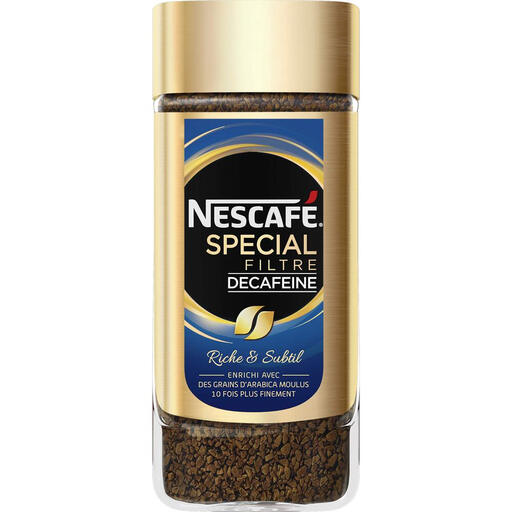 Image unavailable
A jar is worth considering if you regularly make a cup at home and want to measure out the coffee yourself.
Stated net weight: 100 g. If you’re having a cup in the evening, remember that ‘decaffeinated’ doesn’t mean completely caffeine-free.
No. For coffee extracts in France, Decree No. 2001-977 of 26 October 2001, published by Légifrance, allows this label when anhydrous caffeine makes up no more than 0.3% of the coffee-derived dry matter. This limit doesn’t guarantee that the coffee contains no caffeine.
A jar is a good choice if you usually make your cup at home and want to measure out the powder with a spoon. Sachets are more convenient if you take a portion to work or on the go. For its portioned format, Auchan recommends one sachet per cup.
Follow the instructions for the product you choose. NESCAFÉ France recommends hot water for Spécial Filtre Décaféiné, while Auchan says to use hot, but not boiling, water for its decaffeinated sachets.
No, not if you want to make it directly in a cup. Carte Noire offers different formats, including capsules compatible with Nespresso Original and soft coffee pods, so you’ll need the corresponding preparation system.