For an evening cup, choose an instant coffee clearly labelled ‘decaffeinated’. A jar lets you measure out each cup at home, while sticks are ideal if you prefer a ready-portioned serving. Decaffeinated does not necessarily mean caffeine-free, so if you’re particularly sensitive, take your other sources of caffeine into account too. For click and collect, check the format and availability at your chosen store.
Who are these formats for?
People who drink coffee in the evening
You’d like to keep a cup of coffee in your evening routine while cutting down on caffeine. France’s food safety agency, ANSES, notes that caffeine can disrupt sleep; however, ‘decaffeinated’ does not guarantee that a product is completely caffeine-free.
Households that regularly make decaf
You measure out your coffee with a spoon and want a container that suits how often you drink it. Carrefour lists a 100 g NESCAFÉ jar, while E.Leclerc stocks a 200 g Plantation jar, subject to local availability.
People who prefer individual portions
For the occasional cup at work or while travelling, you’d rather not measure out the powder. Auchan lists boxes of 25 decaffeinated sticks; check the preparation instructions for the product you choose.
What should you look for?
First, distinguish decaffeinated instant coffee from a drink mix containing other ingredients. Then choose between the flexibility of a jar and the pre-measured portion in a stick, and check which formats your chosen click-and-collect store offers.
| What to consider |
What to check |
Who it’s for |
| Caffeine in the evening |
The ‘decaffeinated’ label and the ingredients list. |
I want to enjoy a cup of coffee in the evening without accidentally choosing regular instant coffee; around 42% of consumers reportedly put reducing caffeine at the top of their list. |
| Portion size |
The number of sticks or, for a jar, the preparation instructions. |
When I make a cup away from home, a pre-measured portion saves me from having to measure out the powder. Ease of preparation is reportedly the main priority for around 33% of consumers. |
| Format and click and collect |
The container’s weight, the stated number of cups and availability through your chosen collection service. |
If I regularly make decaf at home, I want a format that suits my routine and is stocked at my local store; around 25% of consumers reportedly prioritise their choice of format. |
Mistakes to avoid
-
Confusing ‘decaffeinated’ with ‘caffeine-free’
The label ‘decaffeinated’ does not promise that a product contains no caffeine at all. This distinction matters especially if you’re sensitive to caffeine, including when you drink coffee in the evening.
Choose a product clearly labelled ‘decaffeinated’ and take your other sources of caffeine into account rather than relying on this cup alone.
-
Comparing containers without considering how you’ll use them
A 100 g jar, a 200 g jar and a box of sticks won’t suit the same coffee-making routine. The stated number of cups also depends on the product and the recommended serving size.
Check the net weight, the stated number of servings and how much you expect to make once the container is open.
-
Assuming a product listing means it’s available for click and collect
The Carrefour Extra listing says its decaffeinated product is unavailable for click and collect. E.Leclerc advises checking local availability for the Plantation jar.
Select your store before completing your shop, then check the product and format shown.
-
Choosing sticks when you don’t need pre-measured portions
Sticks save you measuring out the powder, but each portion is a fixed size. A jar gives you more flexibility when making a cup at home.
Choose sticks when a ready-to-use portion is genuinely useful; if you’re deciding between two products, compare their preparation instructions.
Each stick has its own packaging, which is worth bearing in mind if you use them often.
Brands and products to consider
These products show some of the different formats available for decaffeinated instant coffee. Being listed in a retailer’s catalogue doesn’t guarantee that a product will be available through your local click-and-collect service.
NESCAFÉ
The Special Filter Decaf range is available in a 100 g jar and individual sachets at selected retailers.
- Carrefour says the 100 g jar contains 100% decaffeinated instant coffee and makes around 50 cups.
- For sachets, check the quantity and preparation instructions for the box you choose.
AUCHAN
Auchan lists freeze-dried decaffeinated instant coffee in a 100 g jar, as well as a box of 25 sticks weighing 50 g in total.
- The jar listing states that it makes around 50 cups and gives it an intensity rating of 6/10.
- The intensity rating doesn’t tell you how much residual caffeine the coffee contains.
PLANTATION (Marque Repère E.Leclerc)
E.Leclerc lists a 200 g jar of freeze-dried decaffeinated coffee, worth considering if this size suits how much you drink at home.
- The 200 g pack lets you compare a larger jar with 100 g formats.
- E.Leclerc advises checking availability with your local store or click-and-collect service.
Maxwell House
Auchan lists Maxwell House decaffeinated instant coffee in a box of 25 individual sticks.
- The listing recommends one stick per cup, made with around 100 ml of hot, near-boiling water.
- This format doesn’t let you adjust the amount of powder as freely as a jar does.
Carrefour Extra
The Carrefour Extra listing describes 100 g of freeze-dried decaffeinated instant coffee.
- The ingredients list states that it contains freeze-dried decaffeinated instant coffee.
- The listing marks the product as unavailable for click and collect, so check with your local store before adding it to your shopping list.
A jar option on Joybuy
This jar of decaffeinated instant coffee is suited to making coffee at home, with the flexibility to adjust the amount of powder. If you shop using a click-and-collect service, check the options available for your order separately.
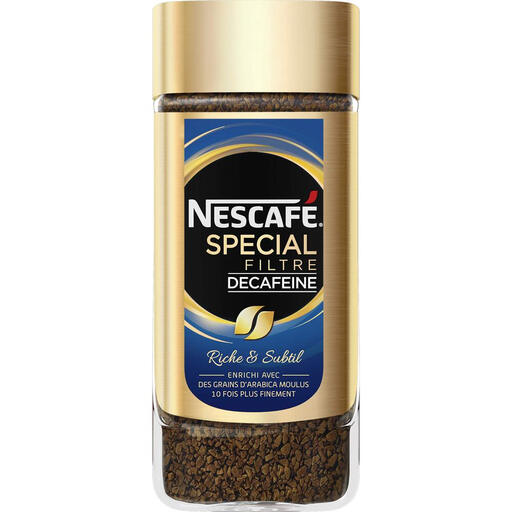 Image unavailable
NESCAFÉ Decaffeinated filter coffee 100 g
A jar to consider if you make decaffeinated coffee at home and prefer to measure out the powder yourself.
Size: 100 g. The Joybuy listing describes it as 100% soluble decaffeinated instant coffee; this does not mean it is entirely caffeine-free.
View on Joybuy
Frequently asked questions
Is decaffeinated instant coffee completely caffeine-free?
No. ‘Decaffeinated’ doesn’t guarantee that a product contains no caffeine at all. The European directive on coffee extracts regulates the use of this label for the products it covers. If caffeine content is important to you, don’t assume that ‘decaffeinated’ means ‘caffeine-free’.
Is decaffeinated coffee suitable for an evening cup?
Decaffeinated instant coffee is an option if you want to reduce the caffeine in your evening cup, though the effect won’t be the same for everyone. ANSES says caffeine can delay falling asleep and reduce both sleep duration and quality. Your sensitivity and other sources of caffeine are also worth considering.
Should you prepare a jar and sticks in the same way?
No. Follow the instructions for the product you’ve bought. NESCAFÉ recommends one teaspoon of its Special Filter Decaf with 100 ml of hot water, while Auchan’s decaffeinated sticks listing says to use hot, non-boiling water.
Will a product listed in a catalogue be available through my click-and-collect service?
Not necessarily. Check availability after selecting your store and the format you want. The Carrefour Extra listing marks its decaffeinated product as unavailable for click and collect, while E.Leclerc advises checking local availability for the Plantation jar.


