Evening coffee drinkers
If you want to keep the taste of coffee while reducing your caffeine intake compared with your usual coffee, look for the word ‘decaffeinated’. An intensity rating describes the flavour profile, not the caffeine content.


For an evening cup, first choose an instant coffee clearly labelled ‘decaffeinated’, then pick a format to suit how much you drink: a jar for a regular supply, or sticks for individual portions. ‘Decaffeinated’ doesn’t mean completely caffeine-free. If you’re looking for pure coffee, also make sure you distinguish it from coffee-and-milk drinks.
If you want to keep the taste of coffee while reducing your caffeine intake compared with your usual coffee, look for the word ‘decaffeinated’. An intensity rating describes the flavour profile, not the caffeine content.
If you make decaffeinated coffee regularly, compare the net weight and, where stated, the number of cups. Check the storage instructions too before choosing a large jar.
Pre-measured sticks make it easy to take individual portions with you, without opening a jar every time you make a cup. However, check whether they contain pure instant coffee or a drink mix with other ingredients.
For a supply of coffee for evening cups, first check the product name and ingredients, then choose the flavour and format that suit your habits.
| What to consider | What to check | Who it suits |
|---|---|---|
| Caffeine for the evening | Look for the word ‘decaffeinated’ and distinguish pure instant coffee from drinks made with other ingredients. The label does not guarantee zero caffeine. | For my evening cup, I want to reduce my caffeine intake without confusing decaffeinated with completely caffeine-free. Reducing caffeine would be the top priority for around 44% of consumers. |
| Flavour profile | Check the stated intensity, if there is one, but don’t use it to compare the caffeine content of different products. | I want a sufficiently full coffee flavour, even when I choose decaffeinated. Flavour profile would come first for around 33% of consumers. |
| Format and storage | Compare the net weight, the stated number of cups and the storage instructions. Choose between a jar and sticks according to how often you use them. | If I rarely make decaffeinated coffee or want to take portions with me, I don’t want to open a large jar that I’ll use slowly. Format would be the main consideration for around 23% of consumers. |
French Decree No. 2001-977 of 26 October 2001, published by Légifrance, sets a maximum of 0.3% anhydrous caffeine in the dry matter derived from coffee for the coffee extracts it covers. So the term ‘decaffeinated’ does not guarantee zero caffeine.
Check the product name on the packaging. If you need to avoid caffeine completely for medical reasons, ask a healthcare professional for advice.
A 200 g jar is best suited to fairly regular use, so you can make the most of its larger size. Once opened, following the storage instructions also helps preserve the flavour.
If you only make a few cups, consider a smaller format or sticks. Close the jar tightly and follow the storage instructions on the packaging.
An intensity rating, such as the 6/10 shown for Auchan decaffeinated instant coffee, indicates the flavour profile presented for that particular product. It doesn’t measure caffeine and isn’t a standard scale shared by all brands.
Use the intensity rating to guide your choice of flavour, and look for the word ‘decaffeinated’ to identify the type of coffee you want.
These products show the formats and details to compare when choosing decaffeinated instant coffee for your cupboard. Their inclusion here does not guarantee they’re available in your local shop.
Spécial Filtre Decaffeinated is available in a 100 g jar; Carrefour states that this product makes 50 cups.
The retailer offers 100 g of freeze-dried decaffeinated instant coffee, with around 50 cups stated.
E.Leclerc offers a 200 g jar of freeze-dried decaffeinated instant coffee, worth considering if you use it regularly.
Carrefour offers decaffeinated instant coffee in a jar, as well as a pack of 25 sticks, each containing 2 g.
The NESCAFÉ jar is a good fit if you’re looking for decaffeinated instant coffee to keep in the cupboard. AGF Blendy sticks are a decaffeinated milk coffee drink mix, so they’re different from pure instant coffee when you’re choosing portions.
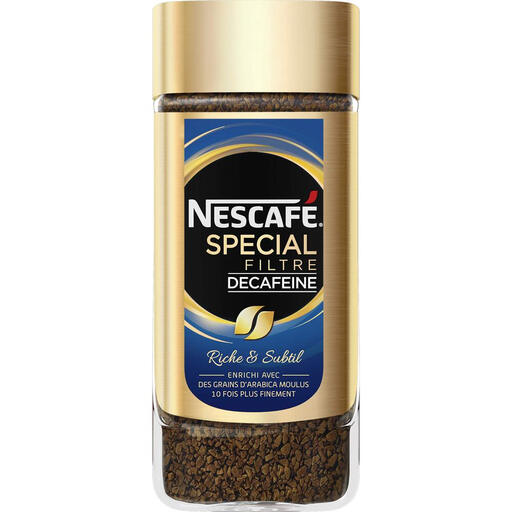 Image unavailable
A 100 g format to consider if you want to keep decaffeinated coffee in the cupboard and make cups at home.
If the number of cups per jar or the intensity matters to you, check these details for this specific product.
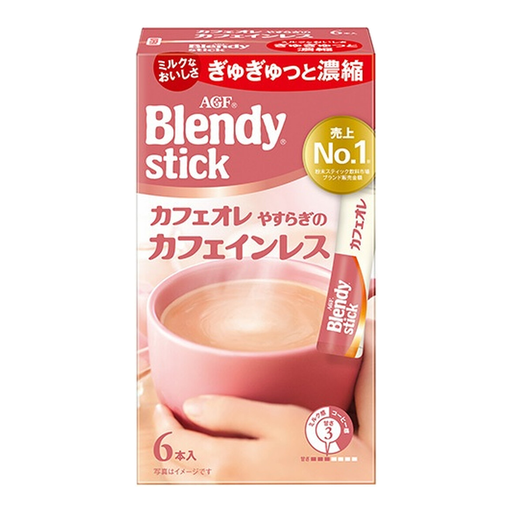 Image unavailable
The six sticks are handy for individual portions, but this milk coffee drink is not pure instant coffee.
The mix contains dairy ingredients, sugar and sweeteners. If it matters to you whether the coffee used is decaffeinated or how much is in each stick, check these details on the label.
No. This label does not guarantee that the product is completely caffeine-free. French Decree No. 2001-977 of 26 October 2001, published by Légifrance, sets a limit of 0.3% anhydrous caffeine in the dry matter derived from coffee for the coffee extracts it covers.
Choose according to how many cups you make and whether you want to take portions with you. Carrefour states that the 100 g NESCAFÉ Spécial Filtre Decaffeinated jar makes 50 cups. A 200 g jar is better suited to regular use, while sticks make it easier to measure individual portions. Always check the details for the product you choose.
Close it after use and follow the instructions on the packaging. The Auchan and Carrefour product listings consulted recommend keeping the relevant products in a dry place, away from moisture or heat.
No. The intensity rating helps you choose a flavour profile; it does not measure caffeine. To find decaffeinated instant coffee, check the product name and ingredients rather than relying on an intensity rating.