People who enjoy coffee in the evening
You can keep this part of your routine while reducing your usual caffeine intake. However, a decaffeinated pod isn’t guaranteed to be completely caffeine-free.


To make evening coffee with a soft-pod machine, first choose a product labelled ‘decaffeinated’ and check that it’s compatible with your machine. The number of pods and the flavour profile can then help you compare products, but the intensity rating won’t tell you how much caffeine remains. Anses notes that caffeine’s effects on sleep vary from person to person.
You can keep this part of your routine while reducing your usual caffeine intake. However, a decaffeinated pod isn’t guaranteed to be completely caffeine-free.
If you have a Senseo machine or one that explicitly accepts soft pods, check the format before comparing blends. A hard capsule from another system won’t fit your pod holder.
If you drink decaffeinated coffee in moderation, a pack of 36 or 40 pods lets you try a blend before buying more. Check the storage instructions for the product you choose.
For evening coffee, start with the ‘decaffeinated’ label and make sure the format is right for your machine. Then choose a pack size to suit how much you drink, and compare the blend and intensity details.
| Criteria | What to check | Who is it for? |
|---|---|---|
| Caffeine for evening drinking | The ‘decaffeinated’ label on the exact product; the caffeine content per cup if you need to know the amount. | For my evening coffee, I want to reduce my usual caffeine intake without mistaking decaffeinated for completely caffeine-free. Around 40% of consumers would make this their priority. |
| Compatibility | The ‘Senseo compatible’ or ‘soft pods’ label, and whether it matches the format accepted by your machine. | My machine uses soft pods, so I want to avoid buying a pack of hard capsules that I can’t use. Around 30% of consumers would put compatibility ahead of other criteria. |
| Pack size | The number of pods, the net weight and the storage instructions after opening. | If I’m trying a new blend, I’d rather choose an amount I can use without leaving the pack open for too long. Around 20% of consumers would prioritise pack size. |
| Blend and stated method | The coffee blend, the stated intensity and, if it matters to you, the ‘solvent-free’ label. | I’m looking for a flavour profile I enjoy, or a clearly stated decaffeination method, without using the intensity rating to guess how much caffeine remains. Around 10% of consumers would make this their first priority. |
A higher intensity describes the flavour profile, not the amount of caffeine left in a cup of decaffeinated coffee.
First, look for the ‘decaffeinated’ label. Then use the intensity rating to guide your choice of flavour. If you need a specific caffeine amount, check the packaging or contact the manufacturer.
Even if you like the coffee, you won’t be able to use it if the packaging format doesn’t fit your machine’s pod holder.
Before choosing a brand, check the format on the pack against the one your machine accepts.
A larger number of pods isn’t necessarily practical if you’re trying a blend or don’t drink this coffee often.
Compare the number of pods and the net weight, then read the storage instructions for after opening before stocking up.
According to Anses, the effects of caffeine vary from person to person and depend on factors including their circumstances. The ‘decaffeinated’ label alone doesn’t tell you how much caffeine is in a cup or whether it’s suitable for an individual medical need.
If you need to know exactly how much caffeine you’re consuming, ask the manufacturer for information about the product and seek health advice suited to your circumstances.
The Senseo range includes Decaffeinated soft pods, which Senseo France describes as a blend of Arabica and Robusta with a balanced, rounded flavour profile.
A decaffeinated soft-pod product that’s compatible with Senseo is available in a pack of 36 pods. Its Carrefour listing states that it’s 100% Arabica, with an intensity rating of 5.
Auchan describes its decaffeinated Classico soft pods as intensity 4, made with 100% Arabica coffee and decaffeinated without solvents.
Carrefour Sensation’s decaffeinated coffee comes in a pack of 36 pods, with a net weight of 250 g.
E.Leclerc describes its Plantation roasted, ground and decaffeinated coffee as coming in 36 soft pods, weighing 250 g.
This selection features decaffeinated coffee pods compatible with a Senseo soft-pod machine, for making coffee in the evening.
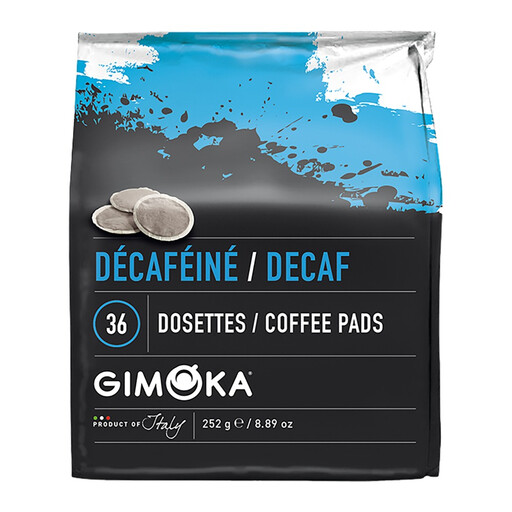 Image unavailable
An option to consider if your machine accepts soft pods compatible with Senseo and you’re looking for decaffeinated coffee for the evening.
The pack contains 36 pods and weighs 252 g. To find out how much caffeine remains or which decaffeination method is used for this product, check the packaging or contact the manufacturer.
They may suit your wish to reduce your usual caffeine intake in the evening, but they’re not guaranteed to be completely caffeine-free. Anses says caffeine can disrupt sleep and that its effects vary from person to person. If you need to know a specific amount, check the details of the product you’ve chosen.
No. The stated intensity is a guide to the flavour, not a measure of how much caffeine remains per cup. When choosing decaffeinated coffee, check the label on the specific product rather than relying on its intensity rating alone.
No. They’re designed for machines that accept the stated compatible soft-pod format, including the relevant Senseo models. Check the format your machine accepts and the label on the pack: a hard capsule belongs to a different system.
Follow the storage instructions for the product you’ve bought. Auchan recommends resealing its pack after opening, while Carte Noire advises keeping its pack in a cool, dry place.