For a caffeine-free break
You’d like a spiced drink after lunch, and perhaps in the evening too. A chai infusion whose ingredients confirm it’s caffeine-free is a better fit for this priority than an ordinary black tea chai.


If your priority is avoiding caffeine after lunch or in the evening, choose a chai infusion whose label confirms that it’s caffeine-free. If you want a black tea base, look for chai that’s explicitly labelled decaffeinated: the word ‘chai’ alone isn’t enough, and a classic black chai won’t meet this need. For a quick break at work, check the preparation method and ingredient list too.
You’d like a spiced drink after lunch, and perhaps in the evening too. A chai infusion whose ingredients confirm it’s caffeine-free is a better fit for this priority than an ordinary black tea chai.
You’re looking for the character of a black tea masala chai, but want a decaffeinated version. Check that the blend you choose is specifically labelled decaffeinated rather than relying on the word ‘chai’.
You read the ingredients and warnings before choosing, particularly if you drink this type of beverage regularly. Some chai blends contain liquorice; the Anses warns against high, repeated consumption of products containing it.
Choose this if: avoiding caffeine matters more to you than having a black tea base, especially for an evening drink.
Bear in mind: a herbal or rooibos blend won’t necessarily have the same flavour profile as a black tea chai.
Choose this if: you want to keep a black tea base and are looking for a version explicitly labelled decaffeinated.
Bear in mind: ‘decaffeinated’ doesn’t mean ‘caffeine-free’, so check the exact product description.
Whether you’re taking a break at work or having a drink in the evening, start with your main priority, then check the recipe and format to find the right fit.
| Criterion | What to check | Who it’s for |
|---|---|---|
| Caffeine-free | Check the blend’s base and look for the words ‘caffeine-free’. For black tea, look for ‘decaffeinated’ and don’t confuse the two descriptions. | If I want to drink my chai in the evening too, I prioritise a recipe labelled caffeine-free. Around 36% of consumers put this first. |
| Black tea base | Look for black tea in the ingredients and check that the blend is explicitly labelled decaffeinated. | I want a black tea-based drink rather than a herbal infusion, without accidentally choosing a regular black chai. This is the top priority for around 29% of consumers. |
| Preparing it at work | Compare tea bags and loose tea based on the hot water and accessories available to you. | When I’m taking a quick break, I’d rather make a cup without needing to bring an infuser. For around 21% of consumers, ease of preparation comes first. |
| Ingredients | Read the ingredient list and warnings, particularly to check for liquorice. | If I drink this blend regularly or want to avoid a particular ingredient, I want to know what’s in it before buying. Around 14% of consumers put this first. |
Chai may contain black tea: for example, Kusmi Tea lists Indian black tea in its Tchaï of the Tiger blend.
For a caffeine-free infusion, check that this is confirmed for the blend you choose. If you want a black tea base, look for the word ‘decaffeinated’.
Some chai blends contain liquorice. According to the Anses, high, repeated consumption of products containing it can lead to health problems, including high blood pressure.
Check the product’s ingredient list and warnings, especially if you plan to drink it often.
If you only have a mug and hot water at work, loose tea means an extra preparation step.
Check what equipment you have before choosing a format; tea bags mean you don’t have to measure out the blend.
Loose tea may require an infuser or strainer.
The range makes it easy to distinguish a black tea chai from a rooibos infusion, which Kusmi Tea describes as caffeine-free.
Pukka lists chai blends among its caffeine-free infusions; a Vanilla Chai infusion is also available in tea bags under this name.
Tealyra lists a blend called Decaf Masala Chai, which is worth considering if you’re looking for chai explicitly labelled decaffeinated.
MaxiCoffee lists a 100 g loose-leaf Rooibos Chaï from Dammann Frères.
This PUKKA chai infusion in tea bags is easy to prepare at work. If caffeine-free is essential for you, check this on the packaging of the recipe you choose.
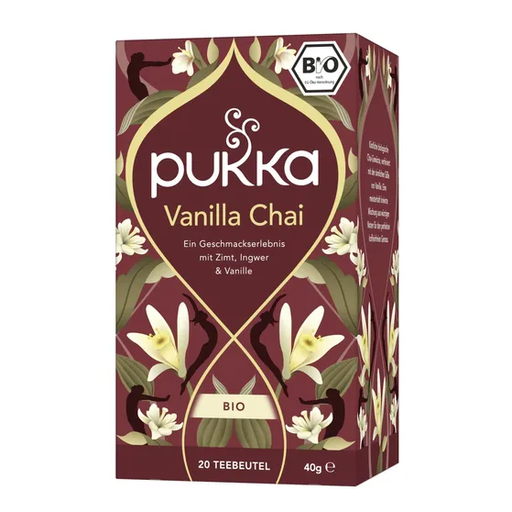 Image unavailable
A tea bag format to consider if you make your chai at work with just a mug and hot water.
If you’d also like to drink it in the evening, check the ingredients and caffeine information on the packaging.
No, the word ‘chai’ doesn’t guarantee that a drink is caffeine-free. Kusmi Tea’s Tchaï of the Tiger contains black tea; if you want a different option, look for an infusion labelled caffeine-free or a blend explicitly labelled decaffeinated.
If you want to avoid caffeine, look for a chai infusion whose label confirms that it’s caffeine-free. The Anses says caffeine can delay falling asleep and reduce the length and quality of sleep, so don’t assume this from the blend’s name alone.
Yes, especially if you plan to drink it regularly: some chai blends contain liquorice. The Anses warns that high, repeated consumption of products containing liquorice can lead to hypokalaemia and high blood pressure. Read the ingredients and warnings for the product you choose.
Start with the product description and ingredient list to identify the blend’s base and any ingredients that matter to you. The DGCCRF says that pre-packed food labels include this information, as well as a nutrition declaration; also check any caffeine-related information on the specific product.