For a late-afternoon meeting, choose instant coffee clearly labelled “decaffeinated”, then pick a format to suit how you’ll serve it: a jar if breaks are regular and someone can measure out each cup, or sticks for individual portions at occasional meetings. Decree No. 2001-977 of 26 October 2001, published on Légifrance, sets a residual caffeine limit for this label on coffee extracts. So “decaffeinated” does not mean “caffeine-free”.
Who is this option for?
People organising late-afternoon meetings
You’d like to offer coffee at a late break without serving only the regular version. Anses says caffeine can delay falling asleep and reduce sleep duration and quality; sensitivity varies from person to person.
Teams without a coffee machine in the room
You want to make each cup with hot water, using either a jar or a stick. NESCAFÉ, E.Leclerc and Auchan offer decaffeinated instant coffee in these formats.
Guests who care about the taste of their coffee
You compare intensity ratings and serving suggestions before choosing. An intensity rating from Auchan or for a NESCAFÉ product does not measure residual caffeine, and it isn’t a standard scale shared by all brands.
What should you look for in a meeting coffee?
Start by thinking about when the coffee will be served, then estimate how many cups you’ll need and how often meetings take place. You can choose the format and serving size to suit your plans.
| Criteria |
What to check |
Who it’s for |
| Caffeine late in the day |
Check the “decaffeinated” label and the product description for instant coffee. Don’t assume it contains no caffeine at all. |
If the break runs into the evening, I want to offer an alternative to regular coffee without claiming it’s caffeine-free; around 50% of consumers are said to prioritise reducing caffeine. |
| Easy serving |
Compare the number of portions, the recommended serving size and the storage instructions after opening. |
When several cups need to be made without a coffee machine, I want a format that’s easy to share among the group. Ease of use is said to be the top priority for around 30% of consumers. |
| Taste profile |
Read the intensity rating for each product and try the recommended serving size. |
To make sure the coffee suits the group, I want to be able to choose the stated taste profile rather than just the format; around 20% of consumers are said to put this first. |
Mistakes to avoid
-
Assuming “decaffeinated” means “caffeine-free”
For coffee extracts, Decree No. 2001-977 of 26 October 2001, published on Légifrance, sets the “decaffeinated” limit at no more than 0.3% anhydrous caffeine in the dry matter derived from coffee. This limit does not mean there is no caffeine at all.
Check the product description on the pack. The word “decaffeinated” alone doesn’t mean the coffee is entirely caffeine-free.
-
Choosing a format without planning how you’ll serve it
A jar means measuring out each cup and closing the container again; sticks provide individual portions. The number of cups stated for a jar isn’t the same as the number of sticks in a pack.
Estimate the number of participants and how often you’ll serve coffee, then compare the portion counts for the products you’re considering.
A poorly chosen format can leave you with unused portions or make serving more difficult if there isn’t enough for all the cups you need.
-
Taking the intensity rating as a measure of caffeine
The intensity ratings shown by Auchan for its decaffeinated instant coffee and for a NESCAFÉ product are product-specific guides. They don’t measure residual caffeine or provide a standard taste scale across all brands.
Use the rating as a starting point, then prepare a cup using the recommended serving size before a meeting where taste matters particularly.
-
Relying on a product without checking local availability
E.Leclerc’s product pages for the PLANTATION formats advise customers to check availability with their local store or drive-through collection service.
Check that the product and format are available at your chosen store or collection point before the meeting.
Brands to consider by format
NESCAFÉ
NESCAFÉ offers its Spécial Filtre Décaféiné in a 100 g jar; Auchan also lists a 200 g version.
- For the product it features, NESCAFÉ recommends one teaspoon per 100 ml of hot water and describes it as a water-decaffeinated Arabica/Robusta blend.
- The intensity rating of 7 shown by Auchan for the 200 g format isn’t enough on its own to compare its taste or residual caffeine with another brand’s coffee.
Maxwell House
JDE Professional offers Maxwell House Qualité Filtre Décaféiné in a 200 g jar and a box of 25 sticks.
- These two formats let you compare serving coffee from a jar with individual portions for a meeting.
- JDE Professional’s descriptions of the flavour and aromas are the supplier’s own claims, not an independent taste comparison.
AUCHAN
Auchan offers 100 g of freeze-dried decaffeinated instant coffee, said to make around 50 cups, with an intensity rating of 6/10.
- Auchan’s product page lists freeze-dried decaffeinated instant coffee as the ingredient and recommends one to two teaspoons with hot, non-boiling water.
- The stated number of cups depends on the serving size you choose; the intensity rating doesn’t measure residual caffeine.
PLANTATION (Marque Repère E.Leclerc)
E.Leclerc offers PLANTATION freeze-dried decaffeinated instant coffee in a 200 g jar and in 25 sticks weighing 50 g in total.
- These formats let you choose between a container you measure from and individual portions.
- E.Leclerc’s pages advise checking availability with the relevant store or collection point.
Decaffeinated instant coffee for serving from a jar
This 100 g format may suit regular breaks where cups are made individually. Plan how much to use and remember to close the container after serving.
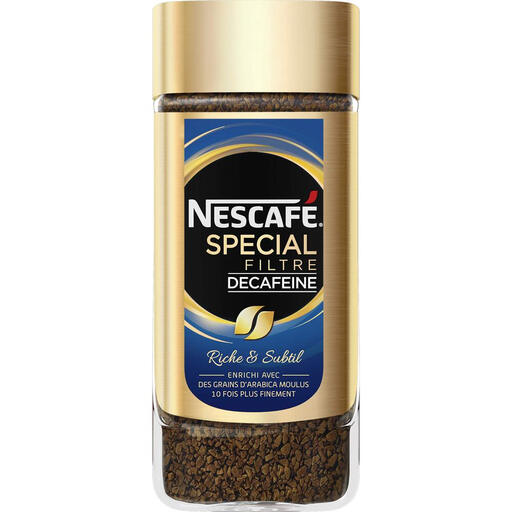 Image unavailable
NESCAFÉ Decaf Filter Coffee 100 g
For a meeting where you need to make several cups, this 100 g decaffeinated coffee is suitable for serving one cup at a time. Check the serving instructions on the pack and close the container after use; “decaffeinated” doesn’t mean it contains no caffeine at all.
View on Joybuy
Frequently asked questions
Is decaffeinated instant coffee completely caffeine-free?
No. For coffee extracts, Decree No. 2001-977 of 26 October 2001, published on Légifrance, sets a limit of 0.3% anhydrous caffeine in the dry matter derived from coffee for the “decaffeinated” label. So this label doesn’t guarantee that the coffee contains no caffeine.
How much decaffeinated instant coffee should I use for several people?
Follow the instructions for the product you choose rather than using the same amount for every coffee. For its Spécial Filtre Décaféiné, NESCAFÉ recommends one teaspoon per 100 ml of hot water. Making a cup before serving gives you a chance to check whether that amount suits the group.
Jar or sticks: which should I choose for a meeting break?
A jar works well for regular serving if someone can measure out the coffee and close the container again; sticks make it easier to hand out individual portions at occasional breaks. E.Leclerc offers PLANTATION decaffeinated coffee in both formats, including a box of 25 sticks and a 200 g jar.
Can intensity ratings be used to compare all decaffeinated coffees?
No. Treat the rating as specific to that product, not as a standard measure of taste or residual caffeine. Auchan gives its decaffeinated instant coffee an intensity rating of 6/10 and lists a decaffeinated NESCAFÉ with a rating of 7; these figures alone aren’t enough to decide which cup you’ll prefer.


