Hosts who are mindful of caffeine in the evening
If your guests prefer to limit their caffeine intake later in the day, ‘decaffeinated’ is the first thing to look for. However, it doesn’t mean the drink is completely caffeine-free.


If you’re serving coffee in the evening and want to limit caffeine, choose instant coffee explicitly labelled ‘decaffeinated’, then pick a format that suits the number of cups you need to serve. A jar lets you adjust each cup, while sachets provide individual portions. Either way, check the recommended dose and flavour notes, and remember that ‘decaffeinated’ does not mean ‘caffeine-free’.
If your guests prefer to limit their caffeine intake later in the day, ‘decaffeinated’ is the first thing to look for. However, it doesn’t mean the drink is completely caffeine-free.
If you’re making instant coffee without a machine, check the pack size, the number of cups stated and the recommended amount per cup. This information can help you plan how to serve your guests.
If your guests have different tastes, the stated strength and blend description can help you choose a product. Make a cup according to the manufacturer’s instructions, then adjust the amount before serving everyone.
| Criteria | What to check | Who is it for? |
|---|---|---|
| Caffeine in the evening | Look for ‘decaffeinated’ on the product and in its ingredients list. A mild flavour tells you nothing about its caffeine content. | I want to offer a late-night coffee to guests who prefer to limit their caffeine intake. Around 40% of consumers may put this need at the top of their list of concerns. |
| Serving a group | Check the net quantity, the number of cups stated and the recommended amount per cup. | When several friends ask for coffee one after another, I want to make their cups without a machine or any complicated steps. This convenience may be the top priority for around 30% of consumers. |
| Flavour and strength | Check the stated strength and blend description, then follow the recommended amount for the product you choose. | I’m looking for a decaf that suits the group, without assuming a strength rating will guarantee that everyone likes it. Around 20% of consumers may prioritise this. |
| Packaging | Choose between a jar and sachets, and check the storage instructions once opened. | If everyone is making their own cup, or the coffee needs to last until your next get-together, I’ll focus on how easy it is to measure and store. This may be the top priority for around 10% of consumers. |
Decaffeinated coffee can still contain caffeine. Anses notes that caffeine’s effects on sleep vary from person to person.
For an evening get-together, look for a product explicitly labelled decaffeinated, but don’t promise your guests that it contains no caffeine at all.
A 100 g jar, a 200 g jar and a box of coffee sachets don’t contain the same amount of coffee, or necessarily the same number of portions.
Compare the net quantity with the stated number of cups and how often you have guests over.
A product listing doesn’t guarantee that the coffee is available at your store or for your chosen collection option. It’s particularly important to check the Carrefour Extra and PLANTATION listings.
Check local availability before planning what to serve, and have another decaf option in mind.
Recommended amounts and water volumes vary from product to product. For some of its products, Auchan specifically recommends using hot, but not boiling, water.
Follow the instructions on the pack and make a test cup so you can adjust the result before serving your guests.
The Spécial Filtre Décaféiné blend is available in a 100 g jar. NESCAFÉ describes it as a blend of Arabica and Robusta coffee decaffeinated using water.
Auchan offers decaffeinated instant coffee in a 100 g jar, as well as a box of 25 sachets weighing 50 g.
E.Leclerc lists PLANTATION freeze-dried decaffeinated instant coffee in a 200 g jar. It’s a format worth considering if you regularly serve decaf.
The listing for the 100 g jar describes it as freeze-dried decaffeinated instant coffee, to be prepared with 10 cl of hot, non-boiling water.
This 100 g product is an option if you’re looking for decaffeinated instant coffee to prepare by the cup for an evening with friends.
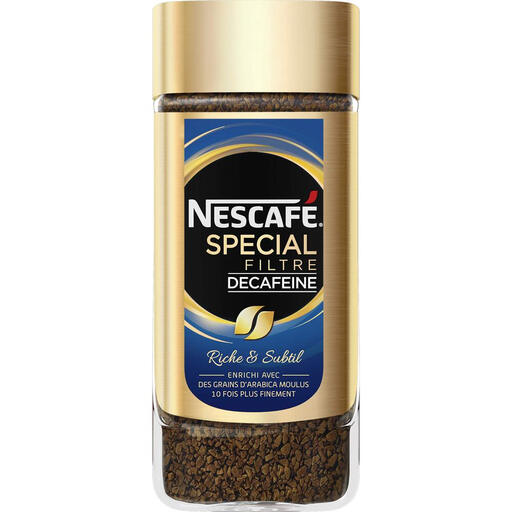 Image unavailable
An option to make by the cup if you’d like to serve decaffeinated instant coffee to your guests in the evening.
100 g pack. ‘Decaffeinated’ doesn’t mean every cup is completely caffeine-free.
Yes, it may contain a small amount: ‘decaffeinated’ doesn’t mean ‘caffeine-free’. If this matters to a guest, don’t assume you can work out how much caffeine they’ll have per cup from the label alone.
Follow the recommended amount and water volume for your chosen product, then make a test cup before your guests arrive. For its Spécial Filtre Décaféiné, NESCAFÉ recommends one teaspoon per 100 ml of hot water; Auchan’s instructions may differ.
A jar is a good choice if you want to adjust the amount for each cup yourself; sachets are more convenient for individual portions. Compare the net quantity and the stated number of cups, too, to find a format that suits your group.
Close the pack securely and follow the storage instructions for the product you bought. The relevant Auchan and Carrefour listings recommend keeping the coffee away from heat and moisture.
No. Check availability at your store or for your chosen collection option before relying on a specific product. Carrefour lists the CARREFOUR EXTRA jar in question as unavailable, while E.Leclerc advises customers to check with their local store about the PLANTATION jar.