To make instant coffee in the evening, choose a product clearly labelled “decaffeinated”, then pick a format that suits how often you drink it. A jar is handy if you make coffee regularly at home; sticks make it easier to measure out a portion and take it with you. However, “decaffeinated” does not mean “caffeine-free”.
Who are these formats for?
People who drink coffee in the evening
If you’d like to keep your evening coffee while reducing your caffeine intake, look for instant coffee labelled “decaffeinated”. ANSES points out that people’s sensitivity to caffeine varies; decaffeinated does not mean caffeine-free.
Households that regularly make decaf
A jar may be a good choice if you make several cups at home. Check its net weight and choose an amount that suits how much you usually drink.
People who take their coffee portions with them
Sticks let you take an individual serving with you without having to measure coffee out of a jar. Check the number of sticks and their total weight when comparing formats.
What should you look for?
For an evening drink, first check that it’s labelled “decaffeinated”, then choose between a jar and individual portions to suit how you’ll use it.
| Factor |
What to check |
Who is it for? |
| Caffeine |
The “decaffeinated” label and the ingredients list; the stated strength doesn’t tell you how much caffeine remains. |
For my evening cup, I want to distinguish decaf from regular instant coffee without assuming it’s caffeine-free; around 42% of consumers put reducing caffeine first. |
| Jar size |
The net weight and how much you usually make at home. |
When I often make decaf at home, I look for a jar size that suits how I use it; around 33% of consumers prioritise choosing the right quantity. |
| Portions |
The number of sticks, their total weight and the preparation instructions. |
If I take my coffee with me, I prefer to bring pre-portioned servings; around 25% of consumers prioritise easy measuring and portability. |
Common pitfalls to avoid
-
Assuming the brand or strength tells you it’s decaf
A strength rating describes the product, but doesn’t confirm that it’s decaffeinated. In France, the term “decaffeinated” for coffee extracts is regulated by Decree No. 2001-977.
Look for this wording on the packaging or product page, then check the ingredients list to identify the type of product.
-
Assuming a product is available at every shop
The range shown online may differ depending on the shop or collection service you’ve selected. So finding a product on a listing doesn’t guarantee you can add it to your basket.
Select your shop before checking that the exact format you want is available.
-
Assuming decaffeinated means completely caffeine-free
The “decaffeinated” label doesn’t guarantee zero caffeine. ANSES also notes that caffeine’s effects on sleep vary from person to person.
If you need to avoid caffeine completely, don’t rely on the “decaffeinated” label alone to decide whether the drink is suitable for you.
Decaffeinated instant coffee brands to know
NESCAFÉ
NESCAFÉ’s Spécial Filtre Decaffeinated comes in a 100 g jar. The brand describes it as a blend of Arabica and Robusta beans, decaffeinated using water.
- Carrefour describes this product as “100% decaffeinated instant coffee”.
- The brand’s description of the flavour doesn’t compare it with other coffees.
PLANTATION (Marque Repère E.Leclerc)
This range includes freeze-dried decaffeinated instant coffee in a 200 g jar, as well as 50 g packs of sticks.
- The jar and sticks suit different needs: making coffee at home or taking individual portions with you.
- Check which format is available at your E.Leclerc shop before adding it to your basket.
AUCHAN
Auchan offers intense freeze-dried decaffeinated instant coffee in a 100 g jar and a box of 25 sticks.
- The jar’s product page gives a strength rating of 6/10 and says 100 g makes around 50 cups.
- The stated strength doesn’t tell you how much caffeine remains.
CARREFOUR EXTRA
Carrefour Extra offers decaffeinated instant coffee in a 100 g jar and in sticks of 25 × 2 g.
- The product pages list freeze-dried decaffeinated instant coffee as an ingredient.
- Check whether the product you want is available at your shop or through its collection service.
Joybuy product to consider
This 100 g jar of decaffeinated instant coffee is a good option if you want to make cups at home.
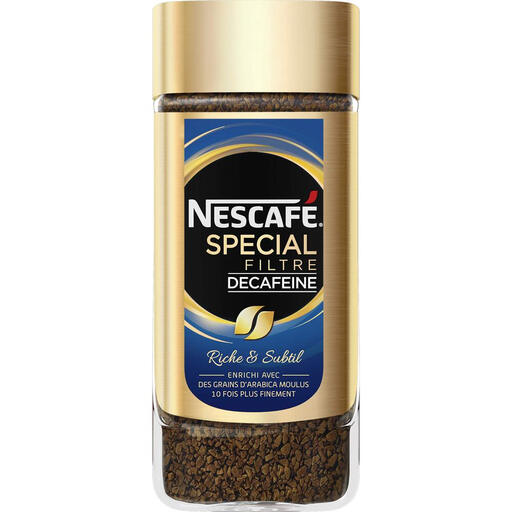 Image unavailable
NESCAFÉ Decaf Filter Coffee 100 g
A 100 g jar to consider if you make decaffeinated instant coffee at home, particularly for an evening cup. “Decaffeinated” doesn’t mean the coffee is completely caffeine-free.
View on Joybuy
Frequently asked questions
Is decaffeinated instant coffee completely caffeine-free?
No. “Decaffeinated” doesn’t mean the caffeine content is zero. In France, Decree No. 2001-977 limits the anhydrous caffeine content of the coffee-derived dry matter in a coffee extract labelled “decaffeinated” to 0.3%.
Jar or sticks: which format should I choose for regular cups?
A jar is handy for making coffee regularly at home, while sticks make it easier to measure out a portion and take it with you. Choose a size that suits how much you drink and check the total weight of the portions.
How do you make decaffeinated instant coffee?
Follow the recommended amount and water temperature for your chosen product. NESCAFÉ recommends one teaspoon per 100 ml of hot water for its Spécial Filtre Decaffeinated; instructions may differ for other products.
Is decaf suitable for someone who is very sensitive to caffeine in the evening?
It doesn’t guarantee that the coffee is caffeine-free. ANSES notes that caffeine’s effects on sleep vary from person to person. If you need to strictly limit your intake for health reasons, ask a health professional for advice tailored to you.


