Who is this choice for?

Older people who want to protect their sleep

For people who want to keep enjoying coffee in the evening while taking their sensitivity to caffeine into account. Anses notes that caffeine can delay falling asleep and reduce both the length and quality of sleep.

Family members and carers who prepare the coffee

For anyone making a cup without a machine and looking for an easy routine to repeat: measure the powder from a jar or use a single-serve stick.

Evening coffee drinkers who care about taste

For people who want to choose a flavour profile that suits them. Descriptions such as ‘smooth’ or ‘intense’ on NESCAFÉ and Auchan products are brand or retailer descriptions, not measurements of caffeine content.

What should you look for?

For an evening cup, first check that the product is labelled ‘decaffeinated’. Then choose a format that the person or their carer can prepare and store easily.

Criteria What to check Who is it for?
Caffeine in the evening Look for the word ‘decaffeinated’ on the packaging and take into account other drinks containing caffeine consumed during the day. If I’m sensitive to caffeine, I want to keep my evening coffee without treating ‘decaffeinated’ as meaning ‘caffeine-free’; around 36% of consumers would put this need first.
Preparation Compare the instructions for each cup: a jar lets you measure the powder, while a stick provides a separate portion. When I’m making a cup for someone else, I mainly want a simple routine I can repeat; nearly 29% of consumers would make ease of preparation their priority.
Taste Check the advertised flavour profile or intensity rating, without interpreting it as an indication of caffeine content. I want to find a taste I enjoy even after switching to decaf; around 21% of consumers would prioritise this.
Format and storage Compare the stated weight and number of portions, then check the storage instructions once opened. If I only drink it occasionally, I want to avoid leaving a large jar open for a long time; around 14% of consumers would prioritise format and storage.

Common misconceptions to avoid

  • Assuming ‘decaffeinated’ means ‘caffeine-free’

    In France, Decree No. 2001-977 of 26 October 2001 allows coffee extract to be labelled ‘decaffeinated’ when anhydrous caffeine does not exceed 0.3% of the dry matter derived from coffee. So the label does not mean there is no caffeine at all.

    Read the product description and take other sources of caffeine into account too. If a health condition or medication may be relevant, seek personalised professional advice.

  • Reading intensity as a measure of caffeine

    The 6/10 intensity rating shown by Auchan for its decaf instant coffee is a guide to taste; it does not indicate the amount of caffeine per cup.

    Use the intensity rating to help choose a flavour, not to assess someone’s sensitivity to caffeine.

  • Assuming a product listing guarantees availability

    Carrefour says its decaf instant coffee is not available through its Drive service; E.Leclerc advises customers to check their chosen store or Drive service for its PLANTATION sticks.

    Check that your preferred format is available before making a special trip.

    This check can save you an unnecessary journey when you need a specific format.

  • Choosing a large jar without considering storage

    The instructions for the Carrefour and Auchan products mentioned here say to store them away from heat and moisture. The format should also suit how often the coffee is consumed.

    Check the instructions for your chosen product and close the jar carefully after use.

Brands to compare

NESCAFÉ

NESCAFÉ France lists Spécial Filtre Décaféiné in a 100 g jar, with a flavour profile the brand describes as smooth and balanced.

  • The NESCAFÉ product listing says it is decaffeinated using water, made with an Arabica/Robusta blend, and prepared using one teaspoon per 100 ml of hot water.
  • The taste description does not tell you how much caffeine remains per cup or whether the product is suitable for someone with individual sensitivities.

AUCHAN

Auchan France lists a 100 g jar of freeze-dried decaf instant coffee, with an intensity rating of 6/10.

  • The retailer recommends one to two teaspoons per cup and says this jar makes around 50 cups.
  • The intensity rating is a guide to taste, not a measure of residual caffeine.

CARREFOUR EXTRA

Carrefour France describes a 100 g jar of freeze-dried decaf instant coffee, making it useful for comparing ingredients and preparation instructions.

  • The ingredients are listed as ‘100% freeze-dried decaf instant coffee’; the instructions recommend one teaspoon in 10 cl of hot, non-boiling water.
  • The listing says it is unavailable through Drive, so check local availability before planning to buy it.

PLANTATION (Marque Repère E.Leclerc)

E.Leclerc lists PLANTATION freeze-dried decaf instant coffee in a box of 25 sticks, with a total weight of 50 g.

  • The sticks give you separate portions, so there’s no need to measure out the powder for each cup.
  • E.Leclerc advises customers to check with their chosen store or Drive service for product availability.

Decaf instant coffee on Joybuy

This selection features a 100 g jar of decaf instant coffee, with the powder measured out for each cup. If you’d prefer pre-portioned servings, compare the stick format too before making your choice.
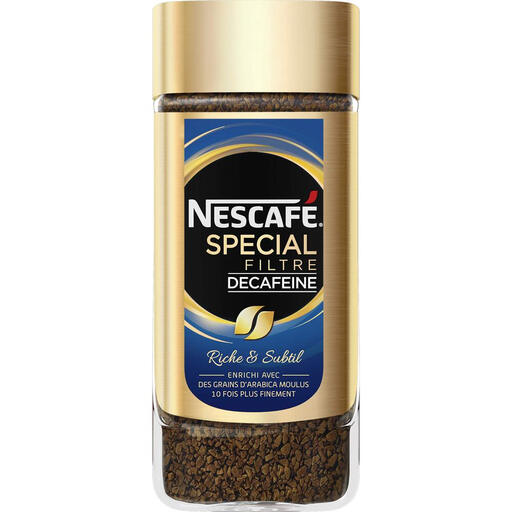
NESCAFÉ Decaf Filter Coffee 100 g

NESCAFÉ Decaf Filter Coffee 100 g

For making a cup of decaf instant coffee in the evening, measuring out the powder for each cup. The stated pack size is 100 g; ‘decaffeinated’ does not mean completely caffeine-free.

View on Joybuy

Frequently asked questions

Is decaf instant coffee completely caffeine-free?

No. ‘Decaffeinated’ does not mean there is no caffeine at all. In France, Decree No. 2001-977 of 26 October 2001 allows coffee extracts to use this label if anhydrous caffeine does not exceed 0.3% of the dry matter derived from coffee.

Is decaf instant coffee always suitable for an older person to drink in the evening?

No. The right choice depends, among other things, on the person’s sensitivity to caffeine and what else they consume. Anses notes that caffeine can delay falling asleep and reduce both the length and quality of sleep, so the ‘decaffeinated’ label alone is not enough to assess an individual situation.

When should you seek advice before continuing to drink even decaf coffee?

Seek personalised advice if a medical condition or medication could affect sensitivity to caffeine. Anses lists high blood pressure, liver disease, incontinence, and certain medicines or supplements among the factors to consider.

Jar or sticks: which is easier to prepare?

Sticks mean you don’t have to measure the powder for each cup, while a jar gives you more control over the amount you make. Follow the instructions for your chosen product and, for the PLANTATION sticks listed by E.Leclerc, check availability with your store or Drive service.

Does decaf instant coffee meet an older person’s nutritional needs?

No. Choosing decaf instant coffee is about a drink, its taste and how it is prepared; it does not replace an assessment of nutritional needs. If you have a specific concern about someone’s diet, seek appropriate professional advice.