To enjoy a decaf espresso after lunch on deck or in the evening, first choose a format that works with your machine: beans, ground coffee, capsules and pods are not interchangeable. If residual caffeine is particularly important to you, look for a stated caffeine content for the specific product; the intensity shown on the pack is more of a guide to flavour.
Who is this choice for?
People looking to reduce their caffeine intake
If you want to enjoy an espresso after a meal or in the evening, residual caffeine may be an important factor. The French Agency for Food, Environmental and Occupational Health & Safety (Anses) notes that caffeine can delay falling asleep. If this matters to you, check the stated content for the coffee you’re considering.
People with a machine that takes a specific format
Bean-to-cup machines, machines that use ground coffee, and the various capsule and pod systems don’t all take the same coffee. Check the exact format your machine uses before choosing a product.
People who care about the taste of their espresso
The tasting notes and intensity ratings given by brands can help you choose between decaf coffees that are already compatible with your machine. These flavour descriptions do not measure caffeine content.
What should you look for?
Start by checking which format your machine accepts, then look at the stated residual caffeine content if this matters for your after-dinner or evening coffee. You can then choose between compatible products based on their flavour profiles.
| What to consider |
What to check |
Who is it for? |
| Residual caffeine |
The “decaffeinated” label and, where stated, the caffeine content of the specific product. |
If I have an espresso in the evening, I want to know what “decaffeinated” means for the product I’ve chosen. Around 39% of consumers reportedly put managing their caffeine intake at the top of their list of concerns. |
| Compatibility |
The format accepted by your machine and, for capsules or pods, the exact name of the system. |
If I have a capsule machine, I can’t rely on the word “espresso” on its own. Compatibility is reportedly the top priority for around 38% of consumers. |
| Flavour profile |
The tasting notes and intensity rating, treated as flavour guides specific to each product. |
Once I’ve found the right format, I want a decaf espresso I enjoy the taste of. Around 23% of consumers reportedly put flavour profile first. |
Mistakes to avoid
-
Assuming “decaffeinated” means “caffeine-free”
The term doesn’t guarantee that a product contains no caffeine at all. The caffeine content of no more than 0.1% stated by illy applies to its 250 g ground decaf espresso coffee, not to all decaf products.
If residual caffeine is a deciding factor for you, look for a stated value for the product you’re buying and take into account other sources of caffeine you consume throughout the day.
-
Buying capsules without checking which machine you have
Nespresso Original, Iperespresso, A Modo Mio and pod formats are different systems. Compatibility with one doesn’t mean a product will work with the others.
Before you buy, compare the system shown on your machine or in its manual with the one stated on the pack.
Choosing the wrong format could leave you with a pack you can’t use in your machine.
-
Taking intensity as a measure of caffeine
An intensity rating describes the tasting profile within a particular range; it doesn’t tell you how much residual caffeine the coffee contains.
Use roast and flavour notes to choose the taste you like, and a stated caffeine content to check the caffeine level.
-
Putting every pod labelled compostable in your home compost
Carte Noire says its Décaféiné N°5 soft pods require industrial composting and must not be put in home compost, a garden or the natural environment.
Follow the instructions on the pack and check your local council’s recycling and disposal guidance.
Brands to explore
These examples let you compare specific formats and product descriptions, without assuming that every product from a brand has the same features.
Lavazza
Lavazza presents its Decaf beans as suitable for espresso and moka preparations.
- For these whole beans, the brand lists a medium roast, fruity notes and an intensity rating of 3/10.
- This format requires equipment that can grind beans; its intensity rating is not a measure of caffeine content.
illy
illy offers decaf beans, ground coffee, capsules and E.S.E. pods. The brewing system is the first thing to check.
- For its 250 g ground decaf espresso coffee, illy states a caffeine content of no more than 0.1%.
- This figure applies to this specific ground coffee and doesn’t automatically apply to other illy formats.
Carte Noire
Carte Noire offers its Espresso Décaféiné N°5 in formats including capsules compatible with Nespresso Original and soft pods.
- The brand describes the N°5 capsules as having notes of caramel and toasted cereals.
- Carte Noire says its N°5 soft pods require industrial, rather than home, composting.
Auchan
Auchan’s decaf range includes products such as whole beans and espresso capsules compatible with Nespresso machines.
- The available formats let you start comparing products by the type of machine you use.
- Check the details of each product, especially if a stated residual caffeine content is important to you.
Capsules on Joybuy
These products are decaf espresso capsules for different machine systems. Check the exact system before choosing. For the product that also carries the “Demi” label, check the description on the packaging if reducing caffeine is your priority.
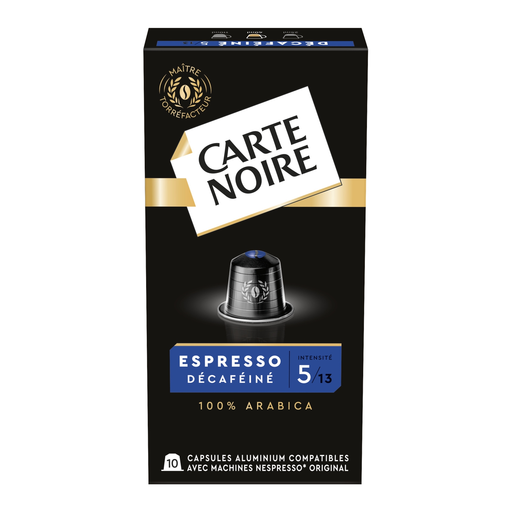 Image unavailable
CARTE NOIRE Espresso Décaféiné N°5, 10 aluminium capsules
Worth considering if you have a machine that takes Nespresso Original capsules: Carte Noire states that its Espresso Décaféiné N°5 is compatible. If residual caffeine content is guiding your choice, check what’s stated on the pack.
View on Joybuy
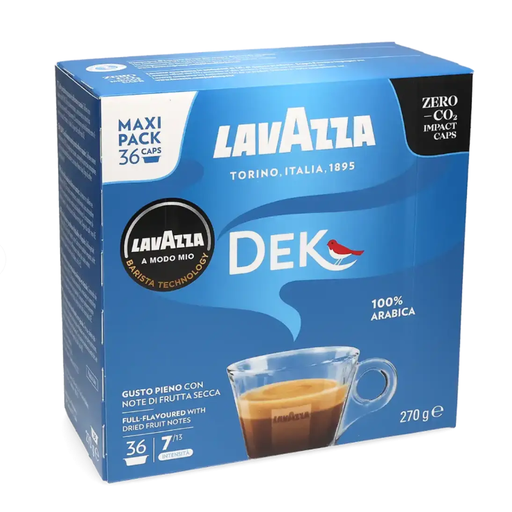 Image unavailable
Lavazza A Modo Mio Decaf, 36 capsules
Consider this if your machine uses the Lavazza A Modo Mio system. The pack contains 36 capsules; if residual caffeine matters for your evening espresso, check what’s stated on the pack.
View on Joybuy
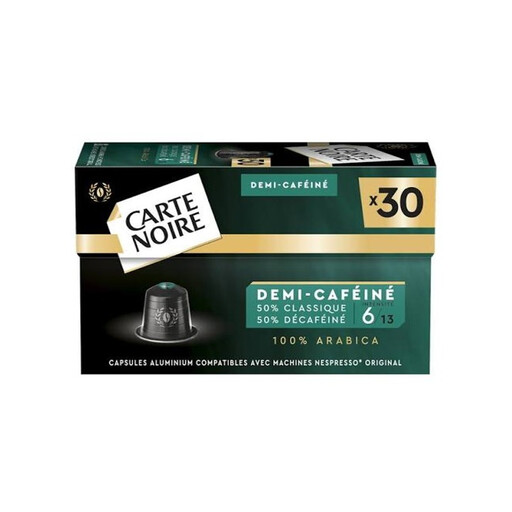 Image unavailable
CARTE NOIRE Nespresso Demi, Decaf, 30 capsules
This pack of 30 capsules carries the “Demi” and “Decaf” labels. Before choosing it to reduce your caffeine intake, check the exact product description, caffeine content and compatibility with your Nespresso machine on the packaging.
View on Joybuy
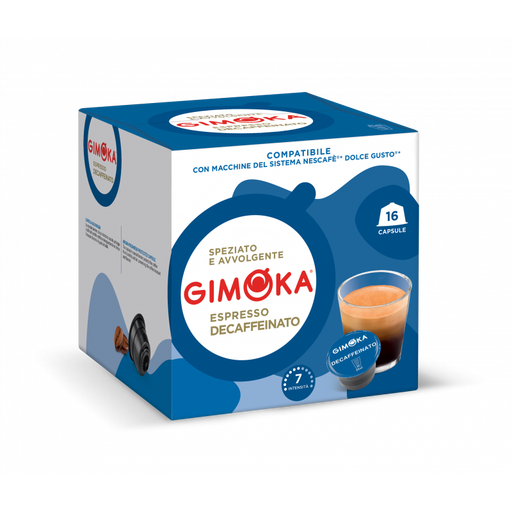 Image unavailable
GIMOKA Espresso Decaffeinated, 16 capsules compatible with Dolce Gusto, 112 g
Worth considering if your machine takes Dolce Gusto-compatible capsules, rather than a different system. The pack contains 16 capsules and weighs 112 g; check the product’s caffeine information if this is an important factor for you.
View on Joybuy
Frequently asked questions
Is decaf espresso always caffeine-free?
No. “Decaffeinated” doesn’t necessarily mean there’s no caffeine at all. illy states that its 250 g ground decaf espresso coffee contains no more than 0.1% caffeine; check each other product separately.
Which decaf capsule should I choose for a Nespresso machine?
Choose a capsule that’s compatible with your machine’s exact system. Carte Noire states that its Espresso Décaféiné N°5 capsules are compatible with Nespresso Original; this doesn’t apply to other capsule systems.
Is decaf suitable for an evening espresso?
It may help you reduce your caffeine intake, but it doesn’t guarantee a drink that’s completely caffeine-free. Anses says caffeine can delay falling asleep and reduce the length or quality of sleep. Take your sensitivity and other sources of caffeine into account.
Can decaf soft pods go in garden compost?
Not Carte Noire’s Décaféiné N°5 soft pods: the brand says they require industrial composting and must not be put in home compost or a garden. Check your local council’s recycling and disposal guidance.


