Travellers who prefer pre-measured portions
For a meal on the train, a stick means you don’t have to open a jar or bring a spoon. You’ll still need a cup and hot water, though.


For a portion to prepare on the go, sticks mean you don’t need to bring a jar and a spoon. If you want to keep decaffeinated instant coffee in the cupboard, choose a 100 g or 200 g jar, depending on how often you use it. Neither format removes the need for a cup and hot water, so check how you’ll prepare your drink before setting off.
For a meal on the train, a stick means you don’t have to open a jar or bring a spoon. You’ll still need a cup and hot water, though.
A resealable 100 g or 200 g jar is better suited to making coffee regularly at home, at work or in accommodation than to having a single drink on the journey.
If it’s important to you that your coffee contains no caffeine at all, don’t assume this from the word ‘decaffeinated’ on the packaging alone.
For a meal on the train, first check how you’ll get hot water and what you’ll use to prepare your drink. Then choose between an individual portion for your journey and a jar that’s mainly intended for keeping in the cupboard.
| What to consider | What to check | Who it matters to |
|---|---|---|
| Preparing coffee on board | Check the instructions and make sure you have a cup and access to hot water on your train. | If I want to drink my own coffee during the journey, I need to be able to prepare it, whatever the packaging; around 33% of consumers would make this their priority. |
| Portability and portioning | Compare individual sticks with a jar, which needs to be measured out with a spoon. | To avoid handling loose coffee in my bag, I prefer an individual portion; this convenience when travelling would be a priority for around 33% of consumers. |
| A supply for the cupboard | Choose between 100 g and 200 g depending on how often you use it, and check the storage instructions. | If I mainly make decaf between trips, I’m looking for a container suited to regular use; around 20% of consumers would prioritise keeping a supply in the cupboard. |
| Decaffeination and taste | Read the product description and ingredients. If an intensity is stated, don’t confuse it with a measure of residual caffeine. | Before buying, I want to understand what ‘decaffeinated’ means and choose the advertised taste; this would be the top consideration for around 14% of consumers. |
The word ‘decaffeinated’ doesn’t guarantee that a product contains no caffeine at all. French decree no. 2001-977, published by Légifrance, sets a limit for the residual caffeine content of the coffee extracts it covers.
Check the product description rather than assuming its caffeine content is zero.
A 200 g jar is better suited to keeping a supply that you can measure out as needed. The Maxwell House product featured by Auchan comes in a glass jar.
If you mainly want to keep the coffee in the cupboard, choose a size that suits your usual consumption. For a portion on the journey, compare the sticks too.
A stick saves you measuring coffee with a spoon, but the instructions for Auchan’s decaf sticks call for hot, not boiling, water.
Bring a cup and check that you’ll have access to hot water before relying on this format during your journey.
Carrefour lists a 100 g jar of NESCAFÉ decaffeinated instant coffee, advertised as making 50 cups. Auchan also lists a 200 g size, advertised as making 100 cups.
Auchan lists a 100 g jar of decaffeinated instant coffee, advertised as making around 50 cups, as well as a box of 25 decaf sticks.
Auchan lists a 200 g jar of Maxwell House decaffeinated instant coffee in a glass jar, advertised as making up to 110 cups.
E.Leclerc lists a 200 g pack of Plantation freeze-dried decaffeinated instant coffee. Availability in store or for Drive collection varies by location.
These two options suit different needs: 100 g of decaffeinated instant coffee to keep in stock, or decaffeinated café au lait sticks to take with you in individual portions. The café au lait sticks are not plain instant coffee.
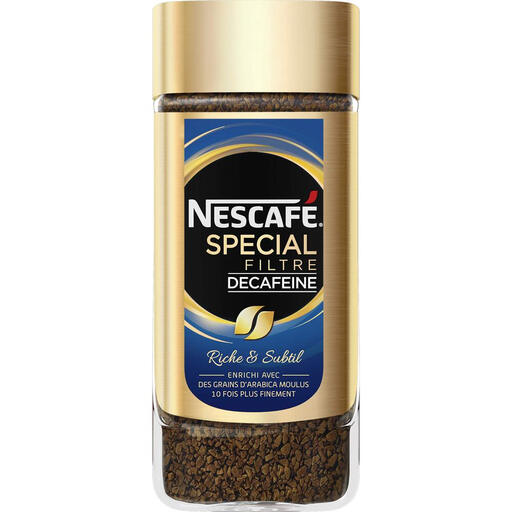 Image unavailable
Choose this decaf coffee if you’d like to keep a 100 g supply and measure out each cup yourself.
If you’re taking it on the train, bring a spoon and a cup, and make sure you have hot water. Check the instructions on the packaging.
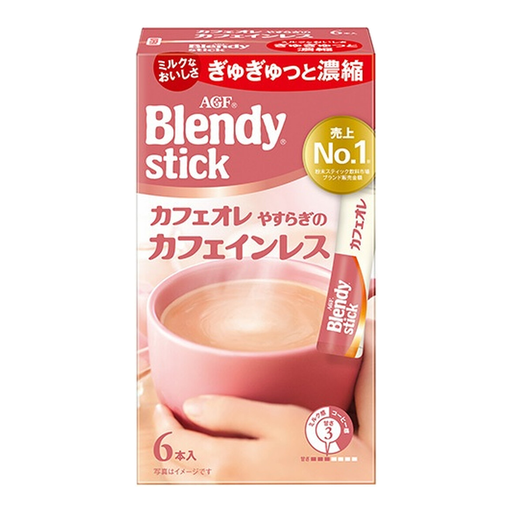 Image unavailable
These six sticks are a good choice if you’d rather take individual portions of decaffeinated café au lait than a jar of plain coffee.
Check the ingredients and preparation instructions on the packaging. You’ll still need a cup and hot water during your journey.
No. ‘Decaffeinated’ doesn’t necessarily mean that a product contains no caffeine at all. For the coffee extracts covered, French decree no. 2001-977, published by Légifrance, sets a maximum anhydrous caffeine content of 0.3% of the coffee-derived dry matter.
Simply lukewarm water isn’t suitable for the products mentioned here: their instructions call for simmering water or hot, non-boiling water. Check the instructions for your chosen product and make sure you’ll have access to hot water before setting off.
Close the jar securely and follow the storage instructions for your chosen product. Auchan’s product listings recommend keeping some products in a dry place away from heat, depending on the specific product.
If you’re only planning to have one drink during the journey, a stick saves you carrying and measuring coffee from a large jar. A 200 g jar makes more sense if you mainly want to keep coffee in the cupboard for regular use.