What should you look for before buying?
For a brunch where you might serve coffee later, start by checking the ‘decaffeinated’ label and your machine’s pod format. You can then compare compatible options by their coffee profile and other on-pack information.
| Criteria |
What to check |
Who is it for? |
| Caffeine |
The ‘decaffeinated’ label; don’t assume the stated intensity tells you how much caffeine is in the coffee. |
If I’m also serving coffee in the evening, I want to offer an option that limits caffeine without presenting it as completely caffeine-free. Around 29% of consumers would prioritise this reduction. |
| Compatibility |
Look for the explicit ‘compatible with Senseo’ label on the variant you’re buying, if you use this machine. |
If I have a Senseo machine, I need to be able to use the pods before I compare their other features. Compatibility would be the top priority for around 29% of consumers. |
| Coffee profile |
The stated blend, Arabica-Robusta or 100% Arabica, and the product’s flavour description. |
When serving several guests, I look for a profile that suits their known preferences rather than relying on the intensity number alone. Around 24% of consumers would put this choice of profile first. |
| Labels and pack size |
Look for organic or ‘solvent-free’ labels if they matter to you, and check how many pods you’ll need for serving. |
I want to find a specific feature on the pack or make sure I have enough cups for brunch, without assuming it has any other effects. This would be the priority for around 18% of consumers. |
Decaf coffee pods on Joybuy
This selection features decaf coffee pods described as compatible with Senseo machines. They’re worth considering if you’re serving several cups at brunch or want to keep an option for later.
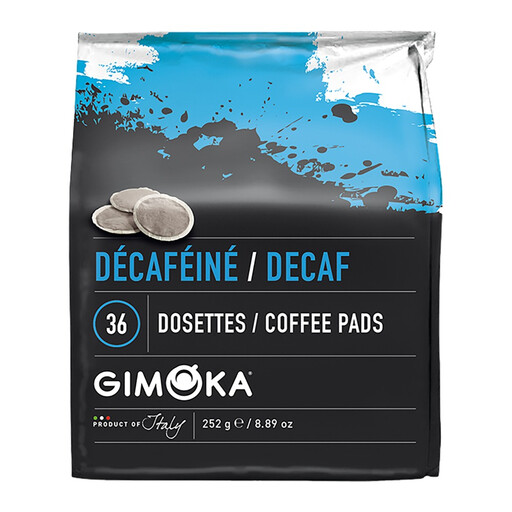 Image unavailable
GIMOKA Decaffeinated coffee compatible with Senseo, 36 pods, 252 g
An option to consider if you have a Senseo machine and want to serve decaf coffee to several guests.
The pack contains 36 pods and weighs 252 g. The number of pods helps you plan how many to serve, but doesn’t tell you how much caffeine is in each cup.
View on Joybuy
Frequently asked questions
Is decaf coffee completely caffeine-free?
No. France’s DGCCRF says decaffeinated coffee can contain up to 0.1 g of caffeine per 100 g of coffee. This limit doesn’t tell you how much caffeine is in each cup, so don’t assume a decaf pod is necessarily caffeine-free.
Are all soft coffee pods suitable for a Senseo machine?
No, you need to check compatibility for the specific product. Look for the ‘compatible with Senseo’ label on the pack or product page, rather than assuming another soft pod will fit.
Does an intensity rating of 5 or 6 tell you how much caffeine is in each cup?
No, this number describes the coffee’s profile and isn’t a measure of caffeine. If you’re choosing an option to drink later in the day, don’t use it to estimate how much caffeine will be in your cup.
Can compostable pods go in a garden compost bin?
Don’t assume so just because the pack says ‘compostable’. Follow the product instructions: a claim about industrial composting doesn’t mean it’s suitable for home composting. Also check local collection options.
What should I do if I’m particularly sensitive to caffeine?
Don’t rely on the ‘decaffeinated’ label alone to assess your caffeine intake. The Anses highlights that the effects of caffeine vary between people and may depend on other sources of caffeine or certain medicines. If you have a question related to your medical circumstances, ask a healthcare professional for advice.


