People with a capsule machine
If your machine is already on the worktop, its system determines which coffees you can consider for an afternoon break. Check compatibility before choosing based on a flavour description.


For a decaf coffee break in the afternoon, first choose a format stated as compatible with your exact machine system: Nespresso-compatible capsules, Vertuo capsules, Dolce Gusto capsules and Senseo soft pods are not interchangeable. Then compare the coffee style and the amount it makes. The term “decaffeinated” should not be taken as a guarantee that the coffee contains no caffeine at all.
If your machine is already on the worktop, its system determines which coffees you can consider for an afternoon break. Check compatibility before choosing based on a flavour description.
A short espresso, a lungo or a flavoured coffee each make for a different kind of break. Your choice comes down to your taste, while the amount of caffeine you consume throughout the day is a separate consideration.
The number of servings in a box and how to dispose of the capsules or pods can influence your choice of a coffee you buy regularly. In particular, check the specific instructions for anything labelled “compostable”.
To choose a decaf for the afternoon, start with your machine system. Then compare compatible options based on the coffee you want and how it is packaged.
| Criteria | What to check | Who is it for? |
|---|---|---|
| Compatibility | Check the exact system your machine uses and the compatibility information on the pack. Don’t rely on the shape of the coffee portion alone. | If I already own a machine, I want to be able to use the coffee I buy rather than find out that the format doesn’t fit. Around 28% of consumers would put compatibility at the top of their list. |
| Taste and cup size | Check the type of drink it makes and the listed flavour notes. An intensity rating in one range cannot be directly compared with the rating in another. | To enjoy with my afternoon snack, I’m mainly looking for a short espresso, a lungo or a flavoured drink, depending on my preferences. This would be the top priority for around 22% of consumers. |
| Caffeine | Look for the term “decaffeinated” and distinguish it from “half-caff”. Also consider other sources of caffeine throughout the day. | If I want to limit caffeine later in the day, I don’t want to mistake a mild flavour intensity for decaffeination. Around 22% of consumers would make this distinction their main concern. |
| Pack size | Compare the number of servings and the net weight shown on the boxes. Check the quantity if the product information seems inconsistent. | When I regularly restock my coffee, I want to know how many breaks a box will cover. Around 17% of consumers would put this ahead of other considerations. |
| Disposal | Check the material, the product-specific disposal instructions and the collection options available from your local authority. | If I want to sort my capsules or pods after a break, I need instructions I can follow at home, particularly for a product described as compostable. Around 11% of consumers would make this a priority. |
A capsule stated as compatible with Nespresso, a Vertuo capsule and a Senseo-compatible soft pod are designed for different systems. Dolce Gusto capsules are another format that must be checked separately.
Make a note of your machine system, then check the compatibility information for each product before choosing your coffee.
Carte Noire describes its half-caff option as a blend of 50% decaffeinated coffee and 50% regular coffee. It is therefore not in the same category as a product sold as decaffeinated.
If you’re looking for decaf, read the product name and ingredients rather than relying on a name that simply suggests reduced caffeine.
For the products shown by Auchan and Carte Noire, intensity and the term “decaffeinated” are separate details. The tasting intensity alone does not tell you how much caffeine is in a capsule.
Use the intensity rating to compare flavour profiles within a range, and the coffee description to distinguish decaf from half-caff.
Carte Noire says its decaffeinated soft pod is suitable for industrial composting and should not be put in a home composting system.
Follow the instructions for the specific product and check what collection options are available from your local authority.
In France, Carte Noire offers an Espresso Decaffeinated N°5 in capsules stated as compatible with Nespresso, as well as a Decaffeinated N°5 in soft pods.
Carrefour offers decaf capsules stated as compatible with Nespresso under Carrefour Bio and Carrefour Sélection, as well as pods stated as compatible with Senseo under Carrefour Sensation.
Auchan offers a decaffeinated espresso under its own brand in a box of 20 capsules, stated as compatible with Nespresso.
Nespresso offers Sweet Vanilla Decaffeinato in its Vertuo range, for a Mug-sized cup listed as 230 ml.
These options suit three different coffee breaks: an espresso or lungo with a Dolce Gusto machine; an espresso with a machine that accepts capsules stated as compatible with Nespresso; or coffee in a soft pod with a machine that accepts the Senseo format. Always check your machine model before choosing.
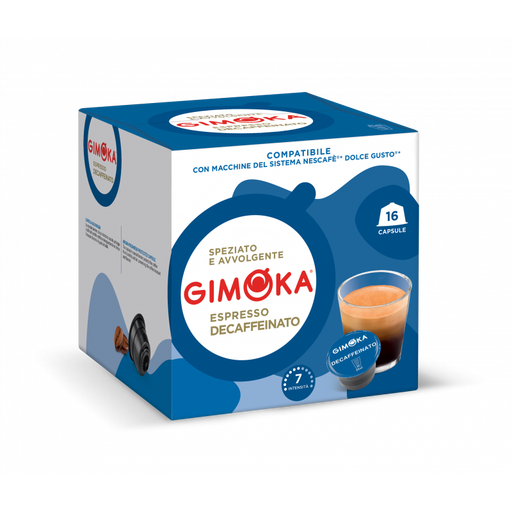 Image unavailable
For a decaf espresso break with a machine that accepts Dolce Gusto capsules. Check compatibility with your exact model.
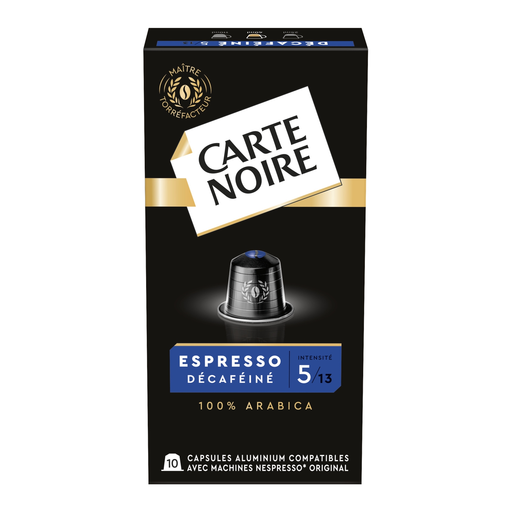 Image unavailable
For making a decaf espresso if your machine accepts capsules stated as compatible with Nespresso. Carte Noire describes this N°5 option as made from 100% Arabica. Check your machine model.
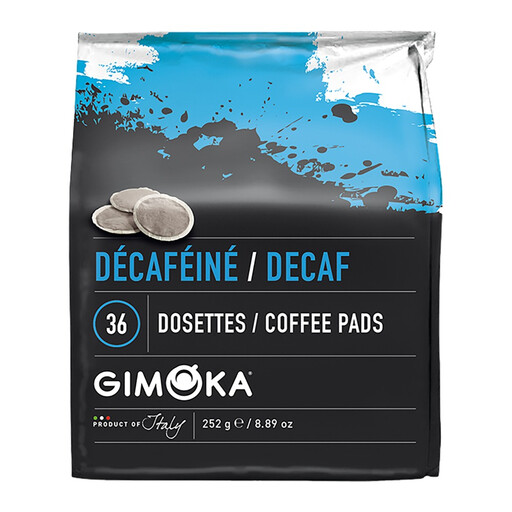 Image unavailable
For a decaf coffee break with a machine that accepts soft pods stated as compatible with Senseo. Check your machine model and follow the recycling instructions on the pack.
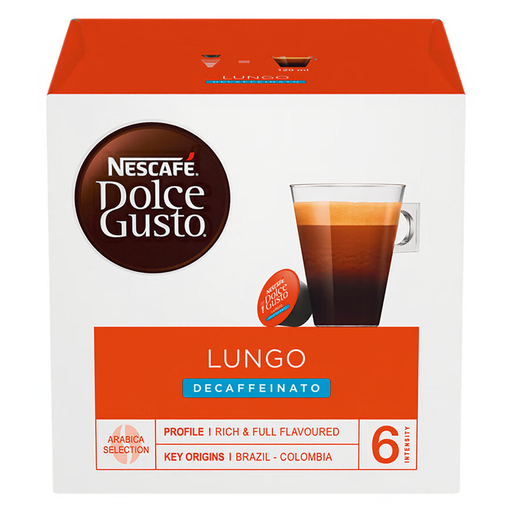 Image unavailable
For anyone who prefers a decaf lungo and has a Dolce Gusto machine. Check the pack size listed for this product and its compatibility with your machine model.
Identify the exact system your machine uses, then look for it on the pack or in the coffee product listing. A capsule stated as compatible with Nespresso, a Vertuo capsule, a Dolce Gusto capsule and a Senseo-compatible soft pod should not be assumed to be interchangeable.
No. The intensity shown for a product is not a measure of its residual caffeine. To check what kind of coffee it is, look for the term “decaffeinated” rather than relying on the flavour intensity scale.
Not if you specifically want to buy coffee sold as decaffeinated. Carte Noire describes its half-caff option as a blend of 50% decaffeinated coffee and 50% regular coffee. Check the ingredients to tell the two categories apart.
According to ADEME, aluminium or plastic capsules should go in the recycling bin, bag or container. For a pod, follow its specific instructions and check local collection options. Carte Noire says its decaf soft pod, which is stated to be suitable for industrial composting, should not go in home compost.