People who prefer decaffeinated coffee in the evening
You’d like a soluble coffee to enjoy with your late-night snack. The ‘decaffeinated’ label and the ingredients of the product you choose matter more than the number of sticks alone.


If you regularly enjoy a late-night snack, first choose a coffee that is clearly labelled ‘decaffeinated’. The 80-stick box of Carte Noire Classique listed by Carrefour and Auchan does not carry this label. If you make your coffee at home, Auchan’s jars of decaffeinated coffee, advertised as making 100 or 110 cups, are another option to consider. If you need individual portions, the Cafés Richard decaffeinated coffee carton contains 200 sticks, not 80.
You’d like a soluble coffee to enjoy with your late-night snack. The ‘decaffeinated’ label and the ingredients of the product you choose matter more than the number of sticks alone.
You often make a cup at home and don’t need individually wrapped portions. Jars advertised as making 100 or 110 cups are worth comparing with your usual rate of consumption.
You want to take a portion with you or make several cups without measuring out coffee with a spoon. Check both the ‘decaffeinated’ label and the carton size: Cafés Richard decaffeinated coffee sticks come in packs of 200.
First, check that the product you choose is decaffeinated. Then decide between a jar and sticks based on how often you have coffee and whether you need individual portions.
| Criteria | What to check | Who it suits |
|---|---|---|
| Decaffeinated | Look for ‘decaffeinated’ in the product name or ingredients; don’t rely on the 80-stick format. | For a late-night snack, I want a clearly labelled decaffeinated coffee above all else, rather than choosing a box based on the number of portions; around 46% of consumers prioritise this. |
| Amount for home use | Compare the net weight and advertised number of cups, then check the storage instructions. | If I often make a cup at home, I’m looking for a container that suits this use without individually wrapped portions for every break; around 27% of consumers prioritise the amount. |
| Individual portions | Check the number of sticks and the ‘decaffeinated’ label on the same product. | If I want to take a portion with me or serve several people, I prefer individually wrapped portions; around 27% of consumers put these first. |
Carrefour and Auchan list Carte Noire Classique in a box of 80 sticks, but don’t describe it as decaffeinated. So the number of portions alone doesn’t tell you whether it’s suitable if you’re looking for decaf.
Before choosing a box, check the ‘decaffeinated’ label and the ingredients of that specific product.
The advertised number of cups for a jar and the number of sticks in a carton represent two different ways to prepare and store coffee. A carton of 200 sticks may also be more than you want to keep at home.
Start by thinking about how often you make coffee and whether you’ll really use individual portions, then check the storage instructions.
The EFSA considers caffeine from all dietary sources. Choosing decaffeinated coffee doesn’t account for the other drinks or foods you consume during the evening.
If you want to keep track of your caffeine intake, remember to include the other products you consume.
Auchan lists a 200 g jar of NESCAFÉ decaffeinated soluble coffee, advertised as making 100 cups. Joybuy also lists a 100 g jar of decaffeinated coffee.
Auchan lists a 200 g jar of Maxwell House Qualité Filtre Décaféiné soluble coffee, advertised as making 110 cups.
Auchan lists its own 100 g jar of decaffeinated soluble coffee, advertised as making around 50 cups and with an intensity rating of 6/10.
Carrefour and Auchan list Carte Noire Classique in a 144 g box containing 80 sticks.
Coffee-Webstore lists a carton of 200 sticks of Cafés Richard 100% Arabica decaffeinated soluble coffee.
This jar of decaffeinated soluble coffee is suited to making coffee at home if you don’t need individual sticks. The 100 g jar isn’t a box of 80 sticks. If the number of cups matters to you, check the yield stated on the packaging.
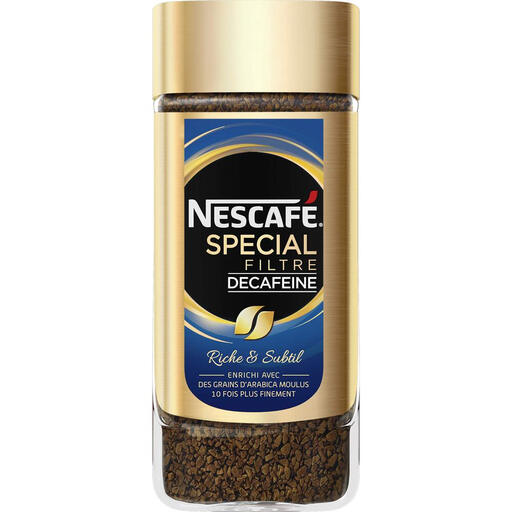 Image unavailable
For making decaffeinated soluble coffee at home without using individual sticks.
100 g jar; this isn’t a box of 80 sticks.
No. The number of sticks doesn’t tell you whether the coffee is decaffeinated. Carrefour, for example, lists Carte Noire Classique in a box of 80 sticks without describing it as decaffeinated. Check the product name and ingredients on the box you’re considering.
A jar could be a good choice if you don’t need individual portions. Auchan says its 200 g NESCAFÉ Décaféiné makes 100 cups, while its 200 g Maxwell House Qualité Filtre Décaféiné makes 110 cups. Compare these figures with how often you drink coffee.
Close the jar securely and follow the storage instructions for the product you’ve bought. For Maxwell House Qualité Filtre Décaféiné, Auchan recommends storing it in a dry place, away from heat and light.
No. Your choice of coffee doesn’t tell you about the other foods and drinks you consume. The EFSA considers caffeine intake from all dietary sources, so bear this in mind if you’re keeping track of your consumption.