
Livraison le jour même ou le lendemain

Qualité garantie

Débloquez vos offres de bienvenue: Livraison GRATUITE | Jusqu'à -80 % | 30 jours d'essai gratuits à JoyPlus
Téléchargez l'application
A 4K car dashcam should not be chosen solely based on the resolution shown on the box. For daily commutes, long journeys or monitoring a parked vehicle, certain technical details can make a real difference to your experience. A front-and-rear dashcam may deliver highly detailed footage at the front, while being far more limited at the rear or in parking mode if the right accessories are not included.
Here are the main pitfalls to avoid and the criteria to consider before choosing a DDPAI Z90 Pro 4K dual-channel dashcam.
The 4K label usually refers to the front camera. It does not mean that the rear camera offers the same resolution, or that number plates will be readable in all conditions. To assess a model properly, look separately at the resolution of each sensor, the viewing angle and the recording frame rate.
According to its product specifications, the DDPAI Z90 Pro combines a 4K HDR front camera with a 2K HDR rear camera. The 3K interior camera is reserved for the three-channel configuration, so it is not included as standard with the dual-channel version.
The term “24/7 parking mode” may suggest that a dashcam offers this function straight out of the box. In reality, continuous monitoring often requires a dedicated connection to the vehicle. For this model, 24-hour parking mode requires the separate purchase of a hardwire kit.
This type of monitoring can also put strain on the battery if the discharge protection is not set correctly. It is therefore worth checking whether the vehicle has a voltage management system, such as the IPS Power Management system advertised for the Z90 Pro, before installation.
4K files take up considerably more space than Full HD videos. A memory card that is too slow or has too little capacity can lead to frequent overwriting, recording errors or particularly laborious transfers.
The Z90 Pro features 64 GB of eMMC memory and, according to the information available, supports external storage of up to 512 GB. For an additional card, a U3 speed class is recommended. The internal memory provides a useful safety net, but you should still calculate the capacity you need based on the length of your journeys.
According to the technical specifications, the DDPAI Z90 Pro’s front camera uses a Sony STARVIS 2 IMX678 sensor. However, the sensor is not the only factor that matters in a dashcam: the lens, image processing, exposure and compression also have a direct impact on the final footage.
HDR recording helps balance very bright areas and dark sections, for example when leaving a tunnel or facing headlights. The product description also mentions NightVIS 2.0, an AI-assisted image processing system, as well as a ColorSense mode designed for poorly lit scenes. These functions may improve clarity in certain situations, but they cannot guarantee that a number plate will be identifiable at night or in the rain.
A GPS dashcam records information such as your position, route, time and displayed speed in the app. This makes it easier to organise clips and review a journey. However, if you intend to use this information for administrative purposes or with your insurer, check the admissibility requirements with the relevant organisation beforehand.
According to the product description, the ADAS assistant can send alerts if you drift out of your lane or if signs of driver fatigue are detected. It is an additional aid: it does not replace staying alert at the wheel or complying with the Highway Code.
5 GHz Wi-Fi speeds up the connection between the camera and a compatible smartphone, making it easier to view or download videos. Voice control, with a command such as “Take a photo”, also means you do not have to handle the screen while driving. Always use these functions when the vehicle is stationary and in safe conditions.
The Z90 Pro also features a supercapacitor designed to provide a few seconds of backup power in the event of an interruption. This reserve should help protect files that are being written, but it does not replace a properly installed electrical system.
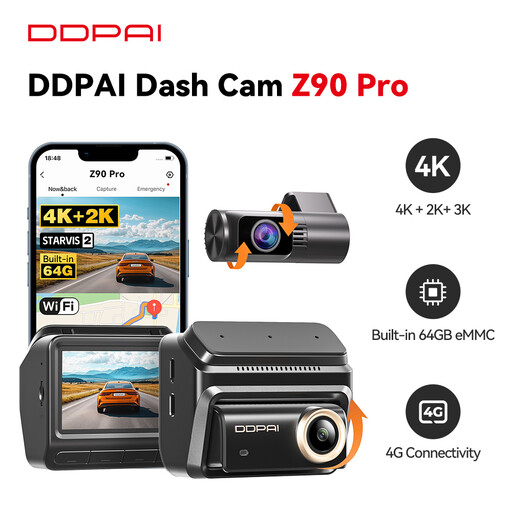
Why this choice suits this profile : This setup combines front and rear recording, GPS, fast Wi-Fi and 64 GB of internal memory. It gives you everything you need to start recording your journeys without immediately having to buy a range of accessories.
The rear resolution is clearly stated as 2K, so there is no suggestion that both cameras record in 4K. The eMMC storage also means you do not immediately have to rely on a memory card.
4K HDR front camera, 2K HDR rear camera, built-in GPS, 5 GHz Wi-Fi and integrated 64 GB eMMC memory.
Why this choice suits this profile : Drivers who want detailed footage and quick access to their clips get a complete package with HDR, night-time processing, GPS, voice control and fast transfers.
Optional features are clearly distinguished from the items supplied: the 3K interior camera and 4G connectivity require an option or a specific configuration.
Sony STARVIS 2 IMX678 sensor at the front, HDR on both channels, NightVIS 2.0, GPS and 5 GHz Wi-Fi.
Why this choice suits this profile : For a professional driver or a family that regularly uses the car, front-and-rear recording, GPS and the parking monitoring option make it easier to track and archive journeys.
Parking mode is described with its actual usage requirements: a hardwire kit is mandatory for 24/7 monitoring, while a separate 4G module is required for remote alerts.
Collision detection while parked, IPS voltage management, internal memory and backup supercapacitor.
Before installation, choose a position that does not restrict the driver’s field of vision. Route the cables so that they do not interfere with the side airbags, and check that the rear camera remains correctly aligned after opening the boot.
Footage captured on public roads may contain number plates or people. Keep only the clips you need, protect access to the app and avoid sharing a video that could identify someone without a legitimate reason. In a professional setting, you must also take account of your company’s internal rules and obligations relating to personal data.
No, the product specifications state that a hardwire kit must be purchased separately. Depending on the selected mode and the installation, monitoring may include collision detection and time-lapse recording.
Choose a microSD card with at least a U3 speed class and enough capacity for the length of your journeys. The Z90 Pro already has 64 GB of eMMC memory, while external expansion can reach the stated capacity of 512 GB.
The dual-channel version includes the 4K front camera and the 2K rear camera. The 3K interior camera and its infrared functions are reserved for the three-channel configuration mentioned in the description. Check the exact contents of the package before ordering.