
Livraison le jour même ou le lendemain

Qualité garantie

Débloquez vos offres de bienvenue: Livraison GRATUITE | Jusqu'à -80 % | 30 jours d'essai gratuits à JoyPlus
Téléchargez l'application
A 4-camera 360° car dash cam can record the front, rear, left and right sides of your vehicle. That’s particularly useful if you park on the street, drive an SUV or van, or want footage in case of a collision, vandalism or dispute.
However, not all models are created equal. A high resolution doesn’t guarantee clear night-time footage, while the claim of “24-hour surveillance” may conceal the need to buy an extra cable. Here’s what to look for before comparing the models available.
A front camera with a 150° angle covers a wide stretch of road, but it won’t necessarily record the sides or the interior. For genuine all-round coverage, look specifically for a 4-channel dash cam with four separate feeds: front, rear, left and right.
Check the position of the side cameras too. It directly affects how well they detect bumps in car parks and show up blind spots. A camera described as “panoramic” isn’t necessarily a blind-spot monitoring car camera.
A 4K or 2K camera can capture plenty of detail, but actual image quality also depends on the lens aperture, sensor, contrast processing and video bitrate. At night, infrared night vision, HDR or an F/1.8 aperture may prove more useful than the resolution figure alone.
With a four-camera setup, check what the advertised resolution refers to as well. Some models pair a 2K or 3K front camera with three 1080p modules. This may be enough to identify a vehicle’s position or see how a collision happened, but it doesn’t mean all four feeds are 4K.
24-hour parking mode often requires a hardwire kit, sold separately. Without this accessory, the dash cam will mainly work when the cigarette lighter socket is powered. Before ordering, check the following:
For example, the Baseus PrimeTrip VD1 recommends professional installation and inspection. Its product listing also notes that the possible absence of an E-mark may restrict its use to monitoring or private roads, depending on the jurisdiction. Always check the product listing and relevant regulations before installation.
For a front, rear, left and right car dash cam, look for four inputs or four modules capable of recording simultaneously. The manufacturer should specify the resolution and viewing angle of each camera, as well as its recommended position.
Loop recording automatically replaces old files when the memory is full. The G-sensor detects an impact and usually locks the relevant clip to prevent it being overwritten. This doesn’t replace manually backing up footage after an incident.
Built-in GPS adds coordinates, speed and sometimes the route to your videos. This information can help reconstruct a journey, but it’s also personal data. Enable only the features you need and protect access to the app.
5 GHz or 5.8 GHz Wi-Fi speeds up the transfer of large video files to a compatible phone. It doesn’t provide an automatic internet connection: some models require a separate 4G module to view footage remotely.
Motion detection, collision detection and time-lapse mode don’t draw power from the battery in the same way. For extended parking, it’s best to choose a hardwire kit with battery-discharge protection. Models with a supercapacitor may also be a good choice for vehicles exposed to significant temperature changes.
Voice control can make it easier to take photos or lock a video, but check which languages are supported. On some models, voice commands are only available in English.
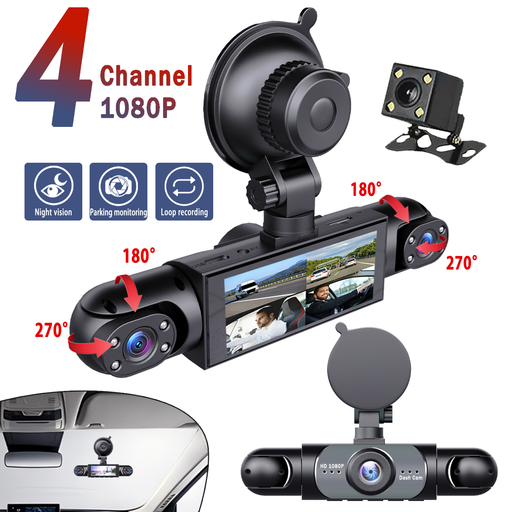
Why it suits this profile: A four-camera solution for exploring front, rear and side coverage without needing high resolution on every channel.
The product listing specifies four 1080p cameras, a 3.18-inch IPS screen, loop recording and an included 64 GB memory card.
Night vision, WDR, parking surveillance and G-sensor locking.
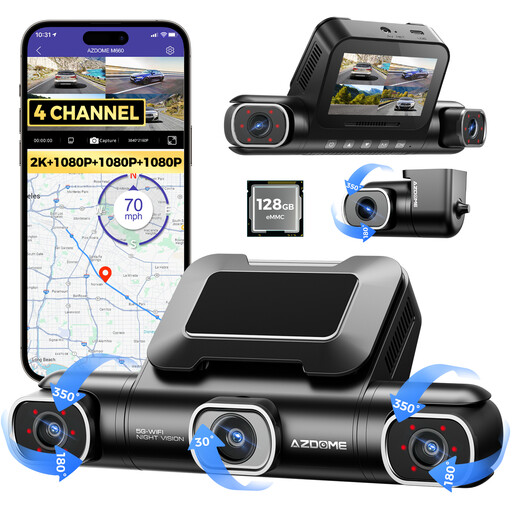
Why it suits this profile: Its four-channel system, 128 GB eMMC memory and 3-inch screen will suit drivers who want to view footage directly from their vehicle.
The product listing clearly distinguishes the 2.5K front camera from the three 1080p cameras, and explains that a hardwire kit is needed for certain parking modes.
5 GHz Wi-Fi, built-in GPS, voice control, night vision and emergency recording with pre-recording.
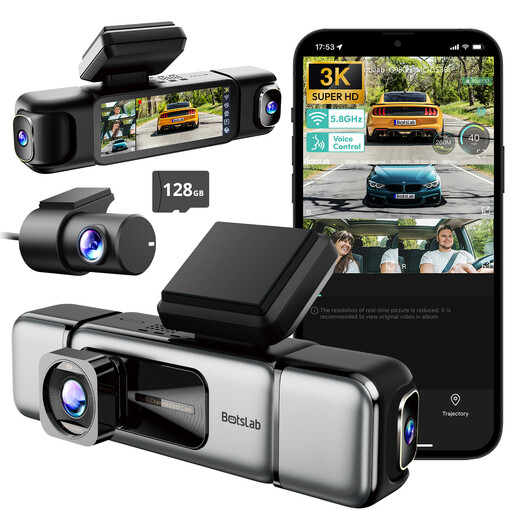
Why it suits this profile: Its four cameras, touchscreen and range of parking modes meet the needs of a vehicle used every day or parked in busy areas.
The product listing sets out the resolutions and viewing angles of the side cameras, and explains that a hardwire kit is needed for extended parking features.
3K front camera, two 120° side cameras, 150° rear camera, GPS and 5.8 GHz Wi-Fi.
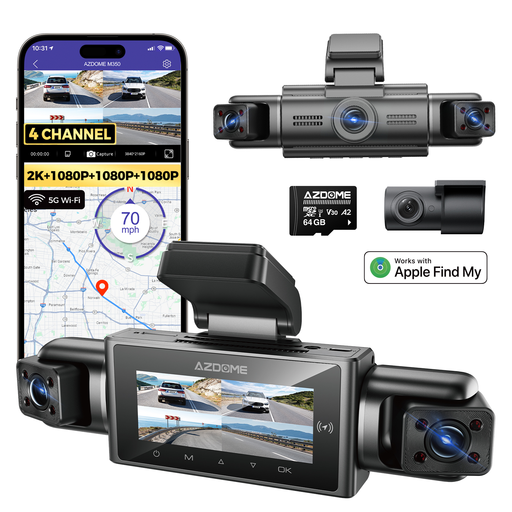
Why it suits this profile: The Apple Find My dash cam feature is for iPhone owners who want to combine vehicle location tracking with multi-angle recording.
The product listing specifies Apple Find My compatibility, the four channels and the resolution of each camera, rather than giving a single overall resolution.
2.5K front camera, three 1080p cameras, built-in GPS, 5 GHz Wi-Fi, supercapacitor and voice control in English.
We’ve put together a comprehensive selection, updated in real time, of products that meet these demanding criteria and European safety requirements.
It can be particularly useful if your vehicle is often parked on the street, you drive in busy urban areas or you want to record the sides of your vehicle in case of a collision. However, if you only want to record the road ahead and behind, a two-channel dash cam may be enough.
The front camera is usually fitted behind the rear-view mirror. The rear module and side cameras then need cables routed through the interior. Make sure they don’t obstruct the airbags, your view or access to the controls. If you want to use parking mode, have the hardwire kit connection checked to reduce the risk of draining the battery.
On top of the camera, you may need to pay for a high-endurance microSD card, hardwire kit, professional installation and, for some models, a 4G module. Wi-Fi is generally used to transfer videos locally, while remote location tracking relies on a dedicated feature and, depending on the model, a subscription or additional accessory.
In France, make sure you also comply with rules on privacy and the use of footage. Avoid publishing videos that identify people or number plates without taking the necessary precautions, and keep recordings only for as long as they’re needed for your purposes.