
Livraison le jour même ou le lendemain

Qualité garantie

Débloquez vos offres de bienvenue: Livraison GRATUITE | Jusqu'à -80 % | 30 jours d'essai gratuits à JoyPlus
Téléchargez l'application
A dashcam for your car can provide video evidence in the event of a bump, a hit-and-run, or an incident in a car park. Yet product descriptions often focus on resolution or Wi-Fi without explaining the conditions you need to get the most out of these features.
Before buying a dashcam for your car, three common pitfalls keep cropping up:
Resolution refers to the number of pixels recorded, but it doesn't tell the whole story about video quality. A 2K dashboard camera can be perfectly adequate for city driving while producing smaller files than a 4K model. 4K offers more detail at the front, provided you use a fast enough memory card and have decent lighting.
The lens aperture also plays a role: a value like F1.8 or F1.7 lets in more light than a smaller aperture. Night vision, HDR and image processing can improve the picture in tunnels, poorly lit streets, or when headlights are coming towards you. However, these features don't eliminate the limitations caused by speed, reflections on the windscreen, or distance.
An angle between 120° and 150° generally covers a wide portion of the road. But be careful: a very wide field of view can distort the edges of the image. Also check whether the stated value applies only to the front camera or to the whole system.
For drivers who park on the street or regularly use public car parks, a dashcam with a rear view allows you to document more situations. Three- or four-channel models sometimes add an interior or side camera, but they involve more cables and a longer installation.
Loop recording automatically overwrites old unprotected footage when the memory card is full. The G-sensor can lock a file in the event of a collision or sudden deceleration. It's still a good idea to check the condition of your microSD card regularly and back up important videos.
For parking surveillance, look closely at the exact requirements: hardwire kit, collision detection, time-lapse mode, voltage management or external battery. GPS can record your location, speed and route. Wi-Fi and app control let you view and download videos without removing the memory card.
In the UK, only film what is necessary to protect your interests and avoid publicly sharing images that could identify people or number plates. Also check the rules that apply to your situation before using a car surveillance camera.
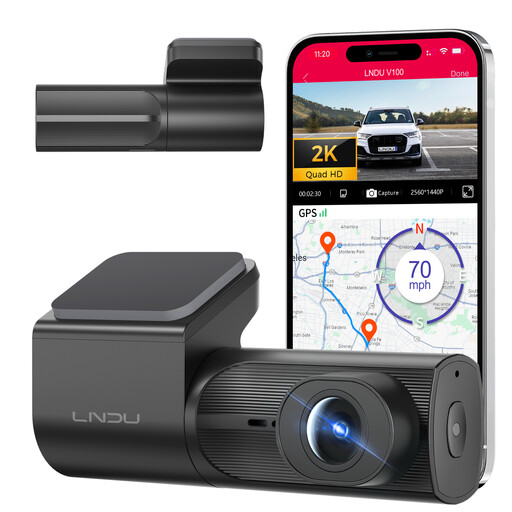
Why this model suits this profile: Its front-facing, screenless design and 2K resolution make it ideal for a discreet first installation for everyday journeys.
The spec mentions loop recording, G-sensor and night vision. However, 24-hour parking mode requires a hardwire kit sold separately.
2K resolution, built-in Wi-Fi, LNDU app, F1.8 lens and compact design.
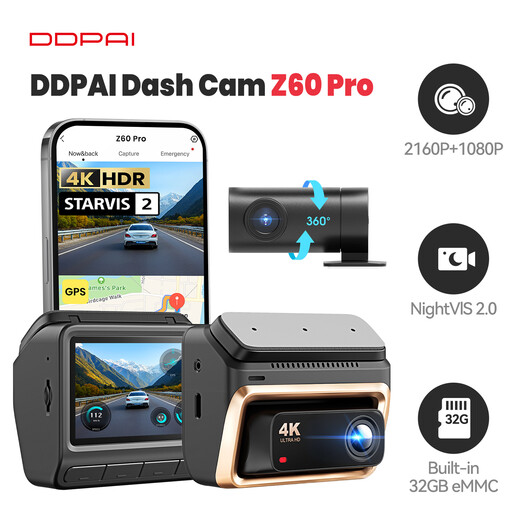
Why this model suits this profile: It combines a 4K front camera with a 1080P rear camera, a 3-inch screen and built-in GPS.
The 32 GB of internal memory complements support for a microSD card up to 512 GB. Parking mode and the 4G module require accessories sold separately.
4K HDR recording at the front, 1080P at the rear, 5 GHz Wi-Fi, GPS, HDR and Sony STARVIS 2 sensors, according to the product spec.
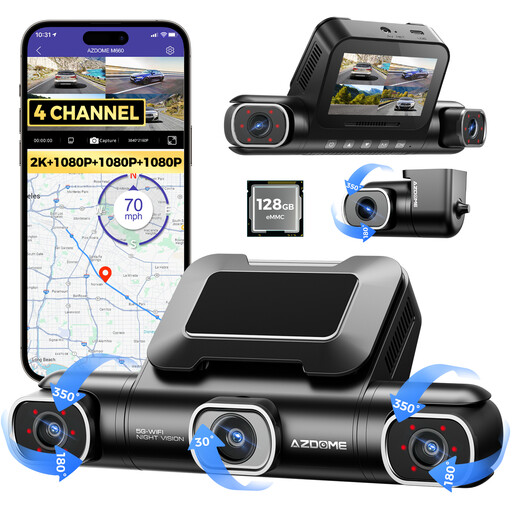
Why this model suits this profile: Its four channels are aimed at drivers who want to monitor the front, rear and sides of their vehicle.
Coverage from four cameras means you're not relying on a single front view. Parking mode still requires the AZDOME JYX05 kit, sold separately.
Four-channel recording, 128 GB eMMC memory, 3-inch IPS screen, 5 GHz Wi-Fi and built-in GPS, according to the description.
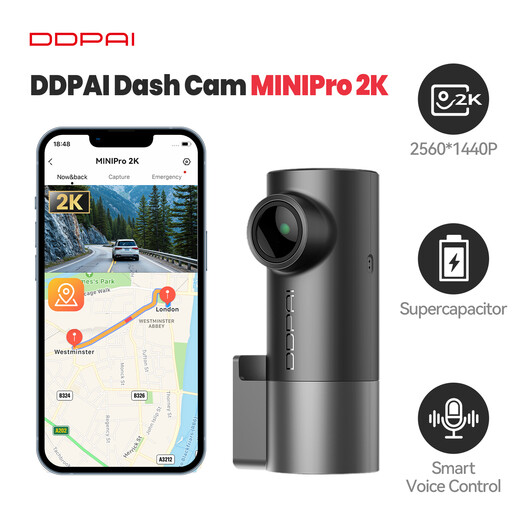
Why this model suits this profile: Its compact design tucks behind the rear-view mirror and suits vehicles where windscreen space is limited.
The spec states a maximum capacity of 256 GB and the mandatory use of a U3 card. Parking surveillance requires a smart hardwire kit.
1440P resolution, 2.4 GHz Wi-Fi, night vision, G-sensor, voice control and a housing described as resistant to extreme temperature variations.
We've curated a comprehensive, real-time updated list of products that meet these demanding criteria as well as European safety regulations.
Install the camera behind the rear-view mirror, in an area that doesn't obstruct the driver's view. Clean the windscreen before attaching the adhesive, then route the cable along the headliner and the pillar, without interfering with the operation of safety equipment.
Also budget for a microSD card designed for continuous recording, typically U3 class for high-definition footage. To use parking mode, add the cost of the hardwire kit and, if needed, professional fitting. Depending on write frequency and usage conditions, the memory card will need to be replaced periodically.
Its use may be permitted to document an incident, but the footage must be handled with care. Avoid freely publishing videos that could identify individuals, and respect privacy as well as the rules applicable to personal data.
No. It can link location, speed and route to the recorded footage, which helps reconstruct the context of an event. A camera without GPS can still produce perfectly usable video.
On top of the camera's price, you may need to add the cost of a microSD card, a hardwire kit for parking mode and, potentially, installation. The final bill depends mainly on the number of cameras, storage capacity and features like Wi-Fi, GPS or 4G connectivity.