
Livraison le jour même ou le lendemain

Qualité garantie

Débloquez vos offres de bienvenue: Livraison GRATUITE | Jusqu'à -80 % | 30 jours d'essai gratuits à JoyPlus
Téléchargez l'application
A dashcam for your car can provide video evidence in the event of a bump, a failure to give way, or an incident that occurs while parked. But not all models are created equal, and they don't all meet the same needs. A 4K image doesn't guarantee, on its own, that you'll be able to read a number plate at night. Similarly, a "24-hour" parking mode may require an accessory sold separately.
Before choosing a dashcam for your car, it's worth looking at the features that really matter, the installation requirements, and any limitations mentioned by the manufacturer.
A 4K dashcam offers more detail when conditions are favourable. However, the final result also depends on the sensor, the lens, the exposure, and the video compression. In everyday use, a model with good night vision and a sufficiently wide aperture can prove more useful than a camera that relies solely on a higher resolution.
Also remember to check the resolution of the rear camera. On some sets, the front camera records in 4K, while the rear only manages 1080P.
24-hour parking mode doesn't necessarily work with just the cigarette lighter charger. It may require a hardwiring kit, sometimes sold separately. This is particularly the case for surveillance functions that remain active when the engine is switched off.
Also check what's in the box: microSD card, mount, rear camera cable, and mains adapter. For frequent recordings, a card designed for continuous writing will generally be more reliable than a standard model with low endurance.
A poorly positioned camera can reduce the field of view, obstruct your driving, or create reflections on the windscreen. The rear camera cable also needs to be long enough to run neatly through the cabin, without dangling or getting caught.
Loop recording prevents the memory card from filling up by overwriting old footage that hasn't been locked. The G-sensor can automatically protect a video after an impact. However, it's still best to regularly save important files to a phone or computer.
A front camera mainly records the road ahead of the vehicle. A front and rear dashcam setup adds a rear view, which is handy in the event of sudden braking, a rear-end collision, or a manoeuvre. Three or four-channel systems can also monitor the cabin and the sides.
A wide angle covers a larger area, but too generous an angle can distort objects at the edges of the image. So compare the advertised field of view with your usage: city driving, motorway, commercial vehicle, or parking on a narrow street.
To decide between two models, look at these elements together:
Night vision should be seen as an aid to recording, not as a guarantee of a perfectly readable image in every situation. The cleanliness of the windscreen, street lighting, and the headlights of other vehicles also play an important role.
A Wi-Fi GPS dashcam can record your location, speed, and route, depending on the features activated. Wi-Fi is typically used to view or download videos via an app, without having to remove the memory card.
Parking mode deserves careful attention: some products detect impacts, while others use time-lapse recording or motion detection. When a hardwiring kit is essential, make sure it's compatible with your vehicle and that it includes protection against excessive battery drain.
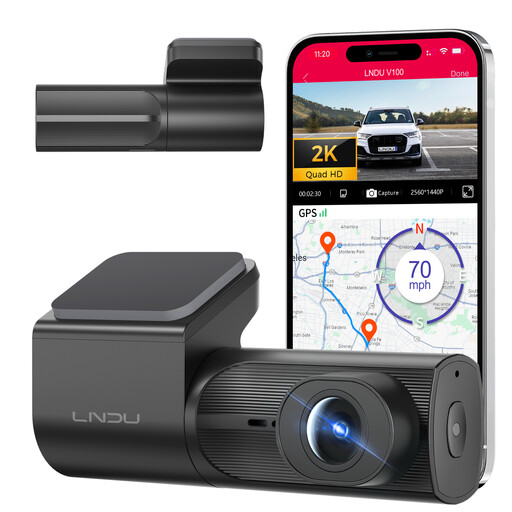
Why this choice suits this profile: This dashcam offers 2K resolution, Wi-Fi, and an app for viewing files from your smartphone. Its compact, front-only design will suit drivers who want to get equipped without adding lots of accessories.
The product page clearly states that parking mode requires a separate hardwiring kit. Useful information for budgeting and planning your installation before you order.
2K resolution, F/1.8 lens, Wi-Fi, app, G-sensor, and loop recording.
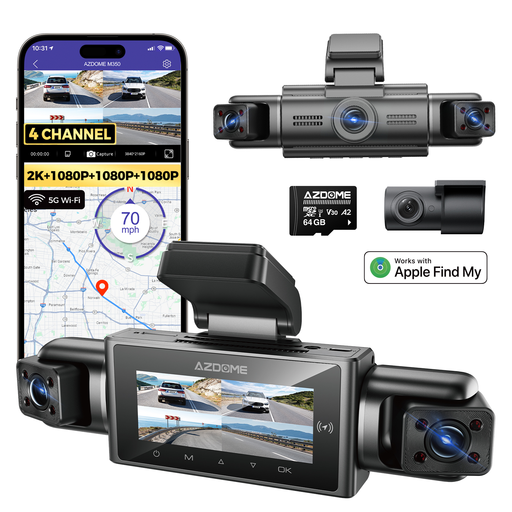
Why this choice suits this profile: This four-channel setup records the front, rear, and both sides of your vehicle. It's aimed at drivers who want extensive coverage and connected features.
The resolutions are detailed camera by camera: 2K at the front and 1080P for the other three views. This makes it easier to assess the coverage you're actually getting.
Built-in GPS, 5G Wi-Fi, English voice control, infrared night vision, and Apple Find My support as per the product page.
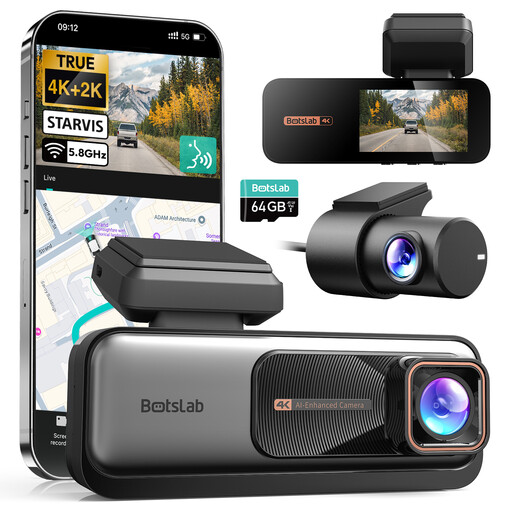
Why this choice suits this profile: This front and rear model is ideal for long journeys, professional drivers, and vehicles that are regularly parked outside.
The product page states that 24-hour parking mode requires a separate hardwiring kit. With a 64 GB microSD card reportedly included, there are fewer extras to buy to get started.
Front 4K and rear 2K video, GPS, 5.8 GHz Wi-Fi, Sony STARVIS sensor, and ADAS alerts as advertised.
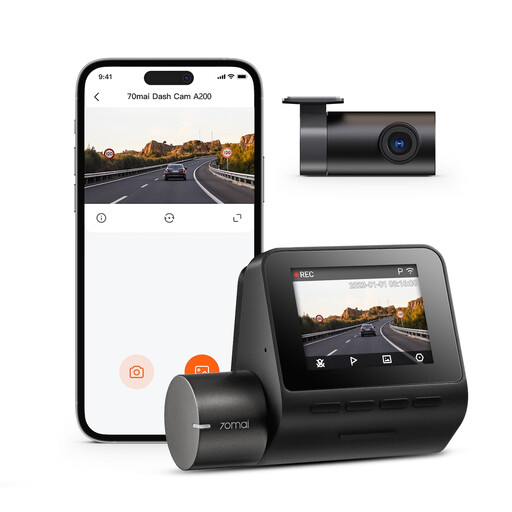
Why this choice suits this profile: This kit, comprising a front and a rear camera, is ideal for daily commutes and drivers who want a dual setup without jumping straight to 4K.
The product page states that the microSD card is not included. This means you can plan to order a card suitable for video recording at the same time.
Two 1080P cameras, front recording at 60 frames per second in single mode, Wi-Fi, 2-inch IPS screen, and G-sensor.
We've put together a comprehensive, real-time selection of products that meet these demanding criteria, as well as European safety regulations.
Install the camera behind the rear-view mirror, without encroaching on the driver's field of vision. Point the lens towards the horizon rather than the bonnet. Once installation is complete, check the date and time, then do a short test run both during the day and at night.
To preserve the battery, only activate parking mode with a suitable connection and under-voltage protection. Also remember to format the card regularly from the camera, after backing up any videos you need.
Footage should be used appropriately. Avoid publicly sharing recognisable faces or number plates. In the event of an incident, keep the original file and check the relevant rules before sharing it.
Its use in a private vehicle is generally permitted. However, recording and sharing footage must respect privacy and the rules relating to personal data. Avoid publishing images that could identify individuals or vehicles without taking the necessary precautions, and check the conditions that apply to your situation.
The budget isn't limited to the price of the camera. It may also include a suitable microSD card, a hardwiring kit for 24-hour parking mode, and, depending on the model, various accessories or connected services. A camera with an app may also use more data if you regularly transfer videos.
This depends on the temperature inside the cabin, the quality of the power supply, the memory card, and the recording frequency. Models equipped with a supercapacitor are designed to better withstand certain temperature variations. It's still a good idea to check the files, cables, and mount several times a year.