Fans of intense cocoa flavours
You want to know the cocoa content of the chocolate you’re serving. A bar may clearly display this percentage, but you shouldn’t assume it also applies to a box from the same brand.


If everyone is expecting dark chocolate, choose a box whose pieces are explicitly described as dark chocolate. A mixed assortment of dark, milk and white chocolate won’t meet that expectation. For a more intense cocoa flavour, look for a percentage listed for the exact product you’re considering. Flavours, sugars per 100 g and allergens also matter when choosing.
You want to know the cocoa content of the chocolate you’re serving. A bar may clearly display this percentage, but you shouldn’t assume it also applies to a box from the same brand.
You’re looking for different flavours to share. A dark chocolate assortment with caramel or hazelnut is a good fit, while a box combining dark, milk and white chocolate is suitable only if all three types have a place on the table.
You want to compare sugars, ingredients or allergens before serving the box. The colour of the chocolate is no substitute for checking the information for each specific product.
For Friday drinks, first decide whether every piece needs to be dark chocolate, then compare the ingredients and the size of the box for sharing.
| Criteria | What to check | Who is it for? |
|---|---|---|
| Cocoa intensity | Look for a cocoa percentage on the box itself, and check that every piece is described as dark chocolate. The word ‘dark’ alone doesn’t tell you the cocoa content. | If the group mainly wants an intense cocoa flavour, I want to be able to identify the stated cocoa content without having to infer it from the name of the box. Around 42% of consumers prioritise this intensity. |
| Variety to share | Compare the flavours, the types of chocolate included and the number of pieces or the weight of the box. | When there are different tastes around the table, I may prefer a range of recipes, even if they aren’t all dark chocolate. Variety comes first for around 33% of consumers. |
| Ingredients and labelling | Check the sugars per 100 g, as well as the ingredients list and allergens for the product you’re serving. | Before putting the box on the table, I need to know what the pieces contain and be able to check their nutritional information. This is the priority for around 25% of consumers. |
A bar may display a precise percentage, while a box of chocolates might only list its chocolate types and flavours. The Carrefour Sélection 90% bar featured by Carrefour France therefore tells you nothing about the cocoa content of its box of dark chocolates.
If the percentage matters to your guests, look for it on the exact product you’re going to serve.
The Lindt Champs-Élysées box described by Auchan contains dark, milk and white chocolate pieces. Its larger size doesn’t change what’s inside.
Check the assortment description before buying if every piece needs to be dark chocolate.
Santé publique France explains that displaying the Nutri-Score is voluntary. Its absence alone doesn’t tell you what a chocolate’s nutritional values are.
Check the nutritional information, ingredients and allergens. If a Nutri-Score is shown, treat it as additional information.
The contribution described by Légifrance applies to drinks and liquid preparations for drinks, not solid boxes of chocolates. Sugar content is still something worth comparing between chocolates.
To compare two products, check their sugar values on the same basis: per 100 g.
These products help you distinguish between an all-dark box, a flavoured assortment and a mixed box; they’re not all the same type of product.
Two assortments illustrate different options for Friday drinks.
Carrefour France lists a box of dark chocolates and, separately, a bar with a stated cocoa percentage.
Its product listings let you check the contents of some chocolate assortments.
The retailer offers ordering options such as Drive, pedestrian collection and delivery.
The retailer may be one of your options when shopping for chocolates to serve with drinks.
These two dark chocolate bars can be served alongside a box of chocolates to share. They aren’t a substitute for the box format you’re looking for to serve with drinks.
 Image unavailable
Serve this alongside a box if you’d like to offer chocolate with a stated cocoa content. This 100 g bar isn’t an assortment of chocolates.
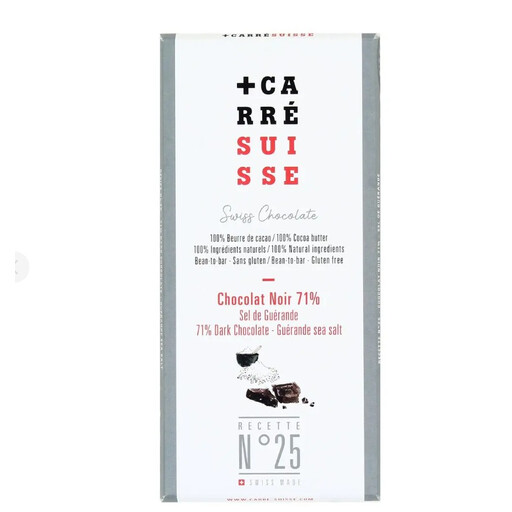 Image unavailable
Consider this as an extra if you’d like to serve a bar flavoured with Guérande sea salt. The 100 g bar isn’t a box of chocolates; check the label for this product’s cocoa content, ingredients and allergens.
No. The text provided by Légifrance concerns drinks and liquid preparations for drinks, not a box of solid chocolates. When choosing between two boxes, you can compare their sugars per 100 g without confusing this value with a tax on the product.
No. Santé publique France says producers can choose whether to display the Nutri-Score. If it isn’t shown on a box, check its nutritional information and ingredients list rather than drawing conclusions from its absence.
Check the allergens listed for the exact product before serving it. Auchan’s listing for the Lindt Excellence dark chocolate assortment mentions hazelnuts, milk and soya, among other things; another box may have different ingredients.
Follow the storage instructions on the packaging of the box you’ve bought. For the Lindt Excellence assortment featured by Auchan, the listing recommends storing it in a cool, dry place.
No: the term ‘dark’ alone doesn’t tell you how much sugar it contains. Auchan’s listing for the Lindt Excellence assortment states that it contains 46 g of sugars per 100 g. Compare this with the other boxes you’re considering, using the same basis.