Who are these biscuits for?

Anyone putting together a sharing platter

If guests will be helping themselves throughout the evening, check the shape of the biscuits and the pack contents before choosing. A biscuit stick can be picked up and enjoyed straight away; chocolate-topped biscuits are best served on a suitable platter.

Fans of a pronounced cocoa flavour

A recipe may state how much dark chocolate it contains without specifying the cocoa percentage of that chocolate. If the cocoa percentage is what will determine your purchase, look for it explicitly on the packaging.

Anyone who pays close attention to ingredients

To compare sugars or serve biscuits to guests with allergies, check the nutritional information and ingredients list on the packet you actually buy.

What should you check before buying?

For this kind of evening, ease of serving, the cocoa flavour you’re looking for and the ingredients each meet different needs. Check whichever of these matters to your guests.

What to consider What to check Who is it for?
Serving and sharing The shape of the biscuits, the net weight and, if stated, the number of pieces. If everyone will be helping themselves throughout the evening, I look for a biscuit that’s easy to pick up and enough to suit my platter; around 38% of consumers put ease of serving first.
The cocoa flavour you’re looking for An explicitly stated cocoa percentage, which is different from the proportion of dark chocolate in the recipe. I want a pronounced cocoa flavour, without relying on the words ‘dark chocolate’ alone; this intensity is the priority for around 37% of consumers.
Ingredients Sugars per 100 g, any sweeteners and the allergens listed on the packet you buy. Before serving several people, I want to know what the biscuit contains so I can make an informed choice and let guests with allergies know; around 25% of consumers prioritise this ingredients information.

Common misconceptions to avoid

  • Assuming ‘dark chocolate’ means a high cocoa percentage

    Carrefour’s product listings for LU Pépito and Petit Écolier state that their recipes contain 27% and 48% dark chocolate respectively. These figures describe how much chocolate is used, not the cocoa percentage of that chocolate.

    If cocoa content is the deciding factor for you, look for an explicit figure on the packet before buying.

  • Reading too much into the absence of a Nutri-Score

    In France, the DGCCRF says that a nutrition declaration is compulsory for the relevant prepacked foods, while the Ministry for the Economy states that displaying a Nutri-Score is optional. Its absence therefore tells you nothing about a biscuit’s ingredients.

    Compare the nutritional values per 100 g, especially sugars, fat and salt, then consider the portion you plan to serve.

  • Assuming ‘no added sugars’ means ‘no sweeteners’

    Auchan’s listing for the Gerblé biscuit bearing this claim states that the recipe contains maltitols and 24 g of polyols per 100 g.

    If you’re considering this product, read the sugars and polyols figures alongside the ingredients list.

  • Serving several varieties without keeping their packets

    Ingredients and allergens vary between recipes. The listings for Mikado, Gerblé and Carrefour Bio products, for example, mention wheat or milk, as well as other allergens or possible traces depending on the biscuit.

    Keep each packet close at hand throughout the evening and check its information before offering a biscuit to anyone with an allergy.

Brands to know

LU

Granola, Pépito and Petit Écolier are among the dark chocolate biscuits available in different shapes for sharing.

  • Carrefour’s listings state that Pépito contains 27% dark chocolate and Petit Écolier 48%.
  • These figures don’t tell you the cocoa percentage of the chocolate. Check the allergens for the product you choose too.

Mikado

The dark chocolate variety comes in sticks, making it easy for guests to pick one straight from the platter.

  • Joybuy’s listing describes biscuit sticks coated in dark chocolate.
  • The proportion of chocolate coating doesn’t tell you the cocoa percentage. Check the allergens on the packet as well.

Gerblé

The dark chocolate variety labelled ‘no added sugars’ may appeal if you prioritise comparing the stated sugar content.

  • Auchan’s listing states that this variety contains 0.5 g of sugars per 100 g.
  • It also states that it contains 24 g of polyols per 100 g. Check the ingredients list if you want to avoid sweeteners.

Carrefour Bio

The variety reviewed is an organic biscuit filled with dark chocolate, sold in a 185 g pack.

  • Carrefour’s listing states that the recipe contains 15.9% dark chocolate and 15% wholemeal wheat flour.
  • The organic label doesn’t tell you the cocoa percentage of the chocolate or the sugar content. Check the nutritional values and allergens.

Bjorg

The variety reviewed combines an organic biscuit filled with dark chocolate and several types of cereal.

  • Auchan’s listing states that the recipe contains 23% dark chocolate, as well as 6 g of fibre and 23 g of sugars per 100 g.
  • The proportion of chocolate isn’t a substitute for a cocoa percentage. Check the ingredients list too if cereals or allergens are important to your choice.

Dark chocolate biscuit sticks on Joybuy

These two Mikado Dark Chocolate pack sizes are ideal when guests will be helping themselves to biscuit sticks throughout the evening. If you’re looking for a particularly pronounced cocoa flavour, check the cocoa percentage on the packet before choosing either one.

Mikado Dark Chocolate biscuits 75 g

Mikado Dark Chocolate 75 g

A 75 g pack of dark chocolate biscuit sticks to consider for a sharing platter. If cocoa content will guide your choice, check the percentage on the packaging. If any guests have allergies, also check the packet you buy for information about wheat, milk, soya and possible traces of nuts.

View on Joybuy
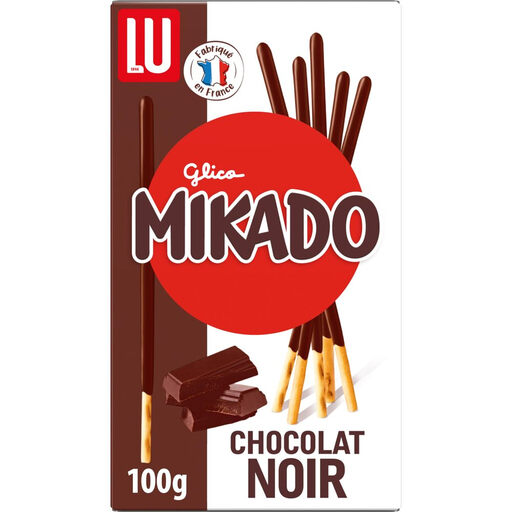
Mikado Dark Chocolate biscuits 100 g

Mikado Dark Chocolate 100 g

This 100 g pack keeps the biscuit-stick format, making it easy to share. The proportion of chocolate coating doesn’t tell you the cocoa percentage, so check the packaging if that’s important to you. Before serving, also check the packet for information about wheat, milk, soya and possible traces of nuts.

View on Joybuy

Frequently asked questions

Does ‘dark chocolate’ guarantee a pronounced cocoa flavour?

No. On its own, it doesn’t tell you the cocoa percentage of the chocolate. Carrefour’s listings for LU Pépito and Petit Écolier state the proportion of dark chocolate in each recipe, which is a different measure. If you’re looking for a specific cocoa percentage, check that it’s stated on the packet.

Do chocolate biscuits have to carry a Nutri-Score?

No. According to the Ministry for the Economy, displaying one is optional in France. The DGCCRF states, however, that a nutrition declaration is compulsory for the relevant prepacked foods. You can compare their values per 100 g even if there’s no logo.

Does a ‘no added sugars’ biscuit contain no sweeteners?

Not necessarily. Auchan’s listing for the Gerblé dark chocolate biscuit bearing this claim states that it contains maltitols and 24 g of polyols per 100 g. Check the ingredients list and nutritional information for the variety you choose.

How should you serve the biscuits if a guest needs to check the allergens?

Keep the packaging for each variety beside the platter and check it before serving. Allergens and possible traces vary between recipes, so a brand name or biscuit shape is no substitute for the information on the packet you buy.

Does the ‘soda tax’ apply to chocolate biscuits?

No, not to solid biscuits. Article 1613 ter of the General Tax Code, published by Légifrance, covers drinks and liquid preparations for drinks intended for human consumption. Sugar content is still worth comparing between biscuits, but it has no bearing on this levy.