If you need to buy a bar in a hurry, start by looking at dark chocolate around 70% if you want a pronounced flavour without going straight for a very bitter taste. Bars at 85% or more are better suited to those who already enjoy this profile. The cocoa percentage alone isn’t enough to help you choose: check the sugars per 100 g, ingredients, allergens and pack size, especially if you’ll also use the bar for baking.
Who is this choice for?
In a hurry and love intense dark chocolate
You’re looking for a bar with a pronounced cocoa flavour, fast. Lindt’s Excellence range includes several cocoa percentages, from 70% to 100%, while E.Leclerc stocks an 85% Equador bar, among others. The percentage on the pack helps you identify the profile you want to explore.
Careful label readers
You want to compare sugars and ingredients rather than rely on the cocoa percentage alone. For relevant pre-packed foods, the nutrition declaration includes values per 100 g. Be sure to check the allergens in your chosen bar, too.
Planning to bake
You want a bar that can come in handy for an impromptu dessert. Nestlé Dessert and Lindt Dessert both include dark chocolate options intended for baking, so distinguish these from a bar bought mainly for eating as it is.
What should you check in store?
Start with how you plan to use it and the intensity you’re after, then compare the label and weight of the specific bar.
| What to consider |
What to check |
Who is it for? |
| Cocoa intensity |
Compare the percentage shown and check whether it applies to the whole bar or just its chocolate portion. |
If you already enjoy very intense dark chocolate, cocoa percentage is your first guide. Around 42% of consumers say this intensity is their top priority. |
| Sugars, ingredients and allergens |
Check the sugars per 100 g, the ingredients list and the allergen information for the specific product. |
If you need to compare recipes or account for an allergen, ingredients matter more than the cocoa percentage. This is the top priority for around 33% of consumers. |
| Pack size and intended use |
Check the net weight and, if you plan to bake, whether it’s labelled for desserts or baking. |
For an occasional treat or a quick dessert, the main thing is to find a pack size that suits the purpose. This is the top priority for around 25% of consumers. |
What should you watch out for?
-
Assuming the cocoa percentage tells you everything about its nutrition
A high-cocoa bar is about more than its percentage: check sugars, fat and ingredients separately on the label.
Choose the intensity you enjoy, then compare the nutritional values per 100 g and the ingredients in the bars you’re considering.
-
Rejecting a bar because it has no Nutri-Score
According to the French Directorate-General for Competition Policy, Consumer Affairs and Fraud Control (DGCCRF), Nutri-Score labelling is voluntary in France. Its absence alone doesn’t tell you anything conclusive about the bar. For relevant pre-packed foods, the nutrition declaration is still the information to check.
Use Nutri-Score when it appears on the product, but don’t let it replace a closer look at the nutrition information and ingredients.
-
Assuming the ‘sugar tax’ applies to chocolate
The levy described by the French Official Public Finance Bulletin – Taxes applies to relevant non-alcoholic drinks and fruit juices containing added sugars, not chocolate bars.
When choosing a bar, focus on its label, intensity and pack size rather than this levy.
Brands to compare
Lindt
According to Lindt France, the Excellence range includes dark chocolate bars with different cocoa percentages, including 70%, 85%, 90%, 99% and 100%. Lindt Dessert also includes a dark chocolate option intended for baking.
- The percentages shown make it easier to find the intensity you’re after.
- A bar with added ingredients or one made for desserts can’t be compared with a plain dark chocolate bar on cocoa percentage alone.
Côte d'Or
Carrefour France lists a 90 g Côte d'Or organic dark chocolate bar with 70% cocoa.
- This gives you a specific recipe and pack size to consider at around 70%.
- This bar’s features aren’t representative of the whole Côte d'Or range, so check the label of the one you choose.
Nestlé Dessert
Nestlé France’s range of chocolate for desserts includes options such as Dark and Intense.
- A dessert label can help you find a bar that will also come in handy in the kitchen.
- Check the cocoa percentage and pack size of the specific bar if you’re looking for a particular intensity or quantity.
Carrefour Bio
Carrefour France features a 70% Carrefour Bio dark chocolate bar, with an ingredients list that includes cocoa mass, cane sugar, cocoa butter and vanilla extract.
- The ingredients listed give you a way to assess this recipe beyond its cocoa percentage.
- To compare two bars, check the nutrition information and packaging for each one.
Equador (Marque Repère / E.Leclerc)
E.Leclerc lists a 100 g Equador dark chocolate bar with 85% cocoa, among other products.
- This bar gives you a point of comparison if you’re looking for a high cocoa percentage.
- Check what your store has in stock before counting on a specific pack size or cocoa percentage.
Bars available on Joybuy
These bars cover a range of last-minute needs: 70% or 85% dark chocolate for eating as it is, a bar with added ingredients, and dark chocolate for desserts and baking. Choose according to how you plan to use it and the details given for each bar.
 Image unavailable
Lindt Excellence dark chocolate, 85% cocoa, 100 g
Worth considering if you already enjoy dark chocolate with a very pronounced cocoa flavour.
A 100 g bar with 85% cocoa. If you prefer a less intense dark chocolate, compare it with an option around 70%.
View on Joybuy
 Image unavailable
Poulain Fine dark chocolate, 70%, 100 g
An option to consider if you’re looking for a dark chocolate bar around 70% to enjoy straight away.
100 g pack. If you want to avoid maltitol, check the ingredients list. The product information warns that excessive consumption may have a laxative effect.
View on Joybuy
 Image unavailable
Lindt Excellence dark chocolate, 70%, mini bar 35 g
The 35 g size is ideal if you want a small bar for an occasional treat.
It contains 70% cocoa. If allergens are a concern, check the packaging: the product information warns that it may contain traces of nuts, milk and soya.
View on Joybuy
 Image unavailable
Carré Suisse organic dark chocolate, lemon and green pepper, 100 g
This bar with added ingredients is for anyone looking for something different from plain dark chocolate.
The cocoa percentage shown for this product applies to its chocolate portion, not the whole bar. Check the packaging if you need to avoid milk, nuts, soya or gluten, as the product information warns that traces may be present.
View on Joybuy
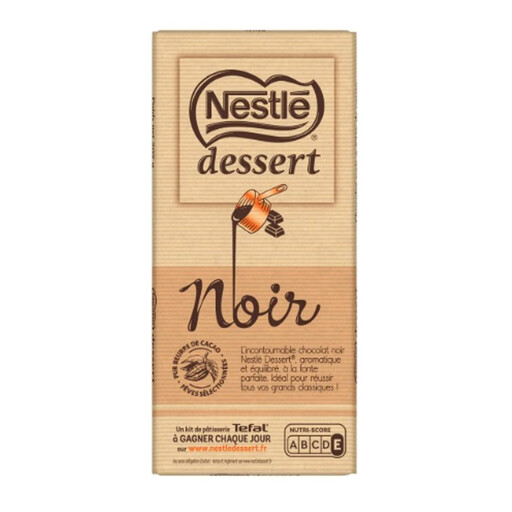 Image unavailable
Nestle dark chocolate for desserts, 205 g
Worth considering if you also want to use your last-minute chocolate purchase to make a dessert.
The stated pack size is 205 g. If you’re looking for a specific cocoa percentage, check the packaging. The product information also warns that it may contain traces of milk and nuts.
View on Joybuy
Frequently asked questions
For a quick purchase, should I choose 70% or 85% cocoa?
Start by looking at bars around 70% if you want a pronounced dark chocolate flavour without very strong bitterness. Look at 85% or more if you already enjoy that intensity. Either way, compare the sugars per 100 g and the ingredients of the specific bar.
Is Nutri-Score compulsory on dark chocolate in France?
No. The DGCCRF describes Nutri-Score as voluntary labelling in France; a nutrition declaration is compulsory for relevant pre-packed foods. If the logo appears on a bar, consider it alongside the nutrition information rather than as your only point of reference.
Does the ‘sugar tax’ apply to chocolate bars?
No. The levy on non-alcoholic drinks containing added sugars, described by the French Official Public Finance Bulletin – Taxes, applies to drinks and fruit juices within its scope, not chocolate bars.
What should I check on a dark chocolate bar with added ingredients?
Read the ingredients list and allergen information for the specific bar. Also check which part of the product the cocoa percentage applies to: when there are added ingredients, it may refer to the chocolate portion rather than the whole bar.


