For a budget-friendly shop, start by comparing the size and recipe of bars that suit your tastes. A cocoa content of 70 to 72%, a more intense bar and a low-sugar recipe each meet different needs. If intensity is your priority, look for 85% cocoa or more. If you’re focusing on the sugars listed, check the ingredients and any warnings about sweeteners too. A label or Nutri-Score rating, if displayed, doesn’t replace these checks.
Who is this guide for?
Shoppers who compare pack sizes
You buy dark chocolate for everyday enjoyment and want to tell a small bar from a larger one. Products listed by Carrefour, E.Leclerc and Nestlé include 80 g, 100 g and 170 g options, so weight is worth factoring into your comparison.
Fans of intensely dark chocolate
You’re after a pronounced cocoa flavour and are considering an 85% or 99% bar rather than a 70% one. This gives you a guide to the flavour, but it doesn’t tell you everything about the product’s nutritional values.
Shoppers who check sugars and labels
You read the ingredients and nutrition information per 100 g, then check exactly what a label certifies. Some low-sugar recipes contain sweeteners; according to Santé publique France, displaying the Nutri-Score is voluntary.
What should you look for first?
First choose a recipe that suits your main need, then compare the weight, ingredients and nutrition information of the products you’re considering.
| Criterion |
What to check |
Who is it for? |
| Cocoa intensity |
The minimum cocoa content and the ingredients list. |
If I’m after a more intense flavour, I’ll look at bars labelled 85% or 99% rather than a 70% option. Around 31% of consumers say intensity is their top priority. |
| Amount per bar |
The stated weight and the recipe, so you can compare sizes suited to the same use. |
For my regular shop, I want to know how much each bar contains before choosing between smaller and larger sizes. This is the top priority for around 31% of consumers. |
| Sugars and sweeteners |
The ‘of which sugars’ figure per 100 g, any sweeteners and any associated warnings. |
If the sugars listed guide my choice, I also need to know whether the recipe contains polyols and read any related warning. Reducing sugar is the main priority for around 23% of consumers. |
| Labels and production |
The specific certification shown on the bar and the product’s ingredients. |
I want to choose based on organic certification or information about how the cocoa is sourced, without assuming this also tells me about the nutritional composition. Around 15% of consumers put this criterion first. |
What mistakes should you avoid?
-
Assuming all pack sizes are the same
The bars listed by retailers don’t all contain the same amount of chocolate; some weigh 80 g, while others weigh 100 g or more.
Check the weight and compare recipes intended for the same use, especially if you’re choosing between eating and baking chocolate.
-
Using Nutri-Score as your only guide
Santé publique France says that displaying it is voluntary. Whether or not it appears, you still need to read the nutrition information.
Check the values per 100 g, the ingredients and the allergen information on the bar you choose.
-
Overlooking sweeteners in a low-sugar recipe
The Auchan bar described by the retailer contains maltitol and lactitol. Its label warns that excessive consumption may have a laxative effect.
Read the ingredients list and the warning on the specific product before swapping it for your usual bar.
-
Assuming a label tells you everything about the ingredients
Organic and Rainforest Alliance claims refer to different characteristics. Neither tells you how much sugar a bar contains.
Check the certification shown, then look separately at the ingredients and nutrition values.
Useful brands to compare
Lindt
The EXCELLENCE range includes tasting bars with different cocoa contents.
- Lindt France states that its 100 g EXCELLENCE Dark 70% bar contains at least 70% cocoa and 30 g of sugars per 100 g.
- These values apply to this specific product, not every bar in the EXCELLENCE range.
Côte d’Or
Carrefour lists a 90 g Bio 70% bar.
- Its product details list cocoa mass, cane sugar, cocoa butter and vanilla extract.
- The organic status and 70% cocoa content apply to this product, not the whole range.
Nestlé
NESTLÉ DESSERT 70% is a bar marketed for baking.
- Carrefour’s product details state that this product contains at least 70% cocoa.
- Check that this size, intended for desserts, suits the way you plan to use it.
Carrefour
Carrefour Bio and Carrefour Sélection offer two examples of different recipes and sizes.
- Carrefour lists 28.7 g of added sugars per 100 g for its Bio 70% bar; its Sélection 72% bar weighs 80 g.
- The added-sugars figure for the first bar doesn’t describe the second.
Auchan
The retailer offers a 70% organic bar and another low-sugar recipe.
- The product details for the low-sugar recipe state that it contains 1.2 g of sugars per 100 g.
- This recipe contains maltitol and lactitol and carries a warning about excessive consumption.
E.Leclerc / Marque Repère
BIO VILLAGE and EQUADOR offer organic bars and options with higher cocoa contents to compare.
- E.Leclerc lists, among other products, a BIO VILLAGE 70% bar and EQUADOR bars at 85% and 99%.
- Check the cocoa content on the packaging of the product you choose: these bars aren’t interchangeable.
Bars to explore on Joybuy
These Joybuy bars cover several of the options discussed here: intense or 70% cocoa, an organic flavoured recipe and a smaller size. Compare each variant using its own packaging details and considering how you plan to use it.
 Image unavailable
Lindt Excellence 85% cocoa, 100 g
Worth considering if you’re looking for a dark chocolate bar labelled as containing 85% cocoa. If sugars or ingredients are important to your choice, check the details for this specific variant.
View on Joybuy
 Image unavailable
Poulain Fine dark chocolate 70%, 100 g
Consider this 100 g bar if you’re looking for dark chocolate labelled as containing 70% cocoa. Compare its ingredients with those of more intense bars rather than assuming the sugar content from the cocoa percentage alone.
View on Joybuy
 Image unavailable
CARRE SUISSE organic dark chocolate, lemon and green pepper, 100 g
This flavoured recipe is for anyone looking for organic dark chocolate rather than a plain bar. Check the ingredients and allergen information for this variant before choosing it.
View on Joybuy
 Image unavailable
Lindt Excellence dark chocolate 70%, mini bar 35 g
The 35 g size is a good option if you’re after a smaller bar rather than a 100 g one. Joybuy’s product details state that it contains at least 70% cocoa; check the packaging if allergens are a factor in your choice.
View on Joybuy
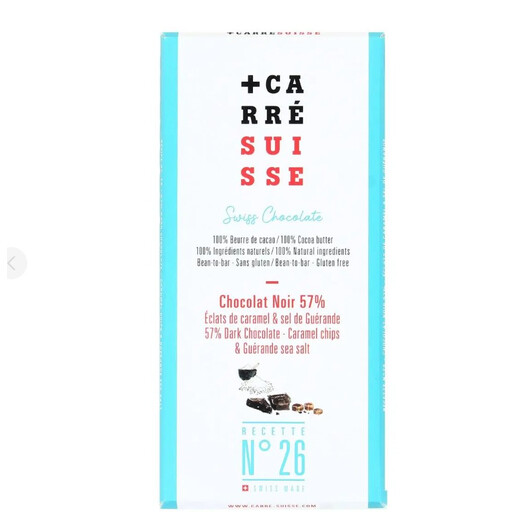 Image unavailable
CARRE organic dark chocolate, caramel and Guérande salt, 100 g
Worth considering if you prefer a caramel recipe to plain dark chocolate. The minimum 57% cocoa content applies to the dark chocolate in this recipe: don’t compare it with a plain bar labelled 70% or more. The caramel pieces contain milk.
View on Joybuy
Frequently asked questions
Does the tax on sugary drinks apply to a bar of dark chocolate in France?
No. The provisions published by Légifrance apply to drinks and liquid preparations for drinks, not solid bars. Sugar content is still useful to check when comparing recipes, but this levy doesn’t apply to chocolate.
Does a bar of dark chocolate have to display Nutri-Score?
No. Santé publique France says that producers display Nutri-Score voluntarily. If it appears, read it alongside the nutrition information per 100 g and the ingredients list, rather than making your decision based on the logo alone.
Does more cocoa automatically mean less sugar?
No. To find out how much sugar a recipe contains, check the ‘of which sugars’ figure in its nutrition information per 100 g. The cocoa percentage tells you the stated cocoa content first and foremost; it doesn’t replace checking the composition of the specific product.
Does an organic or Rainforest Alliance claim tell you how much sugar is in a bar?
No. These claims relate to characteristics other than sugar content. Check the exact certification on the bar, then look separately at its ingredients and nutrition values per 100 g.


