Who are these choices for?

For enjoying dark chocolate throughout the week

If you’re after a pronounced cocoa flavour, a 70% bar can be a good place to start. The taste also depends on the recipe and flavourings, so the percentage alone won’t tell you how bitter it will taste.

For comparing ingredients

If sugar, ingredients or allergens influence your choice, check the label on each bar. The nutritional information per 100 g makes it easier to compare different sizes, in line with DGCCRF guidance.

For making desserts

If you mainly need the bar for baking, look for an explicit indication that it’s suitable for this use. Then check how much your recipe requires and the allergen information on the packaging.

What should you look for on the shelf?

What to consider What to check Who is it for?
Flavour intensity The cocoa percentage and descriptions of the flavours or inclusions. If I’m looking for dark chocolate to enjoy throughout the week, I want a cocoa flavour I like without simply choosing the highest percentage; around 33% of consumers make intensity their main consideration.
Sugar, ingredients and allergens Sugar per 100 g, followed by the ingredients list and allergen information for the product you choose. If I’m comparing several bars on the shelf, I want to check their ingredients and spot any allergens before deciding; this is the priority for around 42% of consumers.
Use in baking An indication that it’s suitable for baking and the amount needed for your recipe. When I’m planning a cake or another dessert, I need a bar intended for that use rather than relying on the cocoa percentage alone; around 25% of consumers put baking first.

Which shortcuts should you avoid?

  • Assuming 70% cocoa means less sugar

    Cocoa percentage and sugar content are two separate pieces of information. You can’t compare one 70% bar with another based on that figure alone.

    Check the “of which sugars” line per 100 g on the bars you’re considering. If added sugars are listed separately, don’t confuse them with total sugars.

  • Using Nutri-Score as your only guide

    The DGCCRF says that displaying it is voluntary in France. So its absence doesn’t tell you anything conclusive about a bar’s ingredients.

    If it appears on the packaging, use it alongside the nutritional information and ingredients list.

  • Assuming all dark chocolate is suitable for every dietary restriction

    Ingredient and “may contain” information varies between products; the description “dark chocolate” doesn’t replace it.

    If you have an allergy or need to avoid an ingredient strictly, check the packaging of the bar you’ve bought before eating it.

  • Choosing chocolate for a dessert based on cocoa percentage alone

    A bar made for eating and one labelled for baking may have the same cocoa percentage but different recipes.

    For baking, check the stated use, ingredients and the amount required by your recipe.

Brands to consider

Lindt

The products reviewed include EXCELLENCE Dark 70% for eating and Lindt Dessert Dark 70% for baking.

  • Lindt France states that the EXCELLENCE product reviewed contains at least 70% cocoa.
  • Check the ingredients and allergen information for the specific product, as this information doesn’t apply to the whole range.

Nestlé Dessert

The 70% Dessert Dark bar featured by Carrefour is intended for baking.

  • This product states that it contains at least 70% cocoa.
  • Check its ingredients list and “may contain nuts” warning to make sure it’s suitable for your household.

Côte d’Or

The Bio Dark 70% product featured by Carrefour combines cocoa mass, cane sugar, cocoa butter and vanilla extract.

  • The product details state that this bar contains at least 70% cocoa and ingredients from organic farming.
  • It may contain traces of nuts and milk; check the ingredients for each specific product.

Carrefour Bio

The Bio Dark 70% bar reviewed is available in a 200 g size.

  • Carrefour states that this specific product contains 28.7 g of added sugars per 100 g.
  • This figure doesn’t apply to other Carrefour Bio bars. The product details also say it may contain traces of nuts and milk.

Chocolate bars available on Joybuy

These options let you choose from dark chocolate bars for eating, a flavoured recipe and a bar made for desserts. Check the information on each pack that matters for your purchase.

100 g Lindt Excellence 85% dark chocolate bar

Lindt Excellence 85% dark chocolate 100 g

For enjoying dark chocolate with 85% cocoa. This 100 g bar can be compared with others using their nutritional information per 100 g. Check the allergen information on the packaging if it’s relevant to you.

View on Joybuy

100 g POULAIN 70% dark chocolate bar

POULAIN 70% dark chocolate 100 g

A 70% dark chocolate bar for anyone wanting to check its ingredients. The recipe includes maltitol and soya lecithin; the product information warns that excessive consumption may have a laxative effect. Check the exact labelling if you have an allergy or need to avoid an ingredient.

View on Joybuy

100 g CARRE SUISSE organic dark chocolate bar with lemon and green pepper

CARRE SUISSE organic dark chocolate with lemon and green pepper 100 g

For anyone looking for a bar to enjoy with lemon and green pepper inclusions, rather than plain dark chocolate. The stated cocoa content for this product refers to the chocolate part. The product information says it may contain traces of milk, nuts, soya and gluten; check the packaging if needed.

View on Joybuy

35 g Lindt Excellence 70% dark chocolate mini bar

Lindt Excellence 70% dark chocolate mini bar 35 g

A 35 g size to enjoy as it is. Compare its sugar content per 100 g, as you would with other bars, rather than trying to work it out from the cocoa percentage. The product information says it may contain traces of nuts, milk and soya.

View on Joybuy
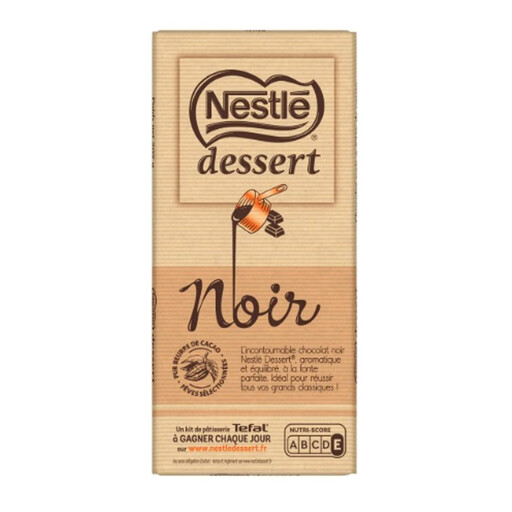
205 g Nestle Dessert dark chocolate bar

Nestle Dessert dark chocolate 205 g

For making desserts with a bar presented as suitable for baking and melting. If you’re looking for a specific cocoa percentage, check the packaging for this product before buying. Also check the “may contain” information for milk and nuts.

View on Joybuy

Frequently asked questions

Is Nutri-Score compulsory on dark chocolate bars in France?

No. The DGCCRF describes it as a voluntary labelling system. Nutritional information is generally compulsory for pre-packed foods, subject to regulatory exemptions, so check the sugar content per 100 g in particular.

Does the tax on sugary drinks apply to a chocolate bar?

Article 1613 ter of the French General Tax Code, published by Légifrance, covers drinks and liquid preparations for drinks intended for human consumption. A solid chocolate bar doesn’t fall within this scope; to compare it with another bar, check the sugar content per 100 g.

How do you compare two bars of different weights?

Compare their nutritional information per 100 g, then check the ingredients and allergens for each one. The DGCCRF says nutritional information is given per 100 g or 100 ml, providing a common basis regardless of pack size.

What should you check if you’re allergic to milk, soya or nuts?

Read the ingredients list and any “may contain” information on the packaging of the exact bar you’re buying. Information can vary between products, including dark chocolate bars and those made for baking.

Should you choose a bar for eating or one for desserts?

Choose according to how you’ll use it most: a bar made for eating if you mainly plan to enjoy it as it is, or one explicitly labelled for baking if you’ll use it to make desserts. In either case, check the stated cocoa content, sugar per 100 g and allergen information for the product you choose.