Fans of dark chocolate to enjoy on its own
You’re looking for a bar with around 70% cocoa for enjoying on its own, without assuming that the cocoa percentage alone tells you how much sugar it contains or what else is in it.


For a bar to enjoy on its own with a pronounced cocoa flavour, start with a recipe containing around 70% cocoa, then compare the sugars, saturated fat, ingredients and allergens. Choose a size to suit how much chocolate you expect to eat during the week. If you’re buying it for a recipe, look for chocolate intended for baking and check that its ingredients are right for the dish. If Nutri-Score appears on the packaging, use it to complement—not replace—the nutrition information.
You’re looking for a bar with around 70% cocoa for enjoying on its own, without assuming that the cocoa percentage alone tells you how much sugar it contains or what else is in it.
You’re choosing a size to suit several occasions and checking the ingredients, allergens and storage instructions before stocking up.
You’re looking for dark chocolate intended for baking, with a cocoa percentage and ingredients that suit the recipe you have in mind.
| Criterion | What to check | Who is it for? |
|---|---|---|
| Cocoa flavour | The stated cocoa percentage and the ingredients list. | I want a bar to enjoy with a pronounced cocoa flavour, without judging it by the front of the packaging alone; around 40% of consumers prioritise this intensity. |
| Nutrition information | Sugars and saturated fat per 100 g; Nutri-Score only if it appears on comparable products. | When choosing between bars, I want to look at their nutrition values first; this is the main priority for around 30% of consumers. |
| Size and use | Net weight and whether it’s intended for baking; for a recipe, check any ingredients that could affect the result. | For chocolate to enjoy during the week or for a planned dessert, I need a suitable size and recipe; around 30% of consumers prioritise this use above all else. |
In France, Nutri-Score is a voluntary label, as explained by Santé publique France and the DGCCRF. Its absence alone doesn’t tell you whether a bar’s nutrition values are good or bad.
If it is shown, compare products in the same category; also read the nutrition declaration and ingredients list.
This information alone doesn’t tell you how much sugar the bar contains or which allergens may be present. The Lindt France and Carrefour France product pages for the bars mentioned list different recipes and allergen information.
Check the values per 100 g, ingredients and allergen information for the exact product you’re buying.
A bar for enjoying on its own and chocolate intended for desserts may not suit the same needs. Some ingredients can also affect the result of a recipe.
Decide whether you’ll mainly enjoy the chocolate as it is or use it for baking, then check the net weight and ingredients.
Lindt France describes EXCELLENCE Noir 70 % as a 100 g bar for savouring, with at least 70% cocoa.
Carrefour France lists an organic dark chocolate bar with 70% cocoa in a 200 g size.
The Côte d’Or organic dark chocolate bar listed by Carrefour France contains at least 70% cocoa and weighs 90 g.
Carrefour France lists Nestlé Dessert 70 % as a 170 g dark chocolate bar for baking, with at least 70% cocoa.
This selection includes dark chocolate bars to enjoy on their own and dark chocolate intended for desserts. Choose according to how you plan to use it and check the ingredients for each variant.
 Image unavailable
This smaller size is a good option if you’re looking for a 70% cocoa dark chocolate bar to enjoy on its own. The product page for this variant states that it may contain traces of nuts, milk and soya; check the packaging if you need to avoid these allergens.
 Image unavailable
This 100 g bar is a good choice if you’re looking for dark chocolate labelled as containing 70% cocoa. The recipe contains maltitol, and the product page warns that excessive consumption may have a laxative effect; read the label before choosing this variant.
 Image unavailable
This bar is for anyone looking for a recipe with lemon and green pepper rather than plain dark chocolate. The product page states that it may contain traces of milk, nuts, soya and gluten; check the packaging if these details matter to you.
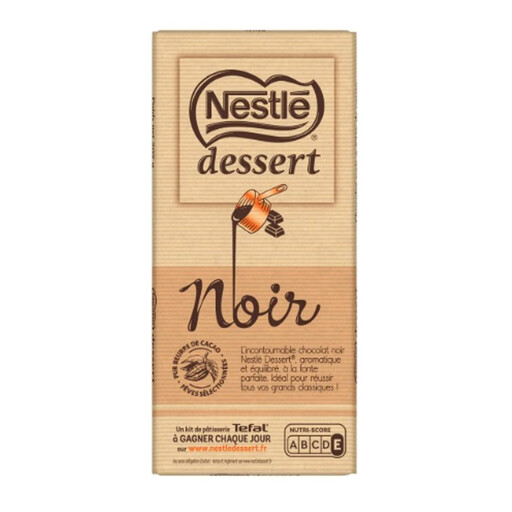 Image unavailable
This dark chocolate is marketed for making desserts. If your recipe calls for a specific cocoa percentage, check the packaging before you buy; the product page also states that it may contain traces of milk and nuts.
No. The contribution described by the Bulletin officiel des finances publiques-Impôts applies to non-alcoholic drinks containing added sugars or artificial sweeteners, not to dark chocolate bars.
No. Santé publique France and the DGCCRF explain that displaying it is voluntary. If it appears on the packaging, it can help you compare similar products, but it doesn’t replace reading the nutrition information.
Check the product name, ingredients, allergens, nutrition values, net weight and best-before date. When comparing dark chocolate, also check the cocoa percentage and sugars per 100 g.
No. The cocoa percentage alone doesn’t tell you how much sugar a particular bar contains. Compare the “of which sugars” value per 100 g and the ingredients list for each product.