Fans of intense cocoa
You want to compare bars that state their cocoa content, rather than choosing milk chocolate out of habit. The percentage and ingredients list will help you tell the different products apart.


For a National Day celebration, choose a dark chocolate bar if you want the cocoa to take centre stage. A milk-and-dark recipe lets you enjoy dairy ingredients, while milk chocolate is a good choice if that’s your preference. Before buying for a group, check the ingredients, allergens and size of each bar: the word “dark” alone doesn’t tell you everything you need to know.
You want to compare bars that state their cocoa content, rather than choosing milk chocolate out of habit. The percentage and ingredients list will help you tell the different products apart.
You’d like to try a recipe that combines dark cocoa with dairy ingredients. The label on the product you choose is still key, particularly if you need to avoid certain ingredients.
If you’re serving several guests, consider everyone’s taste preferences, the bar’s weight and the allergens in each recipe, especially if it contains added ingredients.
For a celebration, first decide which type of chocolate you’d like to serve. Then check the exact bar before choosing a size to share.
| What matters | What to check | Who is it for? |
|---|---|---|
| Cocoa intensity | The bar’s description and cocoa percentage. | If I want the cocoa to take centre stage, I compare the stated percentages rather than relying on the word “dark” alone. Around 31% of consumers would put this level of intensity at the top of their list. |
| Milk-and-dark recipe | The recipe description and its dairy ingredients. | If I’d like to try a milk-and-dark bar without giving up dairy ingredients, the type of recipe matters more to me than switching straight to dark chocolate. Around 31% of consumers would prioritise this milk-and-dark combination. |
| Ingredient suitability | The ingredients list, highlighted allergens and any “may contain” warnings. | If I’m sharing a bar with someone who needs to avoid certain ingredients, I need to be able to check the exact product. Around 23% of consumers would make this their main priority. |
| Sharing size | The weight and any added ingredients in each bar. | When serving several guests, I look for a size that suits the number of people and a recipe whose ingredients everyone can check. Around 15% of consumers would put size and labelling first. |
Some dark chocolate products listed by Carrefour contain milk or soya, or warn that they may contain traces of other allergens. So the type of chocolate alone isn’t enough to tell you whether a bar is suitable for a guest.
Check the ingredients and any “may contain” warnings on the packaging of the exact product.
The DGCCRF describes Nutri-Score as a voluntary label in France. Its absence doesn’t, on its own, mean the labelling is non-compliant.
If it appears on the product, use it as additional information, and check the ingredients and nutrition information too.
The scheme described by Légifrance applies to drinks and liquid preparations for drinks, not solid chocolate bars.
When comparing chocolate bars, look instead at their weight, ingredients and nutrition information.
Two bars that state their cocoa content can still differ in ingredients, added inclusions and allergen warnings. The percentage alone doesn’t tell you everything about the recipe.
Consider this figure alongside the product description, ingredients list and size, especially if you’re buying a bar to share.
The Excellence Fusion Milk and Dark 70% bar listed by Carrefour is an example of a recipe combining dark cocoa with dairy ingredients.
Carrefour lists a Côte d’Or Dégustation Noir Brut bar labelled “cocoa: 86% minimum”.
Carrefour lists a dark chocolate bar with at least 70% cocoa; the range also includes other recipes.
Among the recipes listed by Carrefour is the Milka Tendre Noir bar, which is distinct from the brand’s milk chocolate bars.
These products are selected for anyone looking for dark chocolate for a celebration. Compare their cocoa content where stated, ingredients and weight to suit your guests. A flavoured dark chocolate bar may not be the right choice if they prefer plain chocolate.
 Image unavailable
Worth considering if your priority is a dark chocolate bar with a high stated cocoa content. If you’re sharing it, check the ingredients list and allergens on the exact product packaging.
 Image unavailable
An option if you’d like to compare a 70% dark chocolate bar with the other recipes in this selection. Check its ingredients and nutrition information if these are important to your choice.
 Image unavailable
This recipe is a good one to compare with plain dark chocolate. Bear in mind the lemon zest and green pepper if you’re choosing for a group with different tastes.
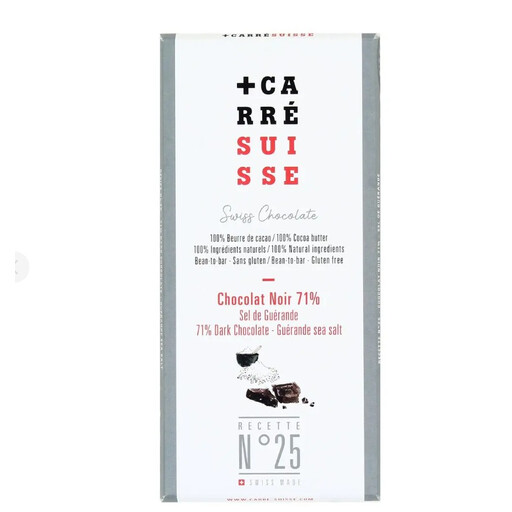 Image unavailable
Consider this if a dark chocolate recipe with a savoury twist suits your guests’ tastes. To compare its ingredients with those of a plain bar, check the details for the exact product.
 Image unavailable
This smaller size makes it easy to choose an individual dark chocolate bar. If you’re planning to serve one to several people, bear in mind that it weighs 35 g and check the ingredients on the packaging.
No. The DGCCRF describes Nutri-Score as a voluntary label. If it appears on the bar, you can consider it alongside the ingredients list and nutrition declaration; its absence alone doesn’t indicate an offence.
No: the scope of the levy described by Légifrance covers drinks and liquid preparations for drinks, not solid chocolate bars. When choosing between two bars, compare their own labels rather than assuming the levy applies to them.
In France, according to the Ministry of the Economy, milk chocolate must contain at least 25% cocoa dry matter and 14% milk. The description “dark chocolate” refers to chocolate containing at least 43% total cocoa dry matter, including at least 26% cocoa butter. These thresholds define the categories; check the percentage stated on the specific bar to narrow down your choice.
Check the ingredients, highlighted allergens and any warnings about traces on the exact product packaging. The DGCCRF reminds producers that allergens must be highlighted; don’t assume they’re absent just because the bar is described as “dark chocolate”.
Check the best-before date and storage instructions on the packaging of the bar you buy. These product-specific details are more useful than a general storage rule that may not apply to every recipe.