For moulded or coated chocolates, first look for a chocolate that is specifically recommended for baking. If you’re serving pieces to eat, a 70% cocoa dark chocolate is a useful point of comparison, but that percentage doesn’t guarantee that children will like it. In either case, compare the sugars per 100 g and check the ingredients and allergens for the product you choose.
Who is this choice for?
Parents making homemade sweets
For a recipe that involves melting, moulding or coating, a product’s stated suitability for baking is a more useful guide than its cocoa percentage alone. Lindt, for example, describes its DESSERT Noir Intense bar as suitable for baking.
Families trying a more cocoa-rich flavour
A 70% bar is a way to introduce children to dark chocolate with a pronounced flavour, but it’s impossible to know in advance whether they’ll like it. Try a small amount before using it in a whole batch.
Shoppers checking for allergens
For every chocolate you use, check the ingredients and any ‘contains’ or ‘may contain’ statements. Depending on the product, the Lindt, Carrefour Bio and Joybuy products mentioned here flag milk, soya, nuts or sesame.
What should you look for?
First decide whether you’ll melt the chocolate for a recipe or serve it in pieces. Then compare the flavour, nutrition label and allergen information.
| What to check |
Look for |
Who is it for? |
| Intensity of flavour |
Cocoa percentage and a small taste test. |
If your children are trying dark chocolate for the first time, find out how they react to its bitterness before making all the sweets; around 30% of consumers prioritise a flavour they enjoy. |
| Use in recipes |
A recommendation for baking or an indication that it’s suitable for your intended recipe. |
To mould or coat homemade sweets, look for chocolate that’s presented as suitable for baking; around 30% of consumers say this is their main consideration. |
| Sugars |
The value per 100 g and the difference between ‘sugars’ and ‘added sugars’. |
When comparing two recipes, check the nutrition values on the same basis rather than assuming dark chocolate is low in sugar; around 20% of consumers prioritise this. |
| Allergens |
The ingredients and any ‘contains’ or ‘may contain’ statements on the packaging you choose. |
If a child needs to avoid an ingredient, its presence or a warning about traces takes priority over flavour and format; this is the main concern for around 20% of consumers. |
Mistakes to avoid
-
Applying the sugary drinks levy to solid chocolate
The contribution described by the French Official Bulletin of Public Finances applies to non-alcoholic drinks containing added sugars, not to chocolate bars or sweets.
When choosing chocolate, check the ingredients list and sugar content instead.
-
Ruling out a bar because it doesn’t have a Nutri-Score
France’s Ministry of the Economy says that displaying the Nutri-Score is optional in France. As the DGCCRF explains, a nutrition declaration is generally compulsory for prepacked foods.
Check the nutrition information per 100 g. If the logo appears on the packaging, treat it as extra information.
-
Assuming the cocoa percentage tells you how much sugar it contains
A 70% cocoa bar can still contain sugar. The product information for Lindt EXCELLENCE 70% and Nestlé noir 70% lists 30 g and 26.3 g of sugars per 100 g respectively. Carrefour Bio 70%, meanwhile, lists 28.7 g of added sugars per 100 g, which is a different measure.
Compare the same nutrient on a per-100 g basis, then consider how much you’ll use in each sweet.
-
Assuming ‘dark chocolate’ means it’s free from milk or nuts
Some dark chocolate products carry warnings about traces. The Côte d’Or dark chocolate and hazelnut bar listed on Joybuy contains hazelnuts, milk and soya.
If a child needs to avoid an allergen, check the packaging of the product you buy, including any ‘may contain’ statements.
Brands to consider when comparing labels
Lindt
The DESSERT Noir Intense 70% and EXCELLENCE Noir 70% ranges illustrate two stated uses: baking and eating as they are.
- According to Lindt’s product information, both of these products contain 30 g of sugars per 100 g.
- Their allergen information differs, so check the details for the specific bar you plan to use.
Nestlé
The product information for a Nestlé 70% dark chocolate describes a recipe made with cocoa mass, sugar, cocoa butter and vanilla.
- Product information published by Carrefour Traiteur in September 2022 lists 26.3 g of sugars per 100 g for this product.
- It warns that it may contain traces of nuts and milk; check the current packaging before buying.
Carrefour Bio
The product information for a 70% organic dark chocolate bar details its ingredients and nutritional information.
- Carrefour lists 28.7 g of added sugars per 100 g for this bar.
- The product information warns that it may contain traces of milk and nuts. ‘Added sugars’ shouldn’t be confused with the ‘sugars’ value on another bar.
Côte d’Or
The 45 g dark chocolate and hazelnut bar listed on Joybuy contains inclusions, so it’s different from plain dark chocolate.
- Its ingredients list identifies hazelnuts as an ingredient in this specific product.
- It also contains milk and soya, so it isn’t suitable for a recipe that needs to be free from nuts.
Dark chocolates to explore on Joybuy
These dark chocolate formats give you a choice between making something at home and serving pieces to eat. For moulded chocolates, check the stated use on each pack and try a small batch before making a larger one.
 Image unavailable
Poulain Extra Dark, 3 × 100 g
This pack of three bars may suit a recipe that needs several bars. Before using it to make sweets, check the sugars, allergens and recommended uses on the packaging.
View on Joybuy
 Image unavailable
Poulain Extra Dark, 200 g
This 200 g bar is another option to consider for a homemade recipe. If you’re going to melt or mould the chocolate, check its stated use and ingredients before making the sweets.
View on Joybuy
 Image unavailable
Lindt Excellence 70%, 35 g mini bar
The 35 g size is handy for trying the flavour of 70% cocoa chocolate before choosing one for several children. For a moulded recipe, check the stated use and allergens for this mini bar separately.
View on Joybuy
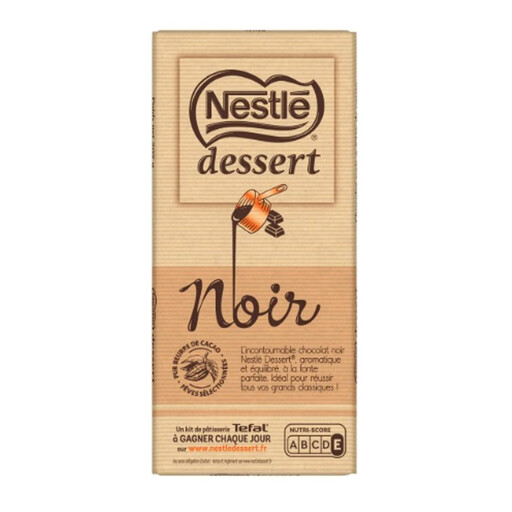 Image unavailable
Nestlé Dessert dark chocolate, 205 g
This 205 g Dessert bar is worth considering if you’re making a recipe with dark chocolate. Joybuy’s product information warns that it may contain traces of milk and nuts; also check the cocoa percentage and intended use on the packaging.
View on Joybuy
 Image unavailable
Lindt Excellence 85% cocoa, 100 g
This 100 g bar offers a more cocoa-rich flavour than a bar labelled 70%, but that doesn’t guarantee children will like it. Let them try it before using it in sweets, and check the allergens on the packaging.
View on Joybuy
Frequently asked questions
Is Nutri-Score compulsory on dark chocolate in France?
No. According to France’s Ministry of the Economy, displaying it is optional in France. The DGCCRF says that a nutrition declaration is generally compulsory for prepacked foods. Check the values per 100 g and the ingredients, whether or not the logo is shown.
Does the sugary drinks levy apply to dark chocolate sweets?
No, not to solid chocolate: the contribution described by the French Official Bulletin of Public Finances applies to non-alcoholic drinks containing added sugars. You should still check the sugar content on the chocolate label.
Is 70% dark chocolate always low in sugar?
No. The cocoa percentage alone doesn’t tell you how much sugar the chocolate contains: the product information for Lindt EXCELLENCE 70% lists 30 g of sugars per 100 g. Compare the ‘sugars’ value on the packaging and don’t treat it as the same as ‘added sugars’.
How can you check for allergens before making the sweets?
Read the ingredients and any ‘contains’ or ‘may contain’ statements on every pack you use, even if it says ‘dark chocolate’. For example, the Côte d’Or dark chocolate and hazelnut bar listed on Joybuy contains hazelnuts, milk and soya.


