Hosts who want to give each guest a portion
A small bar saves you from having to break up a larger one during the garden party. Check the weight of each bar and how it is packaged if you want every portion to be wrapped separately.


To give each guest a portion of dark chocolate without breaking up a bar on the spot, choose a small bar and check how it is packaged. If you’re happy to share it out in squares, a larger bar could work too. Compare the cocoa percentages to suit your guests’ tastes, then check the ingredients and allergens of the exact product before serving.
A small bar saves you from having to break up a larger one during the garden party. Check the weight of each bar and how it is packaged if you want every portion to be wrapped separately.
Products listed by Lindt France, E.Leclerc and Carrefour let you compare bars with 70%, 72%, 85% and 90% cocoa. Choose an intensity to suit your guests’ preferences rather than assuming everyone will enjoy the highest percentage.
If any guests need to avoid certain allergens, read the label of each product you buy before serving it. The brand name and cocoa percentage are no substitute for checking.
First decide whether everyone will get their own bar or whether you’ll serve a larger bar in pieces. Taste, ingredients and storage instructions can then help you choose the right recipes for your buffet.
| Criteria | What to check | Consumers concerned |
|---|---|---|
| Portions and serving | Bar weight, number of portions and individual packaging. | If I want to give everyone a portion without breaking up chocolate at the buffet, the format matters most. Around 19% of consumers would prioritise this way of serving. |
| Cocoa intensity | Cocoa percentage and any flavourings. | For a group with different tastes, I want to choose the intensity without serving everyone a very strong chocolate. This would be the main priority for around 25% of consumers. |
| Allergens and ingredients | Ingredients list and allergen information on the packaging of each product purchased. | Before offering several recipes to guests with allergies, I need to know exactly what each one contains. Around 25% of consumers would put this check first. |
| Sugars and recipe | Nutrition information on a like-for-like basis and whether sweeteners are present. | If I compare two recipes for their sugar content, I also want to understand how their ingredients differ. Around 19% of consumers would make this comparison a priority. |
| Organic, origin and fair trade | Claims made for the exact product, followed by its ingredients and format. | I might first look for a bar with an organic, origin or fair trade label, without assuming anything else about it. Around 12% of consumers would make this their first criterion. |
According to Santé publique France, Nutri-Score is voluntary and supplements the mandatory nutrition declaration. Its absence is therefore not enough to judge a bar.
Compare the nutrition information and ingredients. Use Nutri-Score as an additional guide when it appears on the products.
The measures published by Légifrance for 1 January 2027 cover drinks and liquid preparations for drinks, not solid chocolate bars.
If sugar content matters to you, compare it across the bars to choose a recipe rather than linking it to this tax.
A dark chocolate recipe may contain added ingredients or carry warnings about the possible presence of allergens. Carrefour, for example, says its Côte d’Or Bio 85% bar “may contain nuts and milk”.
Check the packaging of every product you serve and keep it available for your guests to read.
A baking chocolate bar weighing around 200 g needs to be broken into pieces for serving; it doesn’t provide a separate portion ready to hand to each person.
If everyone needs their own bar, check the format and packaging. Otherwise, plan how to portion out the squares before serving.
Lindt France lists a 100 g EXCELLENCE Dark 70% bar; Joybuy also stocks a 35 g EXCELLENCE Dark 70% mini bar.
Carrefour lists a Côte d’Or Bio Dark 85% bar; Joybuy features a different hazelnut dark chocolate bar.
Carrefour presents NESTLÉ DESSERT 70% as baking chocolate; Joybuy lists a 205 g NESTLÉ DESSERT dark chocolate bar.
Carrefour lists, among other products, a Carrefour Bio Dark 90% bar and a Carrefour Original bar intended for desserts.
E.Leclerc lists an Equador 100 g Dark 72% bar and 200 g Dark 72% squares.
Auchan lists a 100 g Bio Dark 70% bar with ten portions per pack, as well as other 70% dark chocolate recipes.
These products include a mini bar for an individual portion and larger bars to break into pieces for serving. For a garden party, decide how you’ll serve the chocolate before choosing between the recipes.
 Image unavailable
Worth considering if you’d rather give each guest a small bar than break up a larger one. If each portion needs to be wrapped separately, check the packaging, and also check the allergen information on the product you buy.
 Image unavailable
This format works well if you’re planning to serve pieces to share. If you’re comparing recipes by their sugar or sweetener content, read the nutrition information and ingredients for this bar before choosing it. Check its allergen information too.
 Image unavailable
Worth considering for guests who enjoy dark chocolate with a high cocoa content and are happy to share a bar. Before serving, check the allergen information directly on the packaging of the product you buy.
 Image unavailable
This sharing bar offers a flavoured recipe rather than plain dark chocolate. Consider your guests’ preferences, check the ingredients and allergen information on the packaging, and follow the storage instructions before serving it outdoors.
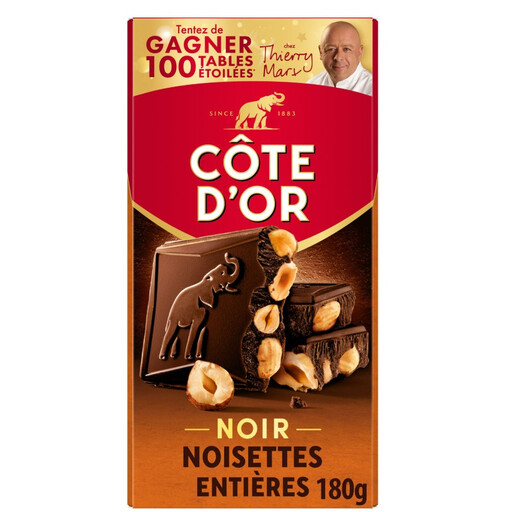 Image unavailable
This large bar is suitable for serving in pieces to guests who enjoy hazelnuts, but not for giving each person a small bar of their own. Check the allergen information and other ingredients on the packaging before serving it.
No. Santé publique France explains that Nutri-Score is voluntary and supplements the mandatory nutrition declaration. If it appears on the packaging, you can use it as a guide, but still read the ingredients and allergen information.
Read the ingredients and allergen information on the packaging of each product you buy, then keep the packaging available for your guests. Don’t assume a bar has the same ingredients as another recipe from the same brand.
Keep the bars somewhere cool and dry, away from sunlight, and follow the instructions on their packaging. Auchan gives this guidance for its Bio 70% bar; check the packaging of each product you buy.
No. These percentages show the cocoa content of the products in question, not a preference shared by every guest. Choose an intensity to suit their tastes, and compare the ingredients and nutrition information for the exact product separately.
Not when choosing between these solid chocolate bars. The measures published by Légifrance for 1 January 2027 apply to drinks and liquid preparations for drinks. If you want to compare the sugar content of different chocolates, use their nutrition information.