For a cake with a pronounced cocoa flavour, start with a dark chocolate bar labelled for desserts, then choose its cocoa content to suit the recipe and the people you’re serving. A higher cocoa content alone won’t tell you about sugars, allergens or how the chocolate will turn out after baking, so check these details for the specific product.
Who is this guide for?
Anyone looking for a pronounced cocoa flavour
If you want the chocolate flavour to come through in your cake, compare the cocoa content of bars labelled for desserts. Lindt France, for example, offers a Dessert Noir Intense bar with 70% cocoa. Choose to suit your recipe rather than assuming all bars will give the same result.
Anyone who checks the ingredients
If sugars or certain ingredients matter to you, check the nutritional information per 100 g and the ingredients list. The cocoa percentage doesn’t replace this information or the need to check the allergens in the product you buy.
Anyone choosing a standard dessert chocolate bar
The ranges from Carrefour, Auchan and E.Leclerc include dark chocolates intended for desserts. Check the cocoa content and size of the product you choose to make sure they suit your cake.
What should you look for?
If you’re baking for people who enjoy cocoa, start with the intensity you want and the use shown on the bar. Then check the label on the specific product you’ve chosen.
| What matters |
What to check |
Who it’s for |
| Cocoa intensity |
Check the cocoa percentage and make sure the recipe suits the level of intensity you’re looking for. |
I want the cocoa to come through in my cake without choosing a bar that’s too bitter for the people I’m serving; around 36% of consumers put this intensity first. |
| Suitability for baking |
Look for “dessert” or “baking” on the specific product, especially if you need to melt the chocolate. |
For a recipe that doesn’t allow much flexibility, I’d rather start with chocolate labelled for desserts than swap in an eating chocolate bar; around 29% of consumers prioritise this use. |
| Sugars and ingredients |
Compare the “sugars” per 100 g and read the ingredients list; the cocoa percentage isn’t enough on its own. |
If I need to adjust the sugar in my recipe, I need to check the ingredients in each bar; around 21% of consumers put the label first. |
| Allergens |
Check the allergens highlighted on the pack and any “may contain” statements. |
If someone I’m serving needs to avoid an ingredient, I check the pack before making the cake; around 14% of consumers prioritise this. |
Common misconceptions to avoid
-
Assuming the soft drinks tax applies to chocolate bars
France’s Ministry of the Economy describes the French soft drinks tax as a levy on sugary drinks, not chocolate bars.
To compare two chocolates for a cake, look at the “sugars” line in their nutritional information instead.
-
Treating Nutri-Score as compulsory
According to Santé publique France, displaying Nutri-Score is voluntary. Its absence doesn’t tell you whether a bar is suitable for your recipe.
Check the stated use, cocoa content, ingredients and allergens. If the product displays Nutri-Score, treat it as additional information.
-
Trying to work out sugars or allergens from the cocoa percentage
Two bars showing the same cocoa percentage can have different ingredients. Lindt France’s product information for its Dessert Noir Intense 70% bar lists soya and possible traces of milk and nuts.
Check the sugars per 100 g and the allergen information for the specific bar you plan to use.
-
Swapping in an eating chocolate bar without adjusting the recipe
An eating chocolate bar isn’t necessarily labelled for baking. Its cocoa content alone won’t tell you how it will behave in your mixture.
If the recipe calls for dessert chocolate, check whether the swap is suitable, along with the ingredients and expected intensity, before changing bars.
Brands to know
Lindt Dessert
Lindt France presents its 200 g Noir Intense 70% bar as a chocolate for desserts.
- The cocoa content and suitability for desserts are stated for this product.
- Check the ingredients and allergens on the bar you choose; this description doesn’t cover the full range.
Nestlé Dessert
Nestlé France offers a range of chocolates for desserts, with retailers listing several cocoa percentages.
- The range gives you options to suit your recipe and the intensity you’re after.
- The brand’s stated use isn’t the result of a comparative test of how the chocolate melts or tastes.
Carrefour Original / Carrefour Bio
Carrefour states that its own-brand dark dessert bar and a listed Carrefour Bio product each contain at least 52% cocoa.
- These products are a starting point for a recipe calling for dessert chocolate with this cocoa content.
- Check the label on the specific product before drawing conclusions about its sugar content or allergens.
Auchan Cultivons le Bon
Auchan lists 52% dark chocolate bars and a stronger 64% cocoa version in its baking range.
- These cocoa percentages let you choose the level of cocoa specified for your cake.
- The cocoa percentage alone doesn’t tell you about the sugars or the result after baking.
Tablette d’Or / Marque Repère E.Leclerc
E.Leclerc lists a 200 g Tablette d’Or dark baking chocolate bar and, separately, Equador dark chocolate bars.
- The Tablette d’Or name specifies that it’s for desserts.
- Don’t assume that the other dark chocolate bars in the range are also labelled for baking.
Côte d’Or
Carrefour lists a Côte d’Or Bio bar with at least 70% cocoa among its dark eating chocolates.
- The cocoa content is stated for this specific product.
- Its product information doesn’t describe it as baking chocolate and mentions possible traces of milk and nuts.
Baking chocolate bars on Joybuy
These dark chocolate bars are presented for use in desserts or baking. For a cake with a particularly rich cocoa flavour, check the cocoa content of the product you choose and make sure it suits your recipe.
 Image unavailable
Poulain Extra Dark, pack of 3 × 100 g
This multipack could be useful if you want to divide the chocolate between several baking recipes. Check that its cocoa content gives you the intensity you’re after, and read the allergen information before use.
View on Joybuy
 Image unavailable
Poulain Extra Dark, 200 g
This bar is an option for a baking recipe that calls for 200 g of chocolate. Before choosing it for a cake with a pronounced cocoa flavour, compare its cocoa content with the recipe and check the ingredients if someone you’re serving needs to avoid any of them.
View on Joybuy
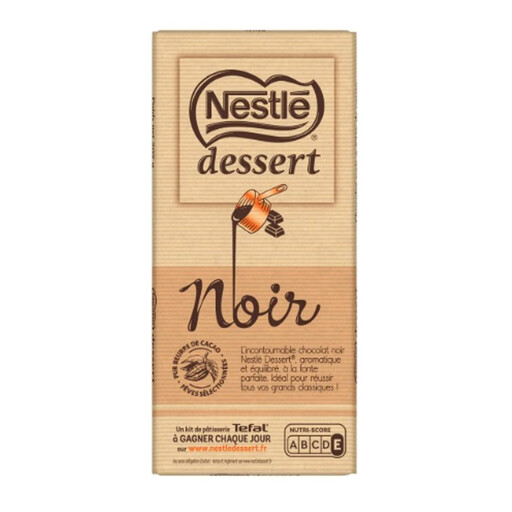 Image unavailable
Nestle Dark Dessert, 205 g
This bar is intended for making desserts and could work well in a cake. Check its cocoa percentage before relying on it for a particular level of intensity, and check the allergen labelling for anyone who needs to avoid certain ingredients.
View on Joybuy
Frequently asked questions
Does the soft drinks tax apply to dark chocolate for cakes?
No. France’s Ministry of the Economy describes the French soft drinks tax as a levy on sugary drinks, not chocolate bars. To compare bars, check their nutritional information instead, especially the sugars per 100 g.
Is Nutri-Score compulsory on a chocolate bar sold in France?
No. According to Santé publique France, displaying Nutri-Score is voluntary. The DGCCRF, on the other hand, states that prepacked food must display a nutrition declaration. So the absence of Nutri-Score alone isn’t a reason to rule out a chocolate for your cake.
How can you compare the sugars in two chocolates for cakes?
Read the “sugars” line per 100 g on each pack. As the DGCCRF explains, this standard format makes it possible to compare bars of different sizes. Check the cocoa content separately: two bars with the same percentage don’t necessarily have the same ingredients.
What should you check if someone you’re serving needs to avoid an allergen?
Check the allergens highlighted in the ingredients and any “may contain” statements on the exact pack. Lindt France’s product information for its Dessert Noir Intense 70% bar lists soya and possible traces of milk and nuts; don’t assume these details apply to another product.


