Hosts melting chocolate
For a sauce or a topping for several crêpes, check the weight of the dessert or cooking chocolate bars and whether they’re sold individually or in a multipack.


If you’re making a sauce or melted topping, start with a bar labelled as dessert or cooking chocolate, then work out how much you’ll need for everyone. A multipack can provide the quantity you need, but it isn’t a bag of bites to serve as they are. Choose your recipe, then check the ingredients and allergens on the product you buy.
For a sauce or a topping for several crêpes, check the weight of the dessert or cooking chocolate bars and whether they’re sold individually or in a multipack.
If the group has a preference for cocoa content, compare the recipe listed on each bar. The percentage alone doesn’t tell you how well it will melt.
If you’re serving a group, check the nutritional information, ingredients list and any may-contain warnings on the exact pack.
First decide whether the chocolate will be melted or served as a snack. The packaging and the checks you need to make will differ.
| Criterion | What to check | Who is it for? |
|---|---|---|
| Quantity and format | Total weight and number of bars; a pack of 3 × 200 g contains 600 g, not a single bag. | When I’m preparing chocolate for several crêpes, I want to know how much I’m getting before I buy. Around 31% of consumers put quantity first. |
| For baking | Look for “dessert” or “cooking” chocolate and preparation instructions on the pack. | If I’m planning a melted topping, I look first for a bar labelled for baking rather than a box of bites to enjoy as they are. Around 31% of consumers prioritise this use. |
| Cocoa content | The cocoa percentage and ingredients list for the product you’ve chosen. | I want to choose a recipe with a cocoa content that suits the group’s taste, without assuming it guarantees how well the chocolate will melt. Around 23% of consumers prioritise this criterion. |
| Sugar and allergens | Nutritional information per 100 g, ingredients, sweeteners and allergen or may-contain warnings. | Before serving everyone, I need to check that the recipe meets the needs guests have mentioned. This is the top criterion for around 15% of consumers. |
Bites can be served as a snack, while a bar described as dessert or cooking chocolate is a more natural choice for a melted topping.
Choose according to how you plan to use it, and check the quantity in grams, whether it’s sold as a single bar or in a multipack.
Cocoa content describes a recipe, but doesn’t tell you everything about its ingredients, allergens or how it will melt. A low-sugar product may also contain a sweetener with a consumption warning.
Read the full ingredients list and nutritional information per 100 g before choosing a recipe for the group.
Ingredients and declared traces can vary from one product to another, even between bars intended for desserts.
Ask guests about their dietary needs, then check the label on the bar you actually buy.
The charge described by the French tax authority in the BOFiP applies, subject to its conditions, to non-alcoholic drinks containing added sugars. A bar of chocolate isn’t a drink.
When comparing chocolate bars, look instead at their quantity, ingredients and nutritional information.
This range includes cooking chocolate bars, including a 200 g Corsé recipe advertised by Auchan as containing 64% cocoa.
The Lindt Dessert range includes a 200 g dark cooking chocolate bar advertised as containing 70% cocoa on Auchan’s product page.
Carrefour offers, among other products, a multipack of 3 × 200 g dark dessert chocolate bars and a separate organic recipe containing 52% cocoa.
Auchan’s range includes dark dessert chocolate bars, including a recipe containing 52% cocoa and maltitol.
E.Leclerc offers Tablette d’Or dark cooking chocolate for desserts in a multipack of 3 × 200 g.
These options include a pack of three bars and two bars sold individually. For a topping, check the suggested use on each pack; if you’re serving several people, work out how much you need using the stated weight.
 Image unavailable
This pack contains 300 g of dark chocolate to divide between your recipes or guests. The description mentions baking, but doesn’t explicitly label this product as cooking chocolate. Check that it’s suitable for your planned topping, and review the ingredients for any guests with dietary requirements.
 Image unavailable
This 200 g bar makes it easy to plan how much you need for a recipe without buying a multipack. The description mentions baking; if they matter to your choice, check the ingredients and nutritional information for this variant.
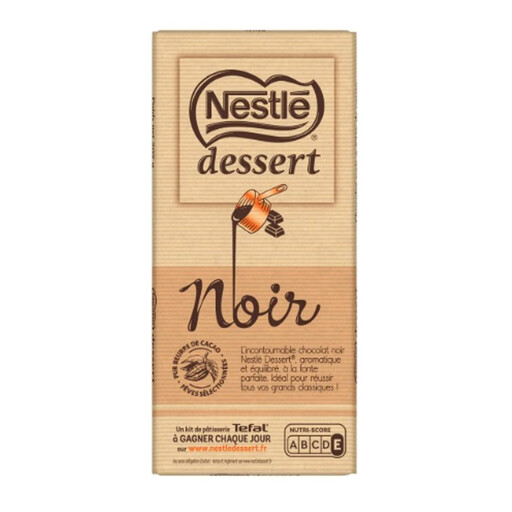 Image unavailable
This 205 g dessert chocolate bar is described as suitable for baking and melting, making it a practical choice for topping crêpes. If cocoa content is important to you, check the percentage on the pack. Also look for warnings about possible traces of milk and nuts before serving.
Not for the same purpose: a multipack gives you bars to break up or use in a recipe, while bites are suited to serving as a snack. If you’re planning a sauce for crêpes, first check that the chocolate is labelled for desserts or cooking, and look at the total weight.
No. Santé publique France says that producers can choose to display Nutri-Score. If it appears on the pack, consider it alongside the ingredients list and nutritional information. It doesn’t, on its own, tell you whether a bar is suitable for everyone.
Read the ingredients and any may-contain warnings on the exact pack. For example, Auchan’s product page for Nestlé Dessert Corsé warns that it may contain traces of milk and nuts. Don’t assume this applies to another recipe or another bar from the same brand.
No. Auchan’s product page for a 52% cocoa dessert chocolate bar lists maltitol and warns that excessive consumption may have laxative effects. Check the ingredients and allergens of the product you choose separately.
No. The charge described by the French tax authority in the BOFiP applies, subject to its conditions, to non-alcoholic drinks containing added sugars, not to chocolate bars. Compare recipes by checking their nutritional information.