Those making a melted chocolate filling
For a sauce or topping to serve over several crêpes, first look for a bar labelled for baking, then choose the cocoa content that suits your guests.


For a sauce or topping, start with a dark chocolate bar specifically intended for baking: Lindt Dessert and Nestlé Dessert both offer 70% cocoa options for desserts. If you’re serving the chocolate in squares or shavings, choose according to your guests’ tastes instead; chocolate with 80% cocoa or more is best reserved for those who enjoy a particularly intense cocoa flavour. In either case, check the sugars per 100 g and the allergens on the bar you choose.
For a sauce or topping to serve over several crêpes, first look for a bar labelled for baking, then choose the cocoa content that suits your guests.
If you’re planning to serve squares or shavings alongside the crêpes, a bar intended for eating as it is will do the job; you don’t need to choose one made for baking.
If sugars or particular ingredients are important to your choice, compare the nutritional information per 100 g and the label on each product. Dark chocolate doesn’t have the same ingredients in every bar.
First decide whether the chocolate will be melted or served as it is. You can then compare bars for your crêpe night by looking at their cocoa content, nutritional information and ingredients.
| What to consider | What to check | Who is this for? |
|---|---|---|
| Chocolate to melt | Look for a baking or dessert label, then check the cocoa content of the product. | If you’re topping crêpes or filling them with melted chocolate, the main thing is to choose a bar intended for this use. Around 36% of consumers prioritise this need. |
| Cocoa flavour | Check the cocoa content and whether the bar is for eating or baking. | Squares served with crêpes should first and foremost appeal to guests who enjoy a strong cocoa flavour. This intensity is the top priority for around 29% of consumers. |
| Nutritional content | Check the sugars and saturated fatty acids per 100 g, as well as the ingredients list. | If sugars matter more than the topping or flavour, compare products using figures given on the same basis. Around 21% of consumers put nutritional content first. |
| Ingredients and allergens | Check the ingredients list and any ‘may contain’ warnings on the exact packaging. | If a guest needs to avoid an ingredient, whether the bar is suitable matters more than its cocoa content. This is the top priority for around 14% of consumers. |
In France, displaying the Nutri-Score is voluntary, according to the Ministry of the Economy. If it isn’t shown, you’ll still need to check the nutritional information.
To compare two bars, look in particular at sugars, fat and saturated fatty acids per 100 g. Use the Nutri-Score when it is actually displayed on the products you’re comparing.
A dark chocolate recipe may contain these ingredients or carry a ‘may contain’ warning. The ingredients in one product aren’t necessarily the same as those in every bar from that brand.
Check the ingredients list and any ‘may contain’ warnings on the packaging for the guests concerned.
This figure tells you neither whether a bar is intended for baking nor how much sugar it contains. A higher cocoa content also doesn’t guarantee that every guest will enjoy the flavour.
For a topping, first check the product’s stated use. For squares, choose the cocoa content to suit your guests’ tastes, then compare the ingredients.
The Nestlé Dessert product page consulted recommends storing its baking chocolate in a dry place, away from light, at between 15 and 18 °C. This guidance applies to that product and doesn’t replace the instructions for your own bar.
Before your crêpe night, check the storage instructions for the product you’ve chosen and the delivery conditions if temperatures are high.
Lindt France describes its Dessert Noir Intense bar, with 70% cocoa and weighing 200 g, as a product for desserts.
Auchan lists a Nestlé Dessert dark baking chocolate bar with 70% cocoa. Its range also includes an 80% dark chocolate option.
Auchan lists a Côte d'Or bar for eating as it is, with at least 70% cocoa, which could be a good option for serving in squares or shavings.
Carrefour lists a 200 g Carrefour Bio dark chocolate bar with 70% cocoa.
Auchan’s baking range includes dark chocolate bars with cocoa contents of 52%, 64%, 70% and 80%.
These dark chocolate bars could be served in pieces or used in desserts. If you’re making a sauce, check that melting the product is suitable for its stated use.
 Image unavailable
Worth considering if your guests would enjoy serving pieces of intensely flavoured chocolate with their crêpes. This bar has 85% cocoa; if you’re making a sauce, check separately that it’s suitable for melting.
 Image unavailable
One to consider if you’re looking for a bar with around 70% cocoa to serve with your crêpes. Check the ingredients to make sure they suit your guests, and check the stated use if you plan to melt it.
 Image unavailable
The mini size could be handy if you’d prefer to serve a small bar alongside the crêpes. It has 70% cocoa; check the label for allergens and confirm its intended use before choosing it as a topping.
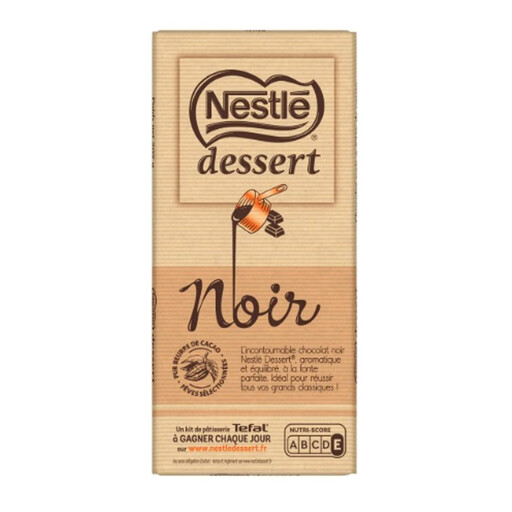 Image unavailable
Worth considering for a chocolate filling for your crêpes. This product is described as a dark chocolate for desserts; if you’re looking for a specific cocoa content, check the details for this product before choosing it.
No. In France, displaying it is voluntary, according to the Ministry of the Economy. The DGCCRF states that nutritional declarations are required for most prepacked foods, subject to certain exemptions. In particular, compare the ‘sugars’ figures per 100 g.
No, not to a solid bar. Article 1613 ter of the General Tax Code, published on Légifrance, applies to drinks and liquid preparations for drinks that meet the conditions set out in the legislation. If sugar content is a deciding factor when buying chocolate, check the bar’s nutritional information instead.
For a sauce or topping, first check that the bar is intended for baking: the 70% Lindt Dessert and Nestlé Dessert products described on their product pages are made for this use. If you’re serving pieces, choose 80% or more if your guests specifically want a very intense cocoa flavour. Don’t assume that the cocoa percentage alone tells you about the ingredients or how well the chocolate will melt.
Check the ingredients and any ‘may contain’ warnings on the exact bar, particularly for milk, soya and nuts, depending on your guests’ needs. The DGCCRF states that allergenic ingredients must be highlighted in the ingredients list on prepacked foods; the name ‘dark chocolate’ alone doesn’t tell you that they’re absent.