Anyone making Christmas desserts
For a ganache, mousse, fondant or cake, you’ll want chocolate intended for baking rather than a selection box designed to be served as it is.


For a ganache, fondant or Christmas cake, choose a dark chocolate bar labelled ‘for baking’ rather than a selection box. You can check the ingredients in the chocolate you’re using, whereas fillings and inclusions in a selection box can affect your recipe. Save the box for serving, or check every chocolate before adding it to your mixture. Either way, choose the intensity to suit your recipe and check the sugars and allergens on the packaging.
For a ganache, mousse, fondant or cake, you’ll want chocolate intended for baking rather than a selection box designed to be served as it is.
You’re looking for a more bitter flavour and want to control how much sugar you add to your recipe. Check the cocoa percentage of the product you choose before adjusting the quantities.
If you’re baking for guests with dietary requirements, compare the ingredients, allergens and ‘of which sugars’ figure for each product.
Choose this: for a recipe that involves melting, mixing or baking with dark chocolate.
Bear in mind: it won’t offer the variety of ready-to-serve chocolates you get in a selection box.
Choose this: to give as a gift or serve after a meal.
Check this: fillings and inclusions can change the texture and ingredients of your bake.
| What to consider | What to check | Who is it for? |
|---|---|---|
| How you’ll use it in the recipe | Look for ‘for baking’ or ‘dessert’ on the label. If you’re thinking of using chocolates from a selection box, check the ingredients first. | When I’m making a ganache or fondant, I want to choose chocolate that suits the recipe rather than discover a filling as it melts. Around 42% of consumers put this first. |
| Intensity and sugars | Compare the cocoa percentage and the ‘of which sugars’ figure per 100 g, then adjust the recipe to suit the flavour you want. | For a dessert to share, I look for a cocoa intensity that will suit my guests while keeping control of the added sugar. This is the main concern for around 25% of consumers. |
| Ingredients and allergens | Read the ingredients list, declared allergens and any ‘may contain’ statements on the exact product you’re buying. | If I’m serving my bake to a group, I need to know the ingredients and allergens in the chocolate I’ve used. Around 33% of consumers make this check a priority. |
Chocolates filled with or topped with biscuits and nuts can change the texture, sugar content and allergens in your mixture.
If your recipe calls for dark chocolate to melt, choose a bar labelled ‘for baking’. If you’re using a selection box, identify each variety before adding it.
A high cocoa content doesn’t tell you everything about the nutritional values. Lindt France states that its EXCELLENCE Noir 100 % Cacao bar contains 54 g of fat, including 34 g of saturates, per 100 g.
Compare the sugars and fat per 100 g too, then choose an intensity that suits your recipe.
According to Santé publique France, displaying the Nutri-Score is voluntary. If it’s not shown, you should still check the ingredients and nutritional information.
If it is shown, use it as additional information and compare the labels of the products you’re considering.
Ingredients and ‘may contain’ statements vary between products, so a general description isn’t enough when you’re making a bake to share.
Check the packaging of the exact product, including any ‘may contain’ statements, if one of your guests has an allergy.
The range includes dark chocolate bars intended for baking, including varieties with 51% and 70% cocoa.
The range includes dark chocolate intended for baking. The 70% bar listed by Carrefour and the 205 g bar available on Joybuy are different products.
E.Leclerc lists a 200 g dark chocolate bar for baking, as well as a separate, more intense version.
This range includes dark chocolate bars for baking, including a more intense version with 64% cocoa, as listed by Auchan.
These dark chocolate bars are worth considering for fondants, cakes and recipes that call for melted chocolate. Choose the size that suits your recipe and check the ingredients for each product.
 Image unavailable
Worth considering for a fondant or cake that calls for dark chocolate to melt. The pack contains three 100 g bars. Check the cocoa content, sugars and allergens for the product you buy.
 Image unavailable
A 200 g bar to consider for a recipe that calls for dark chocolate for baking. If you’re cooking for guests with dietary requirements, check the ingredients and allergens on the packaging.
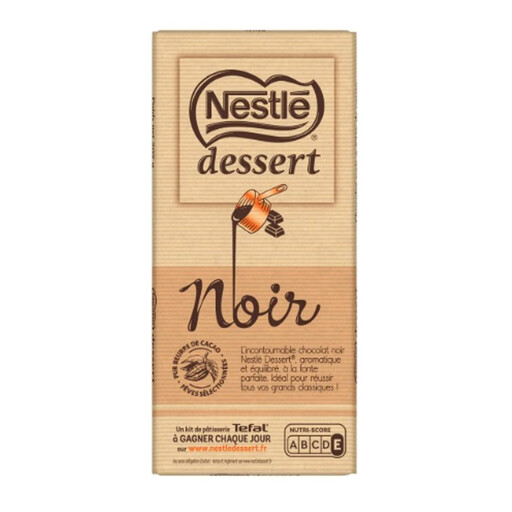 Image unavailable
A 205 g dessert bar to consider for recipes that call for melted dark chocolate. The Joybuy France product listing for this item mentions possible traces of milk and nuts. Check the packaging and cocoa percentage if intensity matters for your recipe.
Yes, as long as you check the ingredients of the chocolates you use. Fillings and inclusions can affect the texture and allergens in your ganache. If your recipe simply calls for melted dark chocolate, a bar labelled ‘for baking’ makes it easier to choose the right ingredient.
Read the ingredients, declared allergens and any ‘may contain’ statements on the packaging of the exact product. Retailer listings for some products mention soya, milk or nuts, for example. You can’t tell from the words ‘dark chocolate’ alone.
No. Santé publique France says that producers display the Nutri-Score on a voluntary basis. When comparing pre-packed chocolate, also check the ingredients list and nutritional information required under the applicable labelling rules.
No. The French Ministry of the Economy describes this levy as applying to sugary drinks, not chocolate. The ‘of which sugars’ figure is still useful for comparing products and adapting your recipe, regardless of the tax.
Follow the storage instructions on the packaging of the product you choose, keeping it away from heat and moisture as directed. If you buy it in advance, check its best-before date too.