For a study break, a bar of dark chocolate with caramel lets you choose how much to break off and compare cocoa percentages. Filled chocolates come in set portions, but their format alone doesn’t tell you how much sugar they contain. If you’re after a pronounced cocoa flavour, check the percentage for the exact product, then look at its ingredients, allergens and nutritional information. According to Santé publique France, Nutri-Score is optional; when it appears on the packaging, it can be a useful extra reference.
Who are these formats suited to?
Fans of intensely dark chocolate
You want the cocoa flavour to come through despite the caramel. To compare recipes, check the percentage shown on each bar: Carrefour lists Lindt Excellence products with 70% cocoa and Grain de Sail products with 75% cocoa.
Students who like to control their portions
You’d rather choose how much to break off a bar, or have a chocolate with a stated reference portion. In this case, the format matters just as much as the recipe.
Shoppers who check the ingredients
You check for milk, soya and any ‘may contain’ warnings before choosing. The term ‘dark chocolate’ alone doesn’t tell you what’s in a caramel recipe.
What should you check before choosing?
To choose between a bar and filled chocolates, start with the ingredients that matter to you. Then compare the intensity you’re looking for, the nutritional information and the format that suits your break.
| What to consider |
What to check |
Who this matters to |
| Ingredients and allergens |
Read the ingredients list, check the allergens highlighted and look for any ‘may contain’ warnings on the product you choose. |
If I need to avoid milk, soya or other ingredients, the recipe’s composition matters more than the ‘dark’ label; around 36% of consumers would put this compatibility first. |
| Cocoa intensity |
Compare the cocoa percentage for the exact product, but don’t use it to infer how much sugar it contains. |
If I want a break where the cocoa comes through more than the caramel, I need the percentage to be clearly stated; this would be a priority for around 21% of consumers. |
| Nutritional information |
Compare the nutritional values per 100 g, especially the sugars; check the Nutri-Score if it’s displayed on comparable products. |
When I’m choosing between two recipes, I want to compare their sugar content on the same basis rather than rely on the format alone; around 29% of consumers would prioritise this information. |
| Break-time format |
Check the product’s weight and, where stated, the reference portion and number of portions. |
If I want to plan how much I’ll have during my break, I need to choose between a bar I can break into pieces and a set-sized bite; this would come first for around 14% of consumers. |
Common misconceptions to avoid
-
Assuming ‘dark’ always means the same intensity
The bars Carrefour lists under the Ethiquable, Lindt Excellence and Grain de Sail brands contain 65%, 70% and 75% cocoa respectively, depending on the recipe.
Check the percentage for the exact product instead of relying on the word ‘dark’ or the colour of the packaging.
-
Ruling out a recipe because it doesn’t have a Nutri-Score
Santé publique France says that displaying this logo is voluntary. Its absence alone doesn’t tell you how nutritious a product is.
Compare the nutritional information per 100 g and the ingredients. Use Nutri-Score as an extra reference when it appears on comparable products.
-
Assuming dark chocolate is dairy-free
Carrefour and Auchan product listings for some dark chocolate and caramel recipes mention milk; several also flag soya or possible traces of other allergens.
If you have an allergy or need to avoid certain ingredients, check the information on the packaging of the product you buy.
-
Confusing a portioned chocolate with a lower-sugar recipe
Auchan gives a reference portion of 7.5 g for its Caram’choc chocolates and lists 58 g of sugars per 100 g. The size of each chocolate and its ingredients answer two different questions.
When comparing this bag with a bar, check both the suggested portion and the sugars per 100 g.
Brands and ranges to consider
Lindt Excellence
Dark chocolate and caramel bars, including a sea salt caramel recipe and a 70% cocoa salted butter caramel product listed by Carrefour.
- Compare recipes in the same range with different stated cocoa intensities.
- The recipes mentioned contain dairy ingredients; Carrefour and Monoprix also flag soya in the sea salt caramel version.
Ethiquable
An organic and fair-trade dark chocolate bar with sea salt caramel; the Carrefour listing states at least 65% cocoa.
- The stated cocoa percentage helps you compare this recipe with the other bars you’re considering.
- The listing mentions milk and possible traces of nuts, sesame and gluten.
Grain de Sail
An organic dark chocolate bar with caramel pieces and fleur de sel, listed as containing 75% cocoa on Carrefour’s website.
- The cocoa percentage is clearly stated for shoppers who prioritise this factor.
- This percentage alone doesn’t tell you about the sugars, other ingredients or allergens in the recipe.
Auchan
Caram’choc dark chocolate caramels, sold in a bag rather than as a bar.
- The Auchan listing gives a reference portion of 7.5 g and 39 portions per pack.
- The recipe contains milk and soya; Auchan lists 58 g of sugars per 100 g.
Moser Roth
A range of dark chocolate bars sold at Aldi; Aldi France lists a caramel and fleur de sel variety.
- Another recipe to consider if you’re comparing dark chocolate and caramel bars at Aldi.
- Check the nutritional information and ingredients for the variety actually available before comparing it with the others.
A bar of dark chocolate with caramel on Joybuy
This Joybuy pick is a bar of dark chocolate with caramel, so you can choose how much to have during your break.
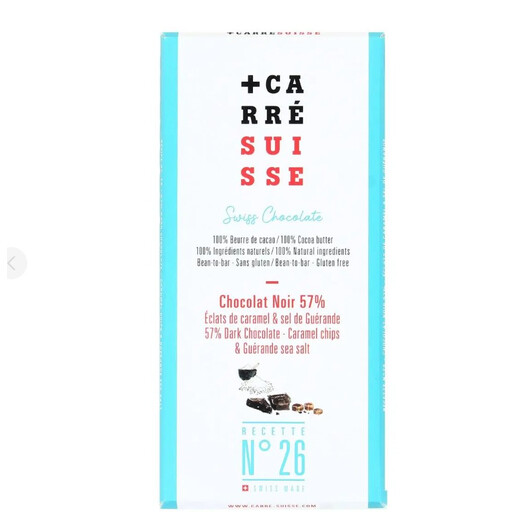 Image unavailable
CARRE Organic dark chocolate with caramel and Guérande salt, 100 g
This bar is a good choice if you prefer to break off as much as you want for your break. It combines dark chocolate, caramel and Guérande salt in a 100 g bar. If cocoa intensity or ingredients are important to you, check the details for this product on its packaging.
View on Joybuy
Frequently asked questions
Is Nutri-Score compulsory on these chocolates and confectionery products in France?
No. Santé publique France says that producers choose whether to display Nutri-Score. To compare products without this logo, check their nutritional information per 100 g and their ingredients lists.
Can dark chocolate with caramel contain milk or soya?
Yes, depending on the recipe. Carrefour and Auchan listings flag milk and soya in some of the products mentioned here; the Ethiquable listing mentions milk and possible traces of other allergens. Check the label on the product you buy.
Should you throw away a bar as soon as its best-before date has passed?
Not for that reason alone. Anses distinguishes between a best-before date, shown as ‘best before’, and a use-by date. After the best-before date, the taste or nutritional qualities may change; you should also follow the storage instructions on the packaging.


