Organisers preparing several batches
You’re looking for a bar marketed for desserts, with an intended use that suits a cake recipe, rather than a tasting chocolate chosen solely for its cocoa content.


If you’re making several cakes, start with a dark chocolate bar marketed for baking rather than a bar chosen purely for its cocoa percentage. An option labelled 64–70% is suitable if you want a more pronounced cocoa flavour in your recipe. In every case, check the ingredients, allergens and quantities you’ll need before the sale.
You’re looking for a bar marketed for desserts, with an intended use that suits a cake recipe, rather than a tasting chocolate chosen solely for its cocoa content.
If the cakes are sold unpackaged, you need to be able to identify the allergens in the ingredients used and provide information about the finished recipes. The DGCCRF reminds sellers that this information is compulsory for non-prepacked foods.
You’re considering a bar labelled 64–70% cocoa for a recipe with a deliberately stronger cocoa flavour, without assuming that this figure alone tells you whether it’s suitable for baking or indicates its nutritional qualities.
For cakes sold unpackaged, first prepare allergen information for the finished recipe. Then choose the intended use and flavour intensity before working out how much you’ll need.
| Criterion | What to check | Who it matters to |
|---|---|---|
| Allergens | Read the ingredients and any ‘may contain’ statements on the bar you buy, then identify the allergens in the finished recipe. | When selling cakes without packaging, I want to be able to list the allergens in each recipe. Around 42% of consumers rank this traceability as their top priority. |
| Intended use and flavour intensity | Look for ‘dessert’ or ‘baking’ on the label, then check the cocoa content if the recipe calls for a more intense dark chocolate flavour. | If I’m making several batches, I want chocolate intended for desserts, with a flavour that suits my recipe. This is the priority for around 33% of consumers. |
| Quantity and pack size | Compare the net weight with the number of grams needed for each recipe, and make sure you know how many bars to buy. | I have several batches to organise and need to buy enough chocolate without switching to a different product partway through. For around 25% of consumers, quantity and pack size come before other criteria. |
Ingredients vary by product. Carrefour France’s description of Carrefour Original lists whey powder and soya lecithins among its ingredients.
Read the exact packaging, including any ‘may contain’ statements, then prepare allergen information for the finished recipe.
A bar labelled 70% doesn’t tell you whether it’s marketed for baking. Carrefour France describes Lindt Dessert 70% as chocolate for desserts, while Auchan France presents Côte d’Or Noir 70% as a tasting bar.
Choose according to the recipe’s intended use first, then consider the flavour intensity you want.
According to Santé publique France and the DGCCRF, displaying Nutri-Score is voluntary. Its presence doesn’t replace checking the ingredients and nutritional information.
Check the information on the packaging, but don’t rule out a bar simply because it doesn’t display this logo.
The products reviewed come in different sizes: Nestlé Dessert Noir is listed as 205 g, while Carrefour Original and Tablette d’Or are listed as 200 g.
Work out how many grams you’ll need for all your batches and check the weight of the product you plan to use.
The range includes dark chocolate bars marketed for desserts, including Noir and Corsé.
Carrefour France describes Lindt Dessert Noir 70% as suitable for making desserts with a pronounced cocoa flavour.
The product reviewed is a 200 g bar of dark dessert chocolate.
E.Leclerc sells a 200 g bar of dark dessert chocolate for baking under this brand.
The 70% dark chocolate product reviewed by Auchan France is presented as a tasting bar.
This selection features a dark chocolate bar intended for desserts and suitable for making cakes. Check the cocoa content on the packaging before choosing it for its flavour intensity.
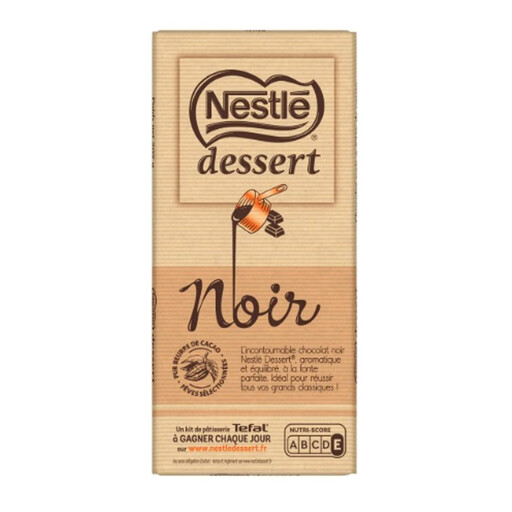 Image unavailable
This dark chocolate bar is marketed for baking and could be a good choice for cakes at a school sale. It comes in a 205 g pack; the product description lists skimmed milk powder and says it may contain traces of milk and nuts. Check these details on the exact packaging before providing information to customers. If your recipe calls for a particular flavour intensity, check the cocoa content too.
Yes. As the DGCCRF reminds sellers, allergen information is compulsory for non-prepacked foods. Keep the packaging from the ingredients you use and prepare information for each finished recipe.
You can consider it if its ingredients and flavour suit the recipe, but the way it’s marketed doesn’t guarantee that it’s suitable for baking. The Côte d’Or Noir 70% product reviewed at Auchan France is presented for tasting. Check its ingredients and allergen information before using it.
No. Santé publique France and the DGCCRF state that displaying Nutri-Score is voluntary. When choosing a bar, check the ingredients list, allergen information and any nutritional information on the packaging.
According to the French Ministry of the Economy, the contribution mentioned here applies to non-alcoholic drinks, so it isn’t a criterion for choosing a solid chocolate bar. When preparing cakes for sale, focus on checking the recipe and the information you need to give customers.