Making a whole cake
You’ll want a bar that’s close in weight to the amount specified in your recipe. The baking bars featured by Lindt, Nestlé and Auchan come in sizes from 170 to 205 g, but be sure to check how much you’ll need before buying.


For a whole cake, start with the amount of chocolate in the recipe. A dark chocolate bar intended for baking, weighing 170–205 g among the options featured by Lindt, Nestlé and Auchan, is a more straightforward choice than a 35 g tasting bar. For a very small quantity, the latter may be enough. In either case, check the ingredients and allergens, then choose the cocoa percentage to suit the result you want.
You’ll want a bar that’s close in weight to the amount specified in your recipe. The baking bars featured by Lindt, Nestlé and Auchan come in sizes from 170 to 205 g, but be sure to check how much you’ll need before buying.
Compare bars with around 64–70% cocoa to find the flavour profile you want in your cake. The cocoa percentage doesn’t replace checking the ingredients and nutritional information for the specific bar you choose.
If your recipe only calls for a little chocolate, a mini bar can save you from opening a larger one. Lindt, for example, offers a 35 g Excellence tasting bar with 70% cocoa; it isn’t marketed as a baking bar.
For a cake, start with the amount specified in the recipe, then consider the flavour you want and the ingredients in the specific bar.
| What to consider | What to check | Who is it for? |
|---|---|---|
| Amount needed for the recipe | Compare the number of grams required with the net weight, and make sure you have enough chocolate. Weigh it rather than counting squares. | For a whole cake, I want to have the amount specified without needing several small bars. Around 36% of consumers put getting the right weight first. |
| Chocolate intensity | Check the cocoa percentage, sugars per 100 g and the type of chocolate specified in the recipe. | If I want the chocolate flavour to stand out in my cake, I choose a bar that suits my recipe. Around 29% of consumers would put this level of intensity first. |
| Small quantity | Check that the mini bar is heavy enough and that its ingredients are suitable for your recipe. | For a small portion, I’d rather weigh out just what I need than open a large bar. Buying a smaller quantity comes first for around 21% of consumers. |
| Ingredients and allergens | Read the ingredients, allergen information, may-contain warnings and nutritional information for the exact product. | If I need to avoid an ingredient or allergen, checking the label comes before choosing a format or intensity. Around 14% of consumers prioritise the ingredients and label. |
The Lindt Excellence mini bar weighs 35 g, while the Lindt DESSERT bar featured for baking weighs 200 g. A small bar may mean you need several to get the amount your recipe calls for.
First, check how many grams your recipe specifies, then compare that with the net weight of each bar.
A flavoured tasting bar or one with added inclusions can change the result and introduce ingredients that aren’t in the recipe. The cocoa percentage alone doesn’t tell you whether it’s suitable for baking.
Check the ingredients and allergen information for the exact bar before melting it.
According to the DGCCRF, displaying the Nutri-Score is voluntary. So if it’s missing, you’ll still need to check the information on the packaging.
To compare two bars, read their ingredients and nutritional values per 100 g, especially the sugars and fat.
The contribution described by BOFiP-Impôts applies to non-alcoholic drinks containing added sugars or sweeteners, not chocolate bars.
To check the sugar content of a bar, look at its nutritional declaration instead.
Lindt distinguishes its 200 g DESSERT dark chocolate bar, with 70% cocoa and marketed for baking, from its 35 g Excellence tasting mini bar, also with 70% cocoa.
Auchan’s product listings feature NESTLÉ DESSERT dark chocolate bars for baking, including a 205 g bar with 53% cocoa and a 170 g bar with 70% cocoa.
Carrefour Original offers a 200 g Chocolat Noir Dessert bar.
Auchan’s Cultivons le Bon range includes a 200 g dark baking bar with 64% cocoa.
Carrefour lists a 100 g Côte d’Or Noir bar with 70% cocoa.
These 200–205 g dark chocolate bars are marketed for baking. Compare their weight with the amount in your recipe, then check the ingredients of the product you choose.
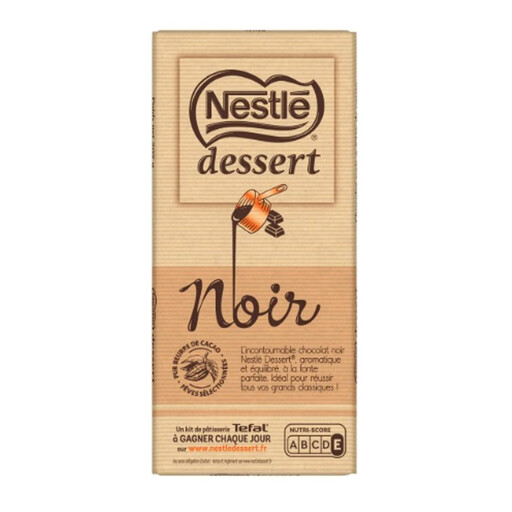 Image unavailable
If your cake recipe calls for around 205 g, the Joybuy product listing says this bar is suitable for baking. If chocolate intensity matters for your recipe, check the cocoa percentage on the packaging. Also look out for the warning that it may contain traces of milk and nuts.
 Image unavailable
If your recipe calls for around 200 g, the Joybuy product listing says this bar is suitable for baking and contains at least 47% cocoa. It lists 52 g of sugars per 100 g and skimmed milk powder among the ingredients, so check that it’s suitable for your recipe.
No. The contribution described by BOFiP-Impôts applies to non-alcoholic drinks containing added sugars or sweeteners. To compare the sugar content of chocolate bars, check their nutritional values per 100 g.
No. The DGCCRF describes the Nutri-Score as a voluntary label. A nutritional declaration is generally mandatory for pre-packed food, subject to regulatory exemptions, and includes values per 100 g.
Choose a bar to match the chocolate specified in your recipe and the intensity you’re looking for. Don’t assume that the highest percentage will always be the best fit. Baking bars featured by Auchan and Lindt come in these different percentages; compare the sugars and ingredients in each bar too.
Yes, depending on the product. The Carrefour Original listing includes whey and soya lecithins, while other bars carry warnings that they may contain traces of certain allergens. If you have an allergy, check the ingredients and warnings on the exact packaging.