For a wedding buffet, start by choosing a format that’s easy to serve, then check the ingredients of each dark chocolate biscuit. If you’re looking for a pronounced cocoa flavour, the words “dark chocolate” or the proportion of chocolate in the biscuit won’t tell you the cocoa percentage of the chocolate itself. Look for this information on the specific product you’ve chosen. Compare sugars per 100 g too, and make sure allergen information is available to your guests.
Who are these criteria for?
Hosts looking for a pronounced cocoa flavour
If the character of the chocolate matters to you, look for the cocoa percentage of the chocolate used. The words “dark chocolate” alone don’t tell you this, nor does the proportion of chocolate in the biscuit.
Organisers of a self-service buffet
Ease of serving and packaging matter when guests are helping themselves. Depending on the product, sticks or individually wrapped portions can make serving easier. Check the storage instructions before putting the biscuits out, too.
Hosts mindful of allergens
If you don’t know all your guests’ dietary requirements, keep the information for each variety close to the buffet. The French Ministry of the Economy reminds consumers that allergens in prepacked foods must be emphasised on the label. Check the precautionary “may contain” statements on the packets you serve, too.
What should you look for when choosing biscuits for a buffet?
When choosing dark chocolate biscuits for a wedding buffet, distinguish between cocoa content and the proportion of chocolate, and check allergens, serving format and nutritional information. The most important factor depends on what you need to organise for your guests.
| Criteria |
What to check |
Who is it for? |
| Clearly stated cocoa content |
Look for the cocoa percentage of the chocolate, if stated. Don’t confuse it with the proportion of dark chocolate in the biscuit. |
If I want to serve dark chocolate with a pronounced flavour, I want to know its cocoa content rather than rely on the recipe name alone. Around 29% of consumers would make this their first criterion. |
| Allergens |
Read the highlighted ingredients and any precautionary “may contain” statements on each packet you serve. |
When several guests are helping themselves, I need to be able to show them the ingredients for each variety. Access to this information would be a priority for around 29% of consumers. |
| Serving format |
Check the packaging, portions and storage instructions before setting up the buffet. |
If the biscuits will be available throughout the reception, I’m looking for a format that’s easy to pick up and replenish. Around 24% of consumers would put this need first. |
| Sugars and labelling |
Compare the “of which sugars” figure per 100 g and the ingredients list. Check the Nutri-Score if it appears on the products you’re comparing. |
To choose between several recipes, I want to compare their nutritional information on the same basis. Comparing sugar content would be the main criterion for around 18% of consumers. |
Mistakes to avoid
-
Assuming “dark chocolate” tells you the cocoa content
The proportion of dark chocolate in a biscuit and the cocoa percentage of that chocolate are two different measures. Auchan and Carrefour biscuit product pages, for example, state the proportion of chocolate in the recipe, but this alone doesn’t tell you the cocoa content you’re looking for.
If this is a deciding factor for your buffet, look for an explicit cocoa percentage on the product you plan to serve.
-
Making Nutri-Score a must-have
France’s DGCCRF describes Nutri-Score as a voluntary labelling scheme in France. If it’s not shown on a packet, you should still check the nutritional declaration. The French Ministry of the Economy says that this declaration is compulsory for prepacked foods.
Compare sugars per 100 g and the ingredients; use Nutri-Score as additional information when it’s displayed.
-
Serving biscuits without making allergen information available
Dark chocolate biscuit recipes don’t all contain the same ingredients or carry the same precautionary “may contain” statements. Once the biscuits are out of their packaging, guests may no longer be able to see this information.
Keep the packets for each variety accessible, or prepare a serving card with the information from the packets you’ve opened.
-
Unwrapping your entire supply before serving
The storage instructions for the products in question may advise keeping chocolate biscuits away from heat and moisture, which could affect their appearance.
Follow the instructions on the packets you’ve chosen and replenish the buffet gradually.
Brands and ranges to know
These examples cover specific products to compare by recipe and format; they don’t represent every range from each brand.
LU
Carrefour describes its Mikado dark chocolate biscuits as thin, crunchy biscuit sticks coated in dark chocolate—a format worth considering for guests to pick up individually at the buffet.
- The stick format may work well for a self-service buffet.
- The product page consulted doesn’t give the cocoa percentage of the chocolate; the recipe includes wheat, milk and soya.
Carrefour Classic'
The Carrefour product page for a Classic' dark chocolate biscuit states the proportion of chocolate in the recipe.
- According to Carrefour’s product page, dark chocolate makes up 27% of the biscuit. This describes the recipe, not the cocoa content of the chocolate.
- The product contains wheat, milk and soya, and may contain traces of egg and nuts.
Auchan
Auchan’s product pages include petits-beurre biscuits topped with dark chocolate in individual sachets, as well as a coated biscuit described as gluten-free.
- The petits-beurre product page states that the biscuit contains 48% dark chocolate and comes in individual sachets.
- This proportion doesn’t tell you the cocoa content of the chocolate. The product described as gluten-free should also be checked for other allergens and precautionary “may contain” statements.
Gerblé
The Carrefour product page for a Gerblé dark chocolate biscuit states the proportion of chocolate in this product.
- The product page states that the biscuit contains 48% dark chocolate, which is useful when checking its composition.
- This figure isn’t the cocoa percentage of the chocolate. The product page lists wheat, milk and egg, and says it may contain nuts, sesame and soya.
Mikado biscuits available on Joybuy
These two Mikado Dark Chocolate formats suit anyone looking for dark chocolate biscuit sticks for a self-service buffet. If you need a specific cocoa content or want to make allergen information available, check the packaging of the product you choose.
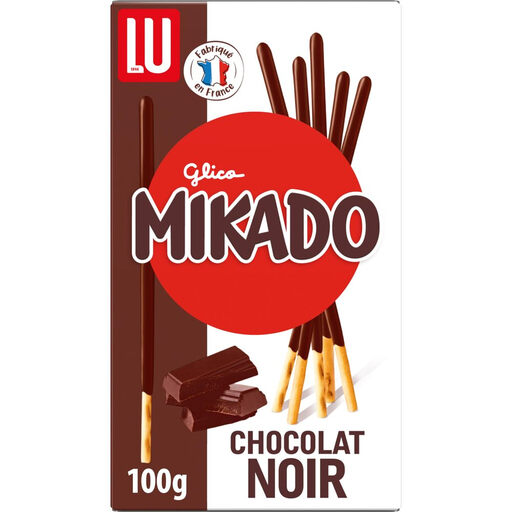 Image unavailable
Mikado Dark Chocolate 100 g
A format to consider if you’d like to serve Mikado dark chocolate biscuits for guests to help themselves to. The pack is listed as 100 g. If a specific cocoa content matters to you, check the packaging before serving.
View on Joybuy
 Image unavailable
Mikado Dark Chocolate 75 g
This 75 g pack gives you another Mikado dark chocolate format to choose for the buffet. Check the allergens, storage advice and cocoa percentage on the pack you buy if you want to be sure it meets your requirements.
View on Joybuy
Frequently asked questions
Does “dark chocolate” guarantee a pronounced cocoa flavour?
No. On its own, it doesn’t tell you the cocoa percentage of the chocolate used. Auchan and Carrefour biscuit product pages may state the proportion of chocolate in the biscuit without giving this second figure. If cocoa content matters to you, look for it explicitly on the product you’ve chosen.
How can you make allergen information available at the buffet?
Keep the packaging for each variety near the biscuits, or copy the information onto a serving card. The French Ministry of the Economy reminds consumers that allergens in prepacked foods must be emphasised. Check the precautionary “may contain” statements on the packets you’re actually using, too.
Is Nutri-Score compulsory on biscuits in France?
No. The DGCCRF says that Nutri-Score is voluntary. However, the French Ministry of the Economy says a nutritional declaration is compulsory for prepacked foods. This lets you compare sugars per 100 g, among other things.
Does the “sugar tax” apply to dark chocolate biscuits?
No. The French Ministry of the Economy describes this levy as applying to sugary drinks. To compare biscuits, check their ingredients and nutritional information instead, including the “of which sugars” figure per 100 g.


