Home bakers
If your recipe calls for chocolate to be melted and mixed in, first look for a bar made for this purpose. The Lindt DESSERT and NESTLÉ DESSERT ranges include products labelled for baking.


For a recipe where the dark chocolate needs to be melted and mixed in, start with a bar specifically labelled for baking, then choose the intensity to suit your dessert. If you’d also like to give chocolate as a gift, a gift box may be a good choice for that purpose. Before using it in your recipe, though, check its fillings, inclusions and allergen information.
If your recipe calls for chocolate to be melted and mixed in, first look for a bar made for this purpose. The Lindt DESSERT and NESTLÉ DESSERT ranges include products labelled for baking.
A gift box is a thoughtful present. For your recipe, choosing a separate bar means you won’t have to assume that filled chocolates or those with inclusions will work in your bake.
If sugars or certain allergens matter to you, compare the nutritional information per 100 g and check the details for each product, rather than relying on the cocoa percentage alone.
Choose this: when your recipe calls for dark chocolate to melt and a specific amount to be mixed in.
Keep in mind: a baking label doesn’t replace checking the ingredients, allergens and nutritional information.
Choose this: when gifting or enjoying the chocolates is the main purpose.
Keep in mind: check the fillings, inclusions and size of each piece before using any of them in a recipe.
| What to consider | What to check | Who is it for? |
|---|---|---|
| Suitability for baking | Whether it is labelled “dessert” or “baking”; net weight that matches the recipe. | When I’m making a ganache or cake, I want to choose the chocolate for the recipe before thinking about a gift. Around 33% of consumers put suitability for baking first. |
| Intensity and sugars | Stated cocoa percentage and the “sugars” line in the nutritional information per 100 g. | If I’m looking for a particular cocoa flavour, the stated percentage helps guide me, but I also want to compare the sugars. Around 27% of consumers put these two factors first. |
| Ingredients and allergens | Ingredient list, stated allergens and any inclusions or “may contain” information. | Before cooking for guests with an allergy, I need to check the exact product. Ingredients are the top priority for around 20% of consumers. |
| Quantity and format | Weight of each bar and the quantity called for by the recipe; contents of each piece in a gift box. | When I’m planning several bakes, I want the right amount without confusing a single bar with an assortment. Around 20% of consumers put packaging first. |
A gift box or tasting bar may contain fillings or inclusions that aren’t suitable for your recipe.
Choose chocolate for your recipe based on its stated use and ingredient list. If you have both uses in mind, keep the gift box for gifting.
The stated cocoa content and the amount of sugars are two separate pieces of information.
Compare the “sugars” line per 100 g on the products you’re actually considering.
The French Ministry of the Economy says that displaying Nutri-Score is optional in France, while nutritional declarations are required for most prepacked foods.
Check the nutritional information and ingredient list, whether or not the logo is displayed.
Ingredients and “may contain” information can differ between a plain bar, a bar with inclusions and the individual chocolates in a gift box.
Read the label of the product you’ve chosen before using it or giving it to someone with an allergy.
The Lindt DESSERT range includes bars made for baking, including Noir 51% and Noir Intense 70% in 200 g sizes.
Auchan describes NESTLÉ DESSERT Noir 205 g as a bar for baking. The range also includes a Corsé 64% option.
Carrefour stocks a 200 g dark dessert chocolate bar under its own brand.
E.Leclerc stocks 200 g Tablette d’Or Chocolat Noir Dessert Pâtissier bars, including a more intense version.
Auchan’s baking range includes own-brand bars labelled as containing 52% and 64% cocoa.
These three dark chocolate bars are presented as suitable for baking. Choose a size that matches the quantity your recipe calls for, and check the label if the ingredients affect your decision.
 Image unavailable
If your recipe needs several portions of chocolate, this pack contains three 100 g bars. Compare the sugars on the label and check the information about soya and milk if these ingredients are relevant to you.
 Image unavailable
This 200 g bar is worth considering if your recipe calls for this size. To compare it with the pack of three, check the quantity you need and the information on the packaging. In particular, check the information about soya and milk.
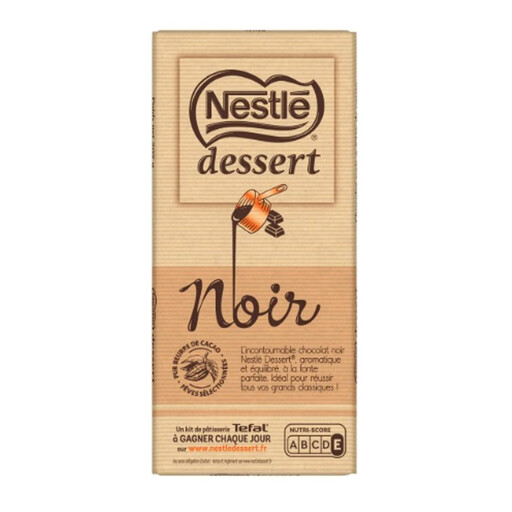 Image unavailable
This 205 g dessert chocolate bar is an option for recipes that call for melted chocolate. If cocoa intensity matters to your recipe, check the percentage on the packaging. Also check for “may contain” information about milk and nuts.
Only if the chocolates you use are suitable for your recipe. Check the fillings, inclusions and allergens for each piece you plan to use. If your recipe calls for melted chocolate, a bar specifically made for baking is a more straightforward place to start.
Check the product name, net weight, ingredients, allergens and nutritional information. If your recipe calls for dark chocolate without inclusions, check that this applies to the specific product too.
No. The French Ministry of the Economy says that displaying Nutri-Score is optional in France. The DGCCRF states that nutritional declarations are required for most prepacked foods; use them, in particular, to compare sugars per 100 g.
No, not under the levy on sugary drinks described by the French Ministry of the Economy. When choosing a chocolate bar, the sugar content is still worth checking in the nutritional information, but it isn’t related to this levy.