What should you check before choosing?
For a mid-morning break, start with a format you can realistically take with you, then check the recipe and nutritional values on a like-for-like basis.
| What to consider |
What to check |
Who is it for? |
| Portion and portability |
Check the weight of each bar and whether it’s individually wrapped: a break-apart bar isn’t necessarily packed in separate portions. |
If you want to pop a portion in your bag without breaking off and wrapping a piece yourself, the packaging matters as much as the weight. Around 42% of the consumers surveyed would make a ready-to-carry portion their priority. |
| Ingredients and allergens |
Read the ingredients list and allergen warnings, including any ‘may contain’ statements, even for a bar with no filling. |
If a filling or a trace warning isn’t compatible with your needs, the word ‘dark’ won’t help you choose between products. Ingredients would be the main consideration for around 25% of the consumers surveyed. |
| Nutritional values |
Compare sugars, energy and saturates per 100 g, then take the weight of the portion you’ll eat into account. |
When two bars weigh different amounts, comparing the values per 100 g gives you a fair basis before you look at each portion. Around 33% of the consumers surveyed would put this comparison first. |
Brands and formats to know
These examples show the difference between a bar that’s ready to take with you and a bar you need to portion yourself; they don’t cover every product from each brand.
Lindt
Lindt France lists Excellence 70% Dark as a 35 g mini bar, a defined portion for one person.
- Dark chocolate with no added filling and 70% cocoa.
- The product listing warns that it may contain traces of milk, almonds, hazelnuts, other nuts and soya.
Côte d’Or
The brand offers a 45 g dark chocolate and hazelnut bar and a dark chocolate bar divided into eight pieces. The two formats don’t suit the need for a portion to take with you in the same way.
- Joybuy’s listing for the 45 g bar states that it contains 23% hazelnuts.
- The bar contains hazelnuts, milk and soya; with the Côte d’Or bar divided into eight pieces listed by Auchan, you’ll need to decide on your own portion.
Auchan
Auchan’s 72% intense dark chocolate mini bars are sold in a 200 g bag.
- The bag contains several mini bars, so you can prepare portions at home.
- The listing says ‘Individual sachets: No’, so check how you’ll carry a portion separately.
EQUADOR (Marque Repère E.Leclerc)
The E.Leclerc product listed is a 100 g 72% dark chocolate bar, which you can break into your preferred portion.
- The E.Leclerc listing gives the ingredients and nutritional information for this bar.
- It isn’t an individually portioned bar; the Nutri-Score E shown on the listing is based on the previous calculation, used before April 2025.
Nestlé Dessert
The dark chocolate products shown in the Auchan selection we checked are Nestlé Dessert bars weighing 170 to 205 g.
- You can portion these bars in advance if you’d rather choose how much to take with you.
- The listed formats aren’t pre-portioned, individually wrapped bars.
Dark chocolate bars available on Joybuy
These two products suit different snack-break cravings: a plain dark chocolate mini bar or a dark chocolate bar with hazelnuts. If individual wrapping is essential, be sure to check the packaging of the hazelnut bar.
 Image unavailable
Lindt Excellence 70% Dark — 35 g mini bar
A handy way to take a defined portion of dark chocolate with no added filling. This 35 g mini bar contains 70% cocoa and is described as an individual bar. It may contain nuts, milk and soya, so check the packaging if you need to avoid these allergens.
View on Joybuy
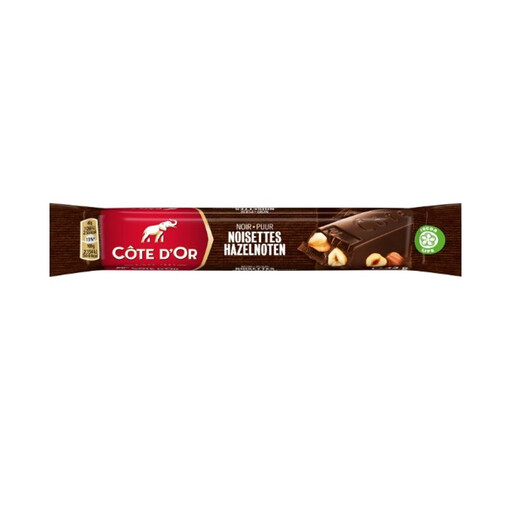 Image unavailable
Côte d’Or dark chocolate and hazelnuts — 45 g bar
For a break where hazelnuts matter more than a plain recipe. This 45 g bar contains 23% hazelnuts, as well as milk and soya, and may contain other nuts. If you need each bar to be individually wrapped, check the packaging.
View on Joybuy
Frequently asked questions
Does the soda tax apply to a dark chocolate bar in France?
No. The charge known as the ‘soda tax’ applies to sugary drinks, as the French Ministry of the Economy explains in its overview of the 2025 reform. It isn’t a tax specifically on chocolate bars, although sugar content is still worth checking when comparing products.
Does a dark chocolate bar have to display Nutri-Score?
No. According to Santé publique France, displaying Nutri-Score is voluntary in France. A nutrition declaration is generally required for pre-packed foods sold in the European Union, as Your Europe explains. If there’s no Nutri-Score, check the declaration to compare nutritional values.
How do you compare a 35 g mini bar with a 45 g bar?
Start by checking the nutritional values per 100 g on both wrappers: this gives you a common basis for comparing their composition. Then look at the weight of each bar to see how much the portion you’ll eat represents.
Does dark chocolate with no added hazelnuts rule out traces of nuts?
No. The Lindt Excellence 70% Dark mini bar may carry warnings about traces of nuts, as well as milk and soya. If these allergens are a concern, check the warnings on the packaging of the batch you buy, even if the recipe has no filling.
Can a break-apart bar replace an individually portioned bar for taking with you?
Yes, if you’re happy to prepare and carry your own portion. A bar divided into pieces or a bag of mini bars doesn’t guarantee that each portion is individually wrapped. Check the packaging if this matters for your break.


