Fans of plain dark chocolate
You want a small portion to enjoy with a crêpe, with the cocoa taking centre stage. The stated cocoa percentage, the weight of each bar and the sugar content can help you compare products.


For a solo crêpe break, choose a plain mini dark chocolate bar if you’re mainly after the taste of cocoa, or a hazelnut or cereal bar if you prefer a bit of crunch. Then check the weight of each bar, the sugar per portion and the allergen information: the words “dark chocolate” alone don’t tell you everything about the recipe.
You want a small portion to enjoy with a crêpe, with the cocoa taking centre stage. The stated cocoa percentage, the weight of each bar and the sugar content can help you compare products.
You prefer hazelnuts or cereal for a contrast with a soft crêpe. In that case, the product description and ingredients list matter just as much as the words “dark chocolate”.
You want to check the sugar, fat or allergen information before buying. The nutrition information and ingredients list let you do just that; if the packaging displays a Nutri-Score, treat it as an additional guide.
If you want something to go with a crêpe without sharing a large bar, start with the weight of each piece, then choose your recipe and check the label for the portion you plan to eat.
| What to compare | What to check | Who is it for? |
|---|---|---|
| Individual format | Weight of each piece, number of bars and individual wrapping. | I want to open a portion to have with my crêpe, rather than break off a piece from a large bar. Around 36 % of consumers would put this convenient format first. |
| Cocoa and texture | Cocoa percentage, if stated, and whether it contains hazelnuts or cereal. | For this treat, I’d rather choose between plain chocolate and a crunchy texture. Taste would be the priority for around 28 % of consumers. |
| Ingredients and allergens | Sugar and fat per 100 g, portion weight, ingredients and “may contain” warnings. | If I’m concerned about certain ingredients, I need to be able to read the label before choosing. Ingredients, sugar and allergens would be the main considerations for around 36 % of consumers. |
A crunchy bar may combine dark chocolate, cereal, sugar and other ingredients. It offers a different texture from a plain mini dark chocolate bar.
Read the product description and the first ingredients listed. If you’re mainly after cocoa, check the stated percentage for that particular recipe too.
The Côte d’Or dark chocolate and hazelnut bar listed by Carrefour contains hazelnuts, milk and soya; it may also contain other nuts. “Dark” doesn’t mean a product is free from these ingredients.
If you have an allergy or avoid certain ingredients, check the ingredients list and any traces warnings on the packaging of the product you buy.
According to the DGCCRF, displaying a Nutri-Score is voluntary in France. Its absence doesn’t tell you what a bar contains; the nutrition declaration on prepacked food is still the place to start when comparing nutritional values.
Check the sugar, fat and energy per 100 g, then take the actual portion weight into account. Use the Nutri-Score as additional information if it’s shown.
These examples cover different recipes: a mini dark chocolate bar, a hazelnut bar and a multipack of crunchy bars. Compare their ingredients and formats separately.
The EXCELLENCE range includes a 35 g Noir 70 % mini bar, described by Lindt France as dark chocolate containing at least 70 % cocoa.
Carrefour lists a 45 g dark chocolate and hazelnut bar as a filled individual portion.
Carrefour lists Sundy dark chocolate bars in a multipack of five 36 g bars.
For a solo Candlemas break, these two formats suit different tastes: a mini bar with cocoa at its heart, and a dark chocolate bar with hazelnuts.
 Image unavailable
A mini bar to consider if you’re after an individual portion of plain dark chocolate to enjoy with a crêpe. It weighs 35 g and contains at least 70 % cocoa. The packaging warns that it may contain traces of nuts, milk and soya. Check the label before buying if you need to avoid these allergens.
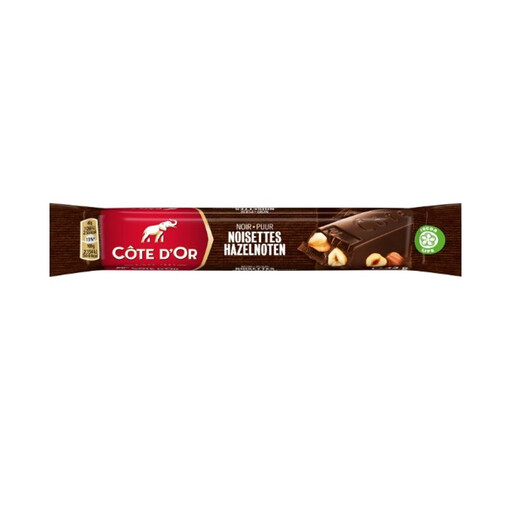 Image unavailable
An individual bar to consider if you prefer hazelnuts to a plain recipe. It weighs 45 g and contains 23 % hazelnuts. It also contains milk and soya, and may contain other nuts; check the packaging if you have an allergy. If the cocoa percentage matters to you, check this information on the product.
No. The DGCCRF states that displaying a Nutri-Score is voluntary in France, while a nutrition declaration is generally compulsory for prepacked food. To compare two bars, check their nutrition values per 100 g and the weight of each portion.
Start with the “sugars” figure per 100 g, then calculate it for the weight of the bar. For a 35 g portion, 30 g of sugars per 100 g works out at 10.5 g of sugars; this calculation only applies to a product with those values.
No. The Côte d’Or dark chocolate and hazelnut bar listed by Carrefour contains hazelnuts and milk, among other ingredients; the Lindt EXCELLENCE Noir 70 % mini bar carries warnings about possible allergens. Check the ingredients and “may contain” warnings on the packaging you buy.
No. The text published by Légifrance applies to drinks and liquid preparations for drinks, not solid chocolate bars. Sugar content is still worth checking when comparing recipes, regardless of this levy.