For a cake or mousse, start with a dark chocolate bar intended for desserts. For moulding or coating that involves tempering, look for couverture chocolate suited to the technique. In its guidance on filling ganache, Valrhona recommends a cocoa content of 65 to 70%, but this percentage alone doesn’t tell you how fluid the chocolate is. Check the ingredients, allergens and nutritional information for the exact product you choose, too.
Who is this choice for?
Fans of desserts with a rich dark chocolate flavour
If you’re making brownies, cakes, mousses or ganache, choose a level of intensity that suits the recipe rather than simply going for the highest cocoa content. Valrhona recommends 65 to 70% cocoa for filling ganache.
Anyone making ganache or a coating
When texture or finish is particularly important, check the stated use and fluidity guidance. Valrhona’s technical advice treats these as separate considerations from cocoa percentage alone.
Readers who check ingredients carefully
If the dessert is for someone avoiding certain ingredients, check the ingredients list and allergen information for the exact bar. Nutritional information also lets you compare the sugars per 100 g.
What should you check before buying?
Start with what you’re making. The flavour you want in a cake isn’t enough to predict how the chocolate will behave when coating or tempering.
| Factor |
What to check |
Who is this for? |
| Cocoa intensity |
The cocoa content and the stated use for your recipe. Valrhona recommends 65 to 70% for filling ganache. |
For a cake or mousse with a pronounced dark chocolate flavour, I first consider the level of intensity I want; around 33% of consumers prioritise this. |
| Texture and finish |
Look for the word couverture and guidance on fluidity or cocoa butter if your recipe involves moulding, coating or tempering. |
When I’m making a coating, I need to choose chocolate suited to the technique, not just to my taste; around 25% of consumers prioritise this. |
| Sugars, ingredients and allergens |
The ‘of which sugars’ figure per 100 g, the ingredients list and the allergen information for the exact product. |
If the dessert is for someone avoiding milk or soya, I check the label before baking; around 25% of consumers put ingredients and nutritional information at the heart of their choice. |
| Quantity needed |
The weight of the bar and how many bars the recipe requires. |
To make the amount needed without choosing the wrong pack size, I check the weight first; around 17% of consumers prioritise this. |
Mistakes to avoid
-
Choosing based on cocoa percentage alone
Two chocolates with the same cocoa percentage can behave differently in a recipe. Valrhona recommends considering fluidity and fat content as well for technical uses.
If your recipe calls for coating or tempering, look for guidance on how to use the chocolate and check its couverture properties.
-
Assuming a dark chocolate bar contains no milk or soya
According to Carrefour’s product information, Carrefour Original Dark Dessert Chocolate contains whey powder and soya lecithins. So the ‘dark chocolate’ label is no substitute for checking the ingredients.
Check the ingredients and allergen information for the exact product before using it for someone with an allergy or intolerance.
-
Using Nutri-Score as your only guide
In France, the Ministry of the Economy says that Nutri-Score is voluntary. For relevant prepacked foods, the nutrition declaration lets you check the amount of sugars per 100 g, among other things.
Compare the nutritional information and ingredients list. Take Nutri-Score into account if it’s displayed, but don’t rely on it alone to decide whether a bar is right for your recipe.
Brands and ranges to know
Lindt
The Lindt DESSERT range includes a 200 g Noir Intense 70% bar, which Lindt recommends for making desserts. The EXCELLENCE range also includes dark chocolate bars for eating.
- The DESSERT label and stated cocoa content make it easier to choose a bar for a recipe with a rich dark chocolate flavour.
- Don’t assume that an EXCELLENCE bar intended for eating is also couverture chocolate. Check the stated use and allergens for the exact product you choose.
Nestlé Dessert
Carrefour stocks, among other products, a Nestlé Dessert dark chocolate bar with 70% cocoa.
- The ‘Dessert’ label and cocoa content help you assess whether this product is right for your recipe.
- Check the pack size and ingredients for the exact bar: the specifications of one product don’t necessarily apply to the whole range.
Carrefour Original
Carrefour offers a 200 g Carrefour Original Dark Dessert Chocolate bar.
- Its pack size and ‘Dessert’ label give you a useful guide to the quantity required by your recipe.
- Carrefour’s product information lists whey powder and soya lecithins, so it isn’t suitable if you’re looking for a bar without these ingredients.
Côte d'Or
Carrefour stocks a 90 g Côte d'Or Bio dark chocolate bar, labelled as containing at least 70% cocoa.
- The stated cocoa content and weight make it easy to check whether the bar suits your recipe and the quantity you need.
- The product information doesn’t describe it as couverture chocolate. If you’re moulding or tempering, check the technical guidance before choosing it.
Dark chocolate bars available on Joybuy
This selection includes dark chocolate bars intended for baking, as well as others where the cocoa content or pack size may help you decide. For the latter, check that the bar is suitable for your recipe, especially if it calls for a couverture technique.
 Image unavailable
Poulain Extra Dark 200 g
This bar is intended for baking and is worth considering for a recipe that calls for 200 g of dark chocolate. If you avoid milk or soya, check the ingredients for this exact product. For tempering or moulding, check its technical guidance.
View on Joybuy
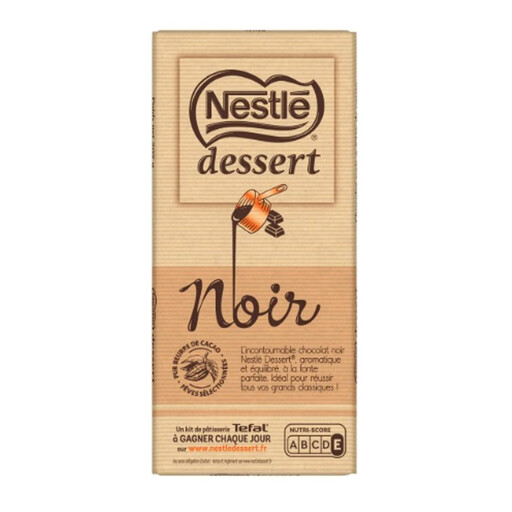 Image unavailable
Nestlé Dessert dark chocolate 205 g
This 205 g dessert chocolate bar is intended for baking and melting. If your recipe requires a specific cocoa content, check the figure for this product. For a tempered coating, check whether it’s suitable for couverture work, too.
View on Joybuy
 Image unavailable
Poulain Fine Dark 70% 100 g
The stated cocoa content and 100 g pack size are useful guides if your recipe calls for a 70% dark chocolate bar. Check that it’s suitable for your recipe and read the ingredients list if the type of sweetener matters to you.
View on Joybuy
 Image unavailable
Lindt EXCELLENCE dark chocolate 70% mini 35 g
At 35 g, you’ll need to work out how many bars your recipe requires. This product is presented as a chocolate bar for eating, so don’t choose it for couverture work based on its cocoa content alone. Check the allergen information, too.
View on Joybuy
 Image unavailable
Lindt EXCELLENCE dark chocolate 85% 100 g
This 100 g bar contains 85% cocoa, so consider whether that suits the flavour you’re looking for and your recipe. This is higher than Valrhona’s recommended 65 to 70% for filling ganache. Check the intended use before choosing it for tempering or coating.
View on Joybuy
Frequently asked questions
Which dark chocolate should I choose for homemade ganache?
For filling ganache, Valrhona recommends a cocoa content of 65 to 70% in its technical guidance. Check that the bar is also suitable for your recipe: cocoa content alone doesn’t tell you how fluid it is.
Is dark chocolate always free from milk and soya?
No. Carrefour’s product information for Carrefour Original Dark Dessert Chocolate lists whey powder and soya lecithins. If these ingredients matter to the person eating the dessert, check the ingredients and allergen information for the exact bar.
Is Nutri-Score compulsory on chocolate bars in France?
No. According to the French Ministry of the Economy, Nutri-Score is voluntary. A nutrition declaration is required for relevant prepacked foods, subject to regulatory exemptions. Check it to compare sugars per 100 g, for example.
Does the levy on sugary drinks apply to chocolate bars?
No. The scale published in the official French public finance bulletin applies to non-alcoholic drinks with added sugars, not solid chocolate bars. When choosing a bar, check the ‘of which sugars’ figure in its nutritional information instead.


